
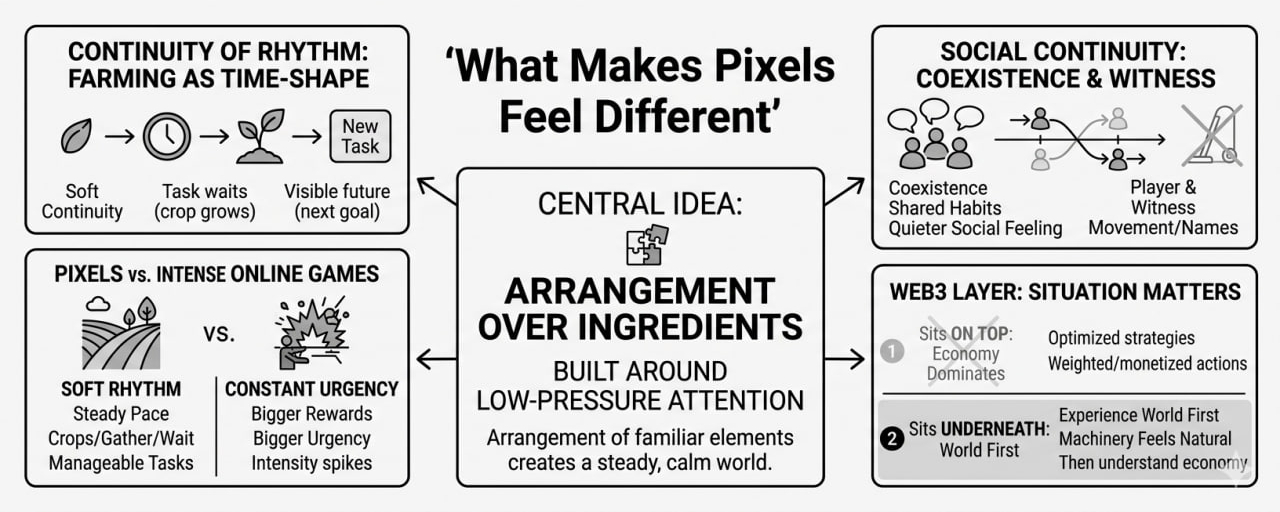
Open worlds are everywhere too. Even the mix of crafting, gathering, and social play is familiar by now. So the interesting part is not the ingredients. It is the way those ingredients are arranged.
Pixels feels built around low-pressure attention.
That may sound like a strange way to describe a game, but it becomes obvious after a while. Most online games want to pull you in hard. They want full focus. Fast decisions. Constant motion. Bigger rewards. Bigger urgency. Pixels seems more comfortable doing the opposite. It gives you small things to care about. Crops to manage. Materials to collect. Spaces to move through. People to notice. And it lets those things build their own weight over time.
That changes the experience more than people expect.
Because when a game stops demanding intensity, you start relating to it differently. You do not enter it like a challenge you need to overcome. You enter it more like a place with its own pace. That pace is part of the design, maybe even the center of it. You plant something and wait. You gather a few things and move on. You come back later and continue where you left off. The loop does not try to overwhelm you. It just keeps offering one more manageable task. Then another. Then another.
And somehow that ends up being enough.
You can usually tell when a game understands that a person’s attention is uneven. Some days you want to sit with it for a while. Some days you just want a few quiet minutes. Pixels seems designed for both moods. That matters because browser-based games live in a different part of people’s lives than larger, more demanding games do. They are closer to routine. Closer to habit. Not always a destination. Sometimes just a return.
That browser quality is worth noticing.
A lot of people treat “web game” like it describes a limitation. But in this case, it feels more like a clue. The whole structure of Pixels makes more sense when you think about how people actually approach something they can open quickly, check in on, and leave without friction. The world has to support interruption. It has to survive fragmented attention. It has to be welcoming without becoming empty. That is not as easy as it sounds.
So the game ends up leaning on rhythm instead of spectacle.
That is where farming becomes more than just a theme. Farming works in games because it gives time a visible shape. You do something now, and the result appears later. That simple delay changes how the world feels. It creates a chain of return. You are never only dealing with the present moment. You are always slightly connected to a future moment too. A crop growing. A task waiting. A resource that will matter when you log back in. It is a soft form of continuity.
And continuity is powerful in shared spaces.
Pixels is described as a social casual web3 game, which sounds accurate, but still a little too neat. The social part is not only about direct interaction. It is also about coexistence. Other players are there. Their routines cross with yours. Their presence gives your own progress a kind of context. You are not just farming in a vacuum. You are doing it inside a world where everyone else is also managing their own small systems. That makes simple actions feel less isolated.
That is where things get interesting, because social energy in a game does not always come from conversation. Sometimes it comes from witness. Seeing movement. Recognizing names. Understanding that the place has its own ongoing life whether you are at the center of it or not. Pixels seems to rely on that quieter kind of social feeling more than on dramatic multiplayer moments. And honestly, that may fit the game better.
The world does not need to shout to feel alive.
A lot of games mistake noise for life. More effects, more alerts, more events, more pressure. But life in an online world can come from steadier things. Repetition. density. routine. shared habits. That is closer to what Pixels seems to be chasing. It wants the world to feel occupied, not constantly explosive. It wants the player to feel part of an ongoing environment, not just trapped in a reward loop.
Of course, the reward loop is still there. Every game has one.
The difference is in how visible it feels. Pixels does not hide the fact that progress matters. You gather things for a reason. You craft for a reason. You build up resources for a reason. But the structure is wrapped in ordinary actions instead of dramatic framing. So the reward system feels softer at the edges. Not absent. Just less aggressive. That gives the game a more relaxed surface, even when there is still a lot of calculation underneath.
And that probably matters even more because of the web3 layer.
With web3 games, there is always a risk that the underlying economy becomes the main lens through which everything is seen. Once tokens, ownership, and asset value enter the picture, every small action can start looking less like play and more like strategy. Sometimes that is the point. But it can also drain the atmosphere out of a game pretty quickly. The world begins to feel like a system waiting to be optimized.
Pixels seems to push back against that, at least a little.
It still operates inside that ecosystem. It still uses the language and structure of web3. It still lives on Ronin, which is closely tied to blockchain gaming. So none of that disappears. But the game seems more careful about where the player’s attention goes first. It wants you to notice the world before the machinery. Or maybe it wants those two things to blur together enough that the machinery feels natural. That is probably the better way to put it.
Because the question is not whether web3 is present. It obviously is. The question is whether it sits on top of the game or underneath it.
That sounds like a small distinction, but it changes everything. If the system sits on top, then every action feels interpreted before it even happens. It feels weighted, tracked, monetized too obviously. If it sits underneath, the player can first experience the world as a world. Then later, maybe, they begin to understand the economic and technical structure supporting it. Pixels seems more interested in that second path.
That may be why it feels calmer than many projects around it.
Not calmer because it has no ambition. More because it does not express its ambition through pressure. It expresses it through consistency. Through the idea that a world can keep someone around by being easy to re-enter. Easy to understand in layers. Easy to care about in small amounts. That is a different philosophy from the one that shaped a lot of earlier web3 games, where so much emphasis was placed on scale, disruption, or earning potential.
Here, the scale feels more personal.
You are not asked to believe in some grand future every time you log in. You are asked to care about the next task. The next crop. The next item. The next part of the map. That smaller scale makes the game feel more grounded. More ordinary, in a useful way. It becomes less about what the game represents and more about what the game feels like while you are inside it.
And what it feels like, more than anything, is steady.
Not static. Not empty. Just steady. There is a difference. A steady game can still be absorbing. It can still have complexity. It can still support economies, communities, and long-term progression. But it presents those things through repeatable patterns instead of intensity spikes. That makes it easier for players to form a relationship with the game that feels durable.
It becomes less about chasing peaks and more about building familiarity.
That familiarity may be the real core of Pixels. Not farming by itself. Not web3 by itself. Not even the social layer by itself. More the way all of those things combine into a world that fits into daily attention without fighting for it too hard. A world that can live in the background of someone’s day and still remain meaningful. That is a different kind of success than what games usually advertise.
And maybe that is the angle that stays with me most. Pixels feels less like a game trying to dominate your time, and more like one trying to earn a place within it. Quietly. Through repetition. Through ease. Through the slow accumulation of little actions that do not look like much on their own, but start to matter once they begin connecting. Then the game is not really about farming anymore, or even about web3 in the obvious sense. It is about the shape of attention, and what happens when a world is designed to meet people there, without forcing too much all at once.