Web3 gaming has recycled the same promises for years — community first, player owned economies, sustainable rewards — but underneath the slogans, most systems still reward one thing above everything else: extractable activity.
Deposit tokens. Run the loop. Collect the incentives.
That model may create short bursts of engagement, but it doesn’t create loyalty. It creates optimization.
The moment rewards are tied only to visible actions, players begin to treat the game like a machine. Every quest becomes a calculation, every mechanic becomes something to exploit, and every system eventually gets reduced to efficiency. The players aren’t participating in an economy anymore — they’re harvesting it.
That’s exactly where most blockchain games lose their identity.
They reward motion, not meaning.
Pixels seems to be taking a different route.
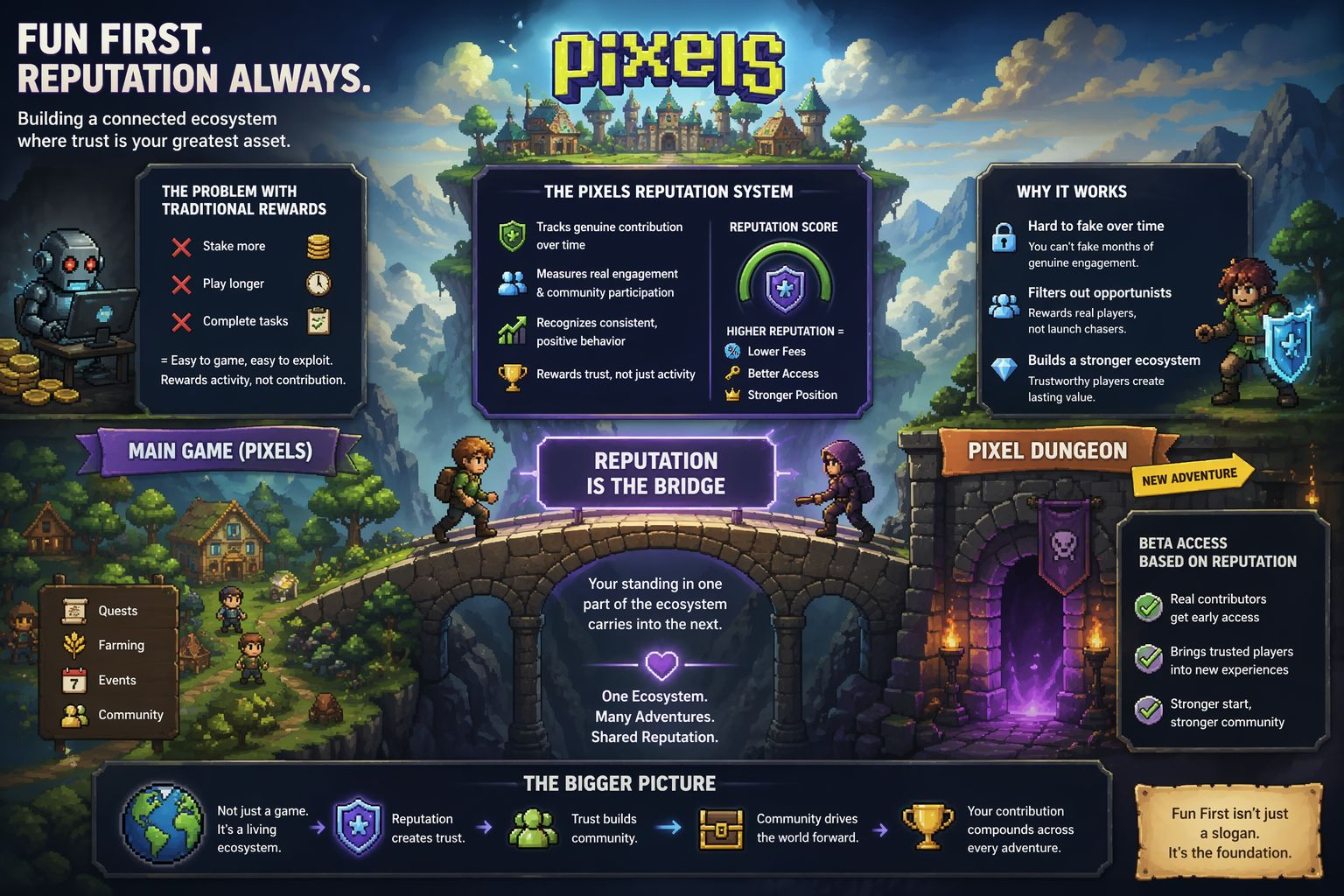
Its Reputation System is interesting because it tries to measure something deeper than transactions or time spent. Instead of asking “how much did this player do,” it asks “how has this player behaved over time.”
That sounds like a small distinction, but economically it changes everything.
Because not every active wallet contributes value.
Some wallets farm. Some wallets automate. Some wallets show up only when there’s something to gain.
Traditional reward systems can’t tell the difference. They treat all activity as productive, even when that activity weakens the ecosystem.
A reputation-based system flips that logic.
It places value on consistency, on patterns, on the kind of engagement that signals a player is actually participating rather than extracting. The reward is no longer tied to a single moment. It’s tied to the relationship a player builds with the ecosystem over time.
That’s where Pixels starts to stand out.
Because reputation creates memory.
A token transfer says what happened once. A reputation score reflects what happened repeatedly.
That makes it harder to manipulate and far more meaningful.
Anyone can fake volume for a day. Anyone can automate a task list. But maintaining the appearance of genuine engagement over weeks or months is a much harder challenge.
That is where “Fun First” stops being marketing and starts becoming design.
Because if rewards are based on long-term credibility, the game naturally encourages players to participate in ways that strengthen the ecosystem. Benefits like lower fees or gated access become more than perks — they become signals that trust has value.
That matters even more now that Pixels is expanding beyond its original game loop.
Pixel Dungeon is where the bigger strategy becomes visible.
Normally, when a Web3 project launches a new title, it also launches a new economy around it. New access rules, new incentives, new speculative hype cycle. Even if the game shares branding with the original, the community effectively resets.
That means loyal players and opportunistic players enter the same starting line.
The people who built value in the original ecosystem don’t carry that value forward in any meaningful way.
That’s a weak foundation.
Pixels didn’t reset the system. It extended it.
By connecting Pixel Dungeon access to existing reputation, the team turned player history into a cross-game asset. The players who contributed in the main ecosystem gain an advantage in the next one.
That is more important than it sounds.
Because it transforms reputation from a reward mechanism into ecosystem infrastructure.
Your participation in one part of the world now shapes your position in the next part. That creates continuity between games that goes beyond tokens, branding, or incentives.
It creates progression at the ecosystem level.
That’s a very different model from what most Web3 projects build.
Most projects expand horizontally: launch another game, launch another token, launch another economy.
Pixels appears to be expanding vertically: strengthen the player layer, carry trust forward, build on top of proven engagement.
That is a much more sustainable foundation.
Because ecosystems are not held together by tokens alone.
Tokens can move value, but they don’t preserve trust. Reputation can.
And trust is what determines whether a new title launches with real momentum or with temporary hype.
When trusted players are the first users inside a new experience, they bring more than activity — they bring legitimacy. They shape culture, establish norms, and create the first layer of real engagement.
That gives Pixel Dungeon something most new blockchain games struggle to build:
an authentic starting community.
That kind of continuity is where long-term ecosystem value is created.
Instead of treating each new game as an isolated event, Pixels is creating a shared identity layer beneath the products. That means the ecosystem itself becomes cumulative.
Every contribution strengthens future launches. Every positive interaction carries forward. Every trusted player becomes part of the foundation for what comes next.
That’s powerful.
But it also means the Reputation System becomes one of the most critical parts of the ecosystem.
Because once reputation unlocks access and status across multiple games, fairness becomes everything.
If the system feels inconsistent, trust breaks. If players don’t understand how value is assigned, confidence drops. If reputation becomes exploitable, the ecosystem loses its integrity.
The same system that creates long-term value can also become a weak point if it isn’t carefully protected.
That’s the challenge Pixels now faces.
The strategic vision is compelling, but the execution has to remain credible. Reputation only works as connective infrastructure if players believe it accurately reflects contribution.
If that trust holds, Pixels may be building something much bigger than a reward system.
It may be building a persistent player economy where trust compounds over time.
And that’s what makes this direction so interesting.
Because the real innovation isn’t Pixel Dungeon. It isn’t gated access. It isn’t lower fees.
The real innovation is making contribution portable.
That changes the relationship between player and ecosystem.
Instead of earning rewards in isolated moments, players build standing that grows in value as the ecosystem grows around it.
That creates retention without forcing it. It creates loyalty without manufacturing it. And it gives players a reason to care about the long-term health of the world they’re in.
That is what most Web3 ecosystems have failed to achieve.
They created transferable assets, but not transferable trust.
Pixels is trying to build both.
If it succeeds, that will matter far more than any short-term reward mechanic.
Because economies can be copied. Game loops can be copied. Token models can be copied.
But a trusted reputation layer that connects an entire ecosystem?
That becomes a real moat.
And for the first time, “Fun First” starts to feel less like a slogan and more like the beginning of an actual ecosystem philosophy