
Sometimes they just want a place that feels easy to return to.
That is probably the angle that makes the game worth looking at.
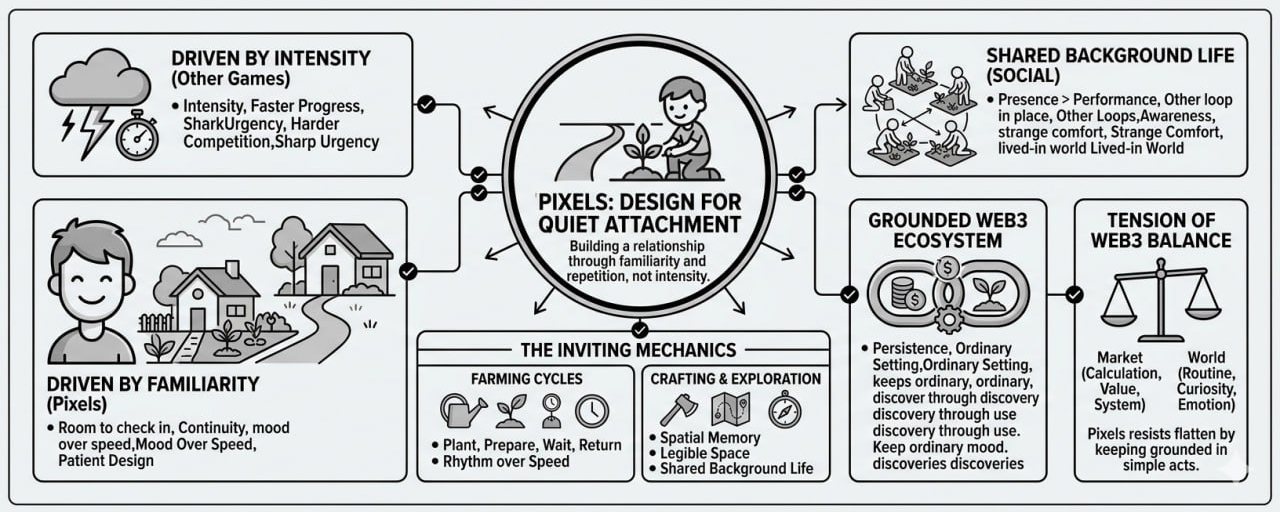
On the surface, Pixels is easy enough to describe. It is a social casual web3 game on the Ronin Network. It has farming, exploration, crafting, and a shared open world. Those are the official pieces. But those pieces, by themselves, do not really explain the feeling of it. A lot of games have similar features. A lot of online worlds let people gather resources, build routines, and move through colorful maps. So the real question is not what Pixels contains. It is what kind of relationship it tries to build with the player.
And the answer seems to be something quieter than usual.
Pixels does not feel built around drama. It feels built around familiarity.
That difference matters more than it sounds. In plenty of games, especially online ones, the structure is always pulling toward intensity. Faster progress. bigger events. harder competition. sharper urgency. The game keeps asking for more energy from you. Pixels seems more interested in the opposite. It gives you enough to do, but it does not feel like it wants to corner all your attention at once. It lets the world become familiar first. That is a slower kind of design. Maybe a more patient one.
You can usually tell when a game is trying to become part of someone’s routine rather than the center of their day.
Pixels has that feel. Not because it is empty or passive, but because it leaves room. Room to check in, do a few things, notice a few patterns, and leave without feeling like you stepped away from something urgent. That may sound minor, though it changes the whole experience. Once a world stops acting like every moment has to be exciting, smaller forms of attachment start to matter more. Repetition matters more. Place matters more. Mood matters more.
That is where the game starts to make sense.
Farming, for example, is not just a mechanic here. It is a way of shaping attention. Farming asks the player to think in cycles. You plant now so something can happen later. You prepare, wait, return. That rhythm pulls the game away from speed and toward continuity. It means the world does not only exist in the exact moment you are playing. It stretches a little beyond that. There is always something in motion that will still be there when you come back.
That is a very specific kind of invitation.
It says, in a quiet way, that progress does not need to happen all at once. It can happen in layers. In small returns. In tiny accumulations that only start to feel meaningful after enough time has passed. A lot of casual games work like this, of course, but in Pixels it seems especially central because the whole world is arranged around that slower rhythm. Exploration is not frantic. Crafting is not presented as some huge technical puzzle. Even the social side often feels less like a performance and more like shared background life.
That part is easy to miss at first.
When people hear that a game is “social,” they often imagine something loud. Constant messages. nonstop group activity. obvious collaboration. Pixels seems to use social space differently. It feels social because the world is occupied. Other players are around. They are working through their own loops while you work through yours. You notice movement. You notice presence. You notice that your progress is happening in a place that belongs to more than just you.
That creates a strange kind of comfort.
Not closeness exactly. More like awareness. The sense that the world continues with or without your full attention. In some games, that would make the player feel less important. Here it seems to do the opposite. It makes the world feel more stable. More lived in. Your own routine gains weight because it sits beside other routines. And after a while, that can be more engaging than a game constantly begging to be noticed.
That is also why the open-world part feels important, even if “open world” is one of those phrases that gets overused until it barely means anything. In Pixels, the open world seems less about scale and more about orientation. It gives the player a sense of movement through space rather than movement through menus. You learn the world by passing through it. You understand its shape gradually. Certain areas become familiar. Certain paths start to feel efficient. Certain spaces feel busy, others quieter. That sort of spatial memory matters because it turns the world into something more than a container for tasks.
It becomes somewhere you recognize.
And recognition is a big part of why people stay in games longer than they expect.
Not just because the tasks are rewarding, but because the environment starts to feel legible. You stop asking basic questions. You start moving through the space with your own habits. You know what you need. You know where to go. You know what is worth doing first. That shift, from confusion to familiarity, is one of the most satisfying things a game can offer. Pixels seems built to let that happen slowly.
Then there is the web3 part, which is always hovering around the conversation whether or not it is the first thing players care about. Pixels is powered by Ronin, and that places it inside a gaming-focused blockchain ecosystem. That matters structurally. It shapes how ownership, assets, and the in-game economy are handled. But from the player’s side, the more interesting question is whether that layer changes the personality of the world.
That is usually where things become complicated.
Because web3 can add a sense of persistence and ownership, but it can also make everything feel overly transactional. A game starts to look less like a world and more like a market with scenery attached. That tension is hard to avoid. In Pixels, the attempt seems to be to keep the world feeling ordinary enough that the economic layer does not immediately dominate the mood. You are still planting, gathering, crafting, exploring. The technical structure is there, but the game seems to prefer that you discover it through use rather than through constant emphasis.
That feels like a deliberate choice.
Maybe even the right one for a game like this. Because once every action is framed too loudly in terms of value, the emotional texture changes. A crop is no longer just part of a routine. It becomes a calculation. An item stops being a useful thing in a world and starts becoming a number in a system. That shift can flatten the whole experience if it becomes too visible. Pixels seems to resist that, at least in spirit, by keeping the surface of the game grounded in simple acts rather than abstract financial language.
It becomes obvious after a while that the real challenge here is balance.
Not balance in the usual game-design sense. More in the emotional sense. How much of the world feels like play, and how much feels like economy. How much of the player’s motivation comes from curiosity, routine, and social presence, and how much comes from external incentives. Those questions do not disappear just because the game is charming or accessible. They stay there. But Pixels is interesting because it seems to place those questions inside a gentler setting.
Instead of turning everything into spectacle, it turns things into habit.
That may be the clearest way to put it. The game does not seem to rely on one huge promise. It relies on return. On the idea that a person will come back tomorrow because they left something unfinished today. Because the world already has a shape in their mind now. Because their place inside it, however small, has started to feel real enough to maintain.
That kind of design can look modest from the outside. Maybe even too modest. But modesty has its own strength. A world that does not oversell itself can sometimes hold attention longer than one that constantly tries to prove how important it is. Pixels has some of that quality. It feels less like a declaration and more like an environment. Less like a big thesis about the future of gaming and more like a steady example of how online spaces can become meaningful through repeated, ordinary use.
And maybe that is what stays with me most when thinking about it. Not the farming alone. Not the blockchain layer alone. Not even the social features by themselves. More the way the game seems arranged around a simple idea: that people often bond with a world not through intensity, but through gentle repetition. Through familiar routes. Small responsibilities. Shared space. Quiet return.
After that, the game starts to look less like a collection of features and more like a pattern someone slowly falls into, almost without noticing, and then keeps following for a while.