
I keep thinking about how small routines can change the feeling of a game.
At first, they do not look like much. You log in, check what needs to be done, collect something, craft something, move from one place to another, and maybe stop for a moment because someone else is standing nearby doing the same thing. It is not always dramatic. It is not always the kind of gameplay that looks exciting in a short clip. But after a while, those small actions start becoming the reason the world feels alive.
That is what I notice when I look at Pixels.
Pixels is a social casual Web3 game powered by the Ronin Network. It is built around farming, exploration, creation, open-world play, and the simple act of sharing space with other players. The official Pixels site describes it as a world where players can make a home, master skills, play with friends, and build communities around digital collectibles.
That sounds broad, but the part that stands out to me today is narrower.
I keep coming back to the Union system from Chapter 3: Bountyfall.
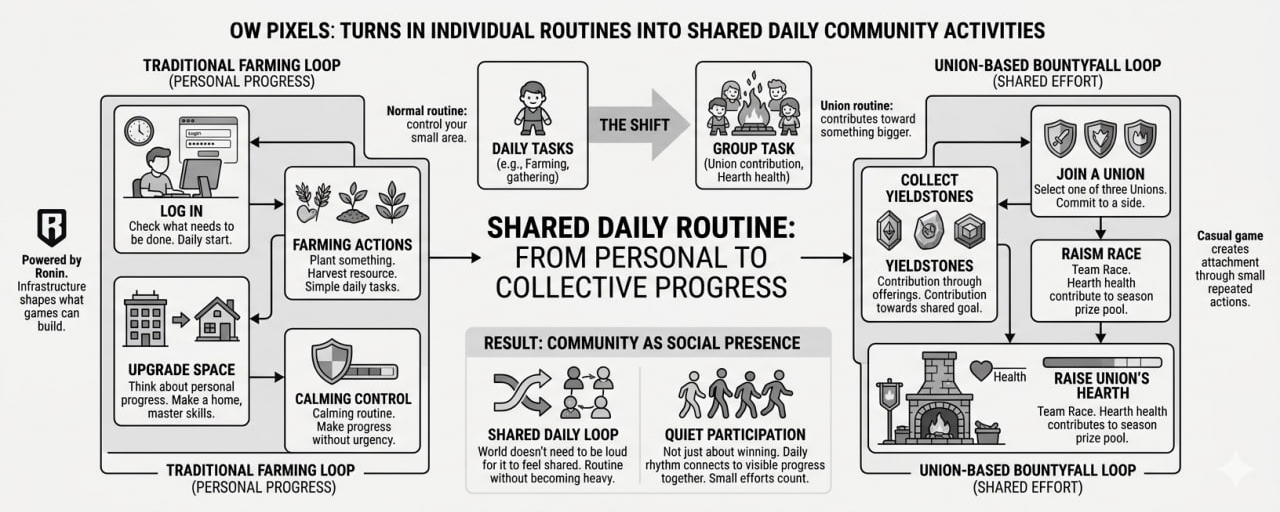
Ronin’s official post described Bountyfall as a team-versus-team race where players join one of three Unions, collect Yieldstones, and help raise their Union’s Hearth health until one side reaches full health. The winning Union receives most of the season prize pool, while players contribute through tasks, crafting, offerings, and even sabotage against rival Hearths.
What I find interesting is not only the competitive part.
It is the way this kind of system changes the feeling of daily play.
A normal farming loop is usually personal. You plant something. You harvest it. You upgrade your own space. You think about your own progress. There is nothing wrong with that. In fact, that is part of why farming games are calming. They give you control over a small area. They let you make progress without needing everything to feel urgent.
But Pixels adds another layer when it asks players to belong to a Union.
Suddenly, the same routine has a little more weight. A task is not only a task. A resource is not only a resource. A Yieldstone is not only something you picked up and moved somewhere. It becomes part of a larger shared push. Even if the action itself is still simple, it now sits inside a group effort.
That is where things get interesting for me.
I do not think every player needs deep strategy to enjoy a game like this. Some people just want a familiar place to return to. Some want a farming loop. Some want rewards. Some want to see progress bars move. Some want to feel like their small effort counts toward something bigger.
Unions seem to touch that last part.
They do not need to turn Pixels into a serious competitive game. They just make the existing routine feel more social. You are still doing daily tasks. You are still gathering. You are still moving through the world. But now there is a side you chose, a Hearth you are helping, and a quiet sense that other players are pushing in the same direction.
That matters more than it sounds.
A lot of Web3 games talk about community, but community can feel empty when it only means a chat room, a Discord channel, or a campaign post. Inside a game, community feels stronger when it changes what people actually do. It becomes easier to notice when players are moving toward the same goal, even if they are not talking much.
Pixels has that kind of social presence.
The world does not need to be loud for it to feel shared. Sometimes it is enough to see people returning to the same places, following similar habits, reacting to the same seasonal systems, or choosing sides in the same event. The social layer is not always about big conversations. Sometimes it is about knowing you are not alone in the loop.
For me, that is the quiet appeal of Bountyfall.
The farming still matters. The open-world feeling still matters. The simple daily actions still matter. But the Union structure gives those actions a frame. It turns some of the repetition into participation.
I also like that it does not completely remove the slower feel of Pixels. A system with Hearths, Yieldstones, offerings, and sabotage could easily become too much if it were pushed too hard. But from the outside, it still seems grounded in the same basic rhythm. Do tasks. Gather resources. Decide where to place them. Watch how the group effort moves.
That is easy to understand.
And sometimes easy to understand is better than impressive.
The Web3 side is present, but I do not think it has to dominate the feeling. PIXEL, digital assets, land, ownership, and Ronin all matter in the background. They give the game its Web3 structure. But when I think about why someone might keep returning, I do not think the answer is only ownership or rewards.
The answer feels more ordinary.
People return because the world gives them something to do. They return because their small choices connect to visible progress. They return because the place becomes familiar. They return because other people are there too.
Ronin also plays a quiet role in this. The chain gives Pixels a home for its Web3 systems, but the best version of that support is not something players should have to think about every second. Ronin recently confirmed that it is moving to Ethereum on May 12, with changes planned around security, inflation, treasury structure, and builder rewards. That may matter for Pixels over time because infrastructure shapes what games can build, even when players are mostly focused on farming, crafting, and social play.
Still, I do not think every player will connect with Bountyfall right away.
Some people may prefer the quieter solo farming side. Some may not care about Unions. Some may find seasonal competition distracting. Others may only notice the reward structure and miss the softer social feeling underneath it. That is normal. A game like Pixels can mean different things depending on how a person enters it.
But I think the Union system shows something important about where Pixels becomes more than a farming loop.
It shows that routine can become social without becoming heavy.
It shows that a casual game can create attachment through small repeated actions.
It shows that players do not always need a huge event to feel involved. Sometimes they only need a shared goal that fits naturally into what they were already doing.
That is what I keep noticing.
Pixels does not feel most interesting to me when it tries to explain itself as a Web3 project. It feels more interesting when it behaves like a place. A place with chores, movement, resources, names, groups, habits, and familiar paths. A place where a simple farming task can quietly become part of something larger.
Maybe that is why the Union idea stays in my mind.
It is not just about winning a season.
It is about how a small daily loop starts to feel different when other people are carrying the same loop beside you.
Still watching the daily rhythm around
$PIXEL #pixel @Pixels