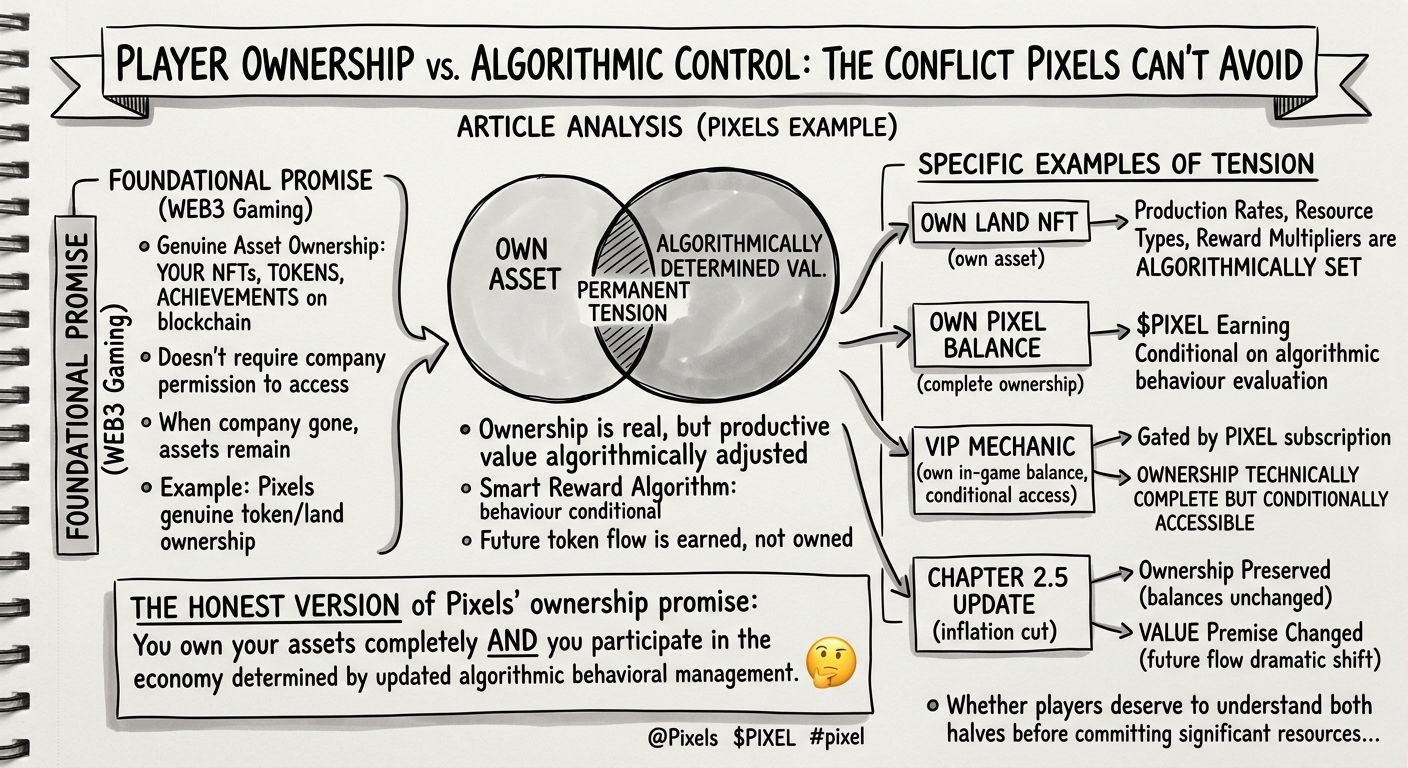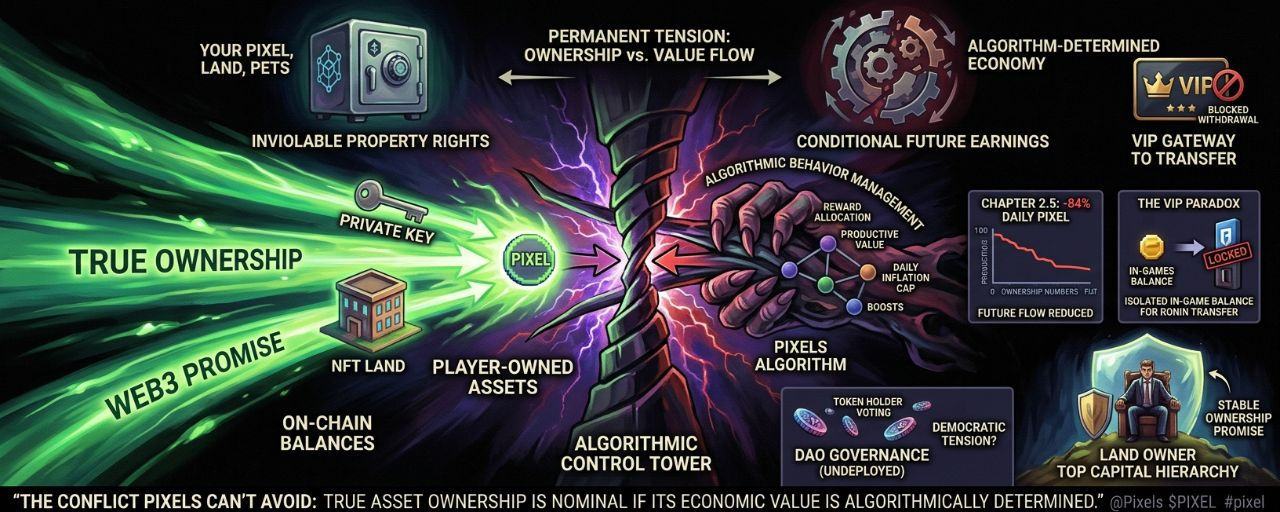
The foundational promise of Web3 gaming is straightforward: true ownership of your assets. Your NFTs, your tokens, your in-game achievements exist on a blockchain that doesn't require the game company's permission to access. When the company goes away, your assets remain. This is meaningfully different from traditional gaming, where your World of Warcraft account is owned by Blizzard and your Fortnite skins disappear if Epic decides to revoke them.
Pixels offers this promise genuinely. Your PIXEL, your NFT lands, your NFT pets: these are on the Ronin blockchain and they're yours in the full property-rights sense. No dispute there.
But Pixels has also built the most sophisticated behavioral management system in the Web3 gaming space, and the two things, genuine asset ownership and algorithmic behavioral control, are in permanent tension in ways that don't get clearly articulated.
Here is how the tension works specifically. You own your land NFT. The land NFT produces resources based on the industries you've built on it. But the rate at which those industries produce resources, the value of those resources in the in-game economy, the reward multipliers that determine your earnings, the cap on boosts per industry, which resource types are available from your land type: all of these are set by Pixels' algorithms and chapter updates. The ownership is real. The productive value of what you own is algorithmically determined and algorithmically adjustable.
The "smart" reward distribution algorithm is the sharpest version of this tension. You own $PIXEL. You can earn PIXEL through play. But the algorithm decides which of your behaviors qualify for reward allocation and at what rate. Your ownership of your PIXEL balance is complete. Your ownership of the future flow of your balance is conditional on the algorithm's evaluation of your behavior. The future flow is the economically valuable part, and it's not owned; it's earned within a continuously calibrated behavioral management system.
The VIP membership mechanic creates another ownership paradox. VIP is required to withdraw PIXEL Ronin wallet. Without VIP, you own PIXEL in your in-game balance but can't access it as a freely transferable asset. The blockchain ownership of PIXEL access to that ownership is gated by an ongoing subscription product that costs PIXEL. Your ownership is technically complete and conditionally accessible. Those are different things.
The Chapter 2.5 update that cut daily PIXEL inflation by nearly 84% is the clearest demonstration of the tension at economic scale. No player's PIXEL balance changed on the day of the update. Ownership was preserved. But the rate at which future $PIXEL would flow to players changed dramatically, and that future flow was the economic value players had been counting on. The ownership was protected. The value premise of what was owned was not.
I want to be careful about what I'm arguing here. I'm not arguing that Pixels is defrauding its players. The ownership claims Pixels makes are accurate. The algorithmic control that operates alongside those ownership claims is disclosed, at least in general terms, in the game's documentation and AMA communications. And some degree of algorithmic control over a shared economy is necessary for the economy to function; pure ownership without any governance would produce the tragedy of the commons that destroys most open economies.
What I'm arguing is that "true ownership" and "algorithmic behavioral management" exist in permanent tension that scales with the sophistication of the management system. As Pixels' "smart" distribution algorithm becomes more precisely calibrated, as the reward system more accurately identifies and incentivizes specific behaviors, the experience of ownership becomes more nominal. You own the asset. The algorithm decides what the asset is worth producing through your behavior.
The DAO governance system that Pixels promises would partially resolve this tension by giving PIXEL holders collective ownership over the rules the algorithm enforces. If token holders can vote on the reward allocation parameters, the tension between individual ownership and algorithmic control becomes a democratic tension rather than a unilateral one. That's meaningfully better. But the DAO remains undeployed years after TGE, and even when it deploys, the scope of governance is described as treasury allocation rather than production rule modification.
The players who have the most stable relationship with this tension are the land owners at the top of the capital hierarchy. Their NFT ownership generates enough persistent value, through tenant rent, passive resource production, and long-term asset appreciation, that the algorithm's influence over their specific behavior matters less than it does for players without capital. The ownership promise is most fully realized at the top of the distribution, which is exactly where you'd expect genuine property rights to be more meaningful in any economy, digital or not.
The honest version of Pixels' ownership promise might be: you own your assets completely and you participate in the economy that determines their value through a system of algorithmic behavioral management that we continuously update. Both halves of that sentence are true. Whether that full version is as compelling as "true ownership" is a marketing question. Whether players deserve to understand both halves before committing significant resources to the ecosystem is not 🤔.