
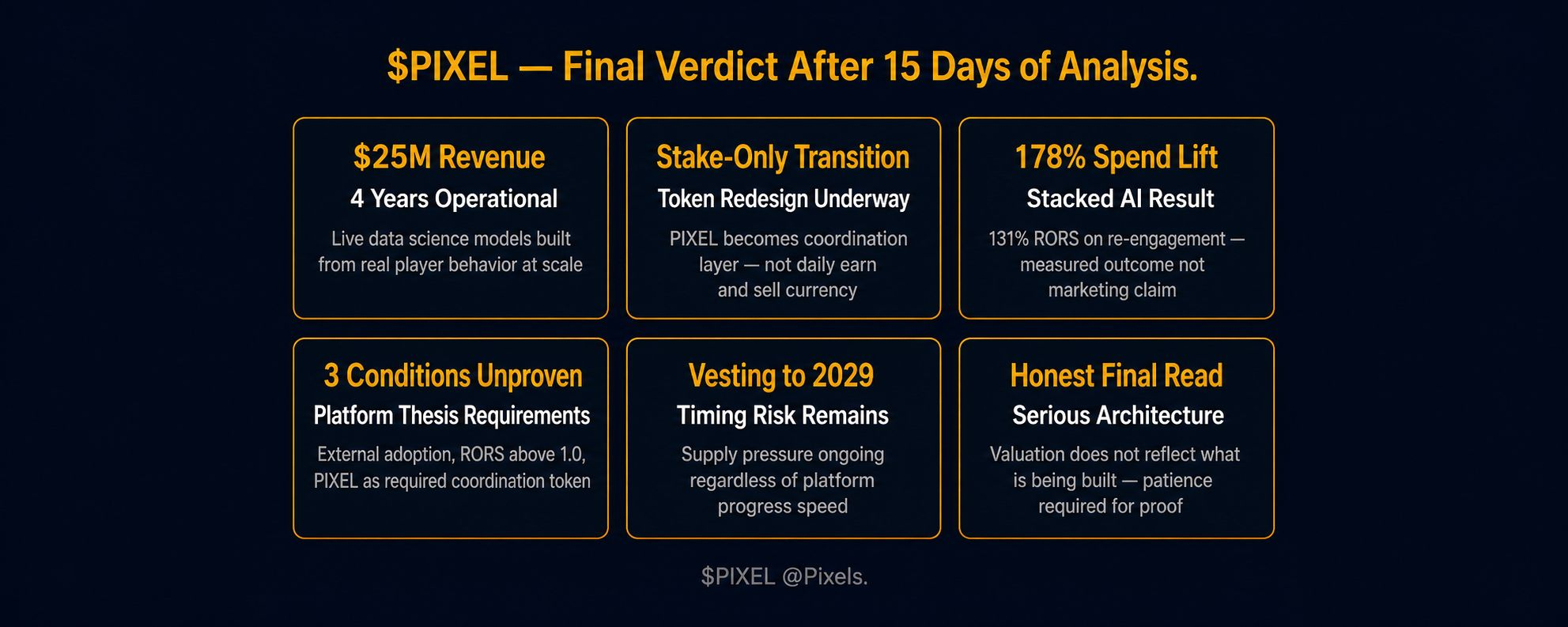
I want to be honest about something before writing the conclusion to this series. I started fifteen days ago with a simple goal understand $PIXEL well enough to form a clear view. What I found instead was a project that resists clean conclusions, and I have come to think that resistance is itself analytically meaningful.
The long-term case for PIXEL is not the farming game. I want to state that plainly because most of the market conversation still treats this as a gaming token whose value rises and falls with daily active users and chapter update cycles. That framing was accurate in 2024. I do not think it holds anymore.
What changed is the architecture underneath it. Four years of running a live game economy produced something most Web3 gaming projects simply do not have real operational data on player behavior at scale. The team knows which wallet profiles extract versus reinvest. They know where reward budgets leak. They know why players leave on day one versus day seven versus day thirty. They built data science models around all of it, and then they started productizing those models into Stacked. The $25 million in revenue generated across the ecosystem is not the number I keep coming back to. The number I keep coming back to is that the AI engine behind Stacked produced a 178 percent lift in conversion to spend and a 131 percent return on reward spend when applied to targeted re-engagement. That is not a marketing claim. That is a measured outcome from a live experiment on real players, and it changes how you read everything else the team is building.
Luke said something in a recent podcast that I find more significant than anything in the formal roadmap. He said they are slowly transitioning PIXEL to become stake-only. Player rewards will shift toward USDC for those who want liquidity. The token itself becomes the coordination mechanism the thing you hold to direct which games receive ecosystem resources, not the thing you earn daily and sell on exchanges. That is a fundamentally different asset design from what launched in February 2024, and it is being implemented quietly while the market still prices $PIXEL as a gaming reward token.
The staking architecture maps this transition clearly. Four phases were announced publicly. Phase one was fixed allocations to hand-selected games. Phase two makes reward pools dynamic the more PIXEL staked to a game, the larger that game's monthly allocation. Phase three removes curation entirely and opens the ecosystem to any game meeting a minimum activity threshold. Phase four introduces USDC support for user acquisition while keeping PIXEL as the only token eligible for staking rewards. That progression is not a feature roadmap. It is a deliberate transition toward a system where PIXEL derives its value from being the required coordination layer for a multi-game ecosystem, not from being spent on in-game items.
The Hivemind AI integration is a detail most coverage skipped entirely. PIXEL's became the first project to deploy this system intelligent agents that give players real-time answers about prices, progress, and events inside the game universe. That is not a retention gimmick. It is a signal about where the team's technical ambition points. The same team building an AI game economist into Stacked is also building AI-native player interfaces into their core product. These are connected decisions, not isolated feature drops.
Now I have to sit honestly with what I cannot resolve, because a real final verdict requires acknowledging the limits of the analysis alongside its conclusions.
The first unresolved question is external adoption. The entire platform thesis depends on independent studios choosing Stacked without being invited. Everything built the cross-chain layer, the one-line SDK, the AI game economist was designed for that moment. But the moment has not arrived at visible scale. One genuinely independent integration in over twelve months is a thin foundation for a platform thesis, however serious the architecture underneath it.
The second unresolved question is what the USDC transition actually does to token demand. Luke was explicit that rewards shift toward USDC as Stacked scales. If the value proposition of Stacked is the AI data network and the rewards are increasingly paid in USDC, the platform could scale while creating minimal new $PIXEL demand. The token becomes stake-only in design which reduces sell pressure from daily earners but if fewer new participants need to acquire $PIXEL to benefit from the ecosystem, the demand side does not grow proportionally with the platform. I have not seen this tension resolved in any public communication, and I think it is the most important open question in the entire $PIXEL analysis.
The third unresolved question is timing. The vesting schedule runs to 2029. Monthly unlock events arrive regardless of whether RORS crosses 1.0 or whether Stacked onboards its fifth independent studio. The window between structural supply pressure and proven platform thesis could be measured in years. Holding through that window requires a conviction level the available evidence does not yet fully justify, however directionally compelling the architecture is.
What I am left with after fifteen days is this. $PIXEL is being built by one of the most intellectually honest teams in Web3 gaming. The infrastructure is more sophisticated than the valuation reflects. The transition from gaming token to coordination mechanism is real and deliberate. And the three unresolved questions are genuine enough that confident bullish conclusions would be intellectually dishonest.
I started skeptical. I am ending genuinely uncertain. In a space where almost everyone arrives at a confident take, I find that uncertainty harder to dismiss than either clean conclusion. The architecture deserves more serious attention than the price chart has been getting. Whether the three conditions get answered in the right order on a timeline that actually matters for token holders is the question fifteen more days of analysis would not resolve. It requires watching the data as it arrives.
The project has earned serious attention. The token demands patience and specific signals before conviction. Everything else right now is noise around a genuinely interesting open question.