
The first thing that bothered me about #StriveQ1Results15009BTCHoldings was not the BTC count.
It was the calm around it.
15,009 BTC sitting on a balance sheet sounds clean. Heavy. Safe. Institutional. The kind of number people screenshot, nod at, and pretend they understood the deeper move. But I don’t think the real signal is “institutions like Bitcoin.” That part is stale bread now.
Big capital is no longer asking, “What story can pump next?” It’s asking, “Where can size move without being taxed by bad pipes?”
That’s where the Infrastructure Reckoning starts.
I used to think this cycle would be won by the loudest chain, the fastest claim, the neatest launch. Fine, I was wrong. The market grew up, which is rare for this industry, almost suspicious. Now the edge lives lower in the stack. Not in slogans. In state access. In execution paths. In who can settle stress without turning every trade into a traffic jam.
Think of an old city road after rain.
Everyone wants to reach the same bridge. Cars, trucks, buses, half-broken scooters. The bridge is not the problem. The problem is every lane fighting for the same narrow turn. That’s state contention. Too many actions need the same piece of chain state at the same time.
State Contention Ratio is just a clean way to ask:
How much does the system choke when real demand shows up?
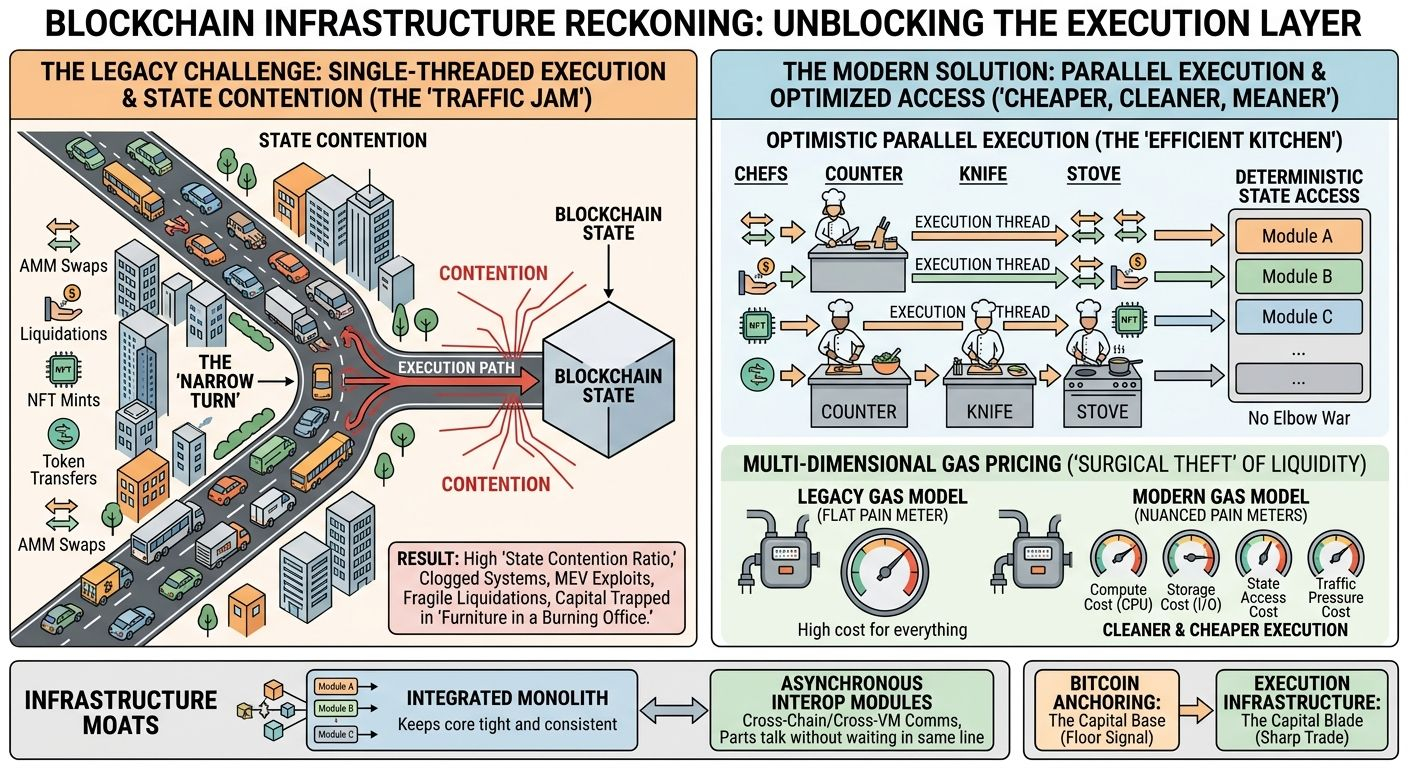
Legacy protocols may still hold deep TVL, but some of that liquidity now looks like furniture in a burning office. Looks rich. Hard to move. Easy to trap.
And this is where Surgical Theft comes in.
Not theft in the cartoon sense. No ski masks. No drama. I mean capital rotation with a scalpel. Funds don’t need to “leave crypto.” They can just move from slow execution zones into systems where liquidations, routing, and state updates cost less and clear faster.
If Optimistic Parallel Execution and Multi-dimensional Gas Pricing let MEV-shielded liquidations run at around 1/100th the cost of older rails, then the market has a new hunting ground. Not louder. Cheaper. Cleaner. Meaner.
Okey, let’s slow that down.
Deterministic State Access means a protocol can know what state it needs before execution, like a surgeon asking for the right tool before the cut. No rummaging. No blind reach. Less mess.
Optimistic Parallel Execution means many actions may run side by side, as long as they don’t crash into the same state. Like six chefs working in one kitchen, but each has a marked counter, knife, and stove. Less elbow war.
Multi-dimensional Gas Pricing means fees can reflect different types of strain, not just one flat pain meter. Compute, storage, state access, traffic pressure. Each gets priced closer to its real cost.
That matters.
Because the next serious trade may not be “buy the coin with the biggest pitch.” It may be “find the protocol where execution cost becomes the moat.”
This is why Integrated Monoliths and Asynchronous Interop Modules matter. One keeps the core tight. The other lets parts talk without every action waiting in the same cursed line. Humans invented queues, then spent history pretending queues are normal. Chains don’t have to accept that disease.
Institutional BTC anchoring is the floor signal, not the full trade. The sharper read is that BTC gives capital a base, while execution-first infra gives it a blade. I’d watch protocols that reduce state friction, protect liquidation flow, and price demand with more care than the old one-lane gas model.
Not because they sound clean.
Because they can make old TVL look lazy.
#BTC #Bitcoin #ParallelExecution #BinanceSquare

Disclaimer: This is educational analysis only, not financial advice. I’m not telling anyone to buy, sell, chase, or worship any protocol like a sleep-deprived fund intern. Markets can punish clean logic when timing is bad. Do your own work.