
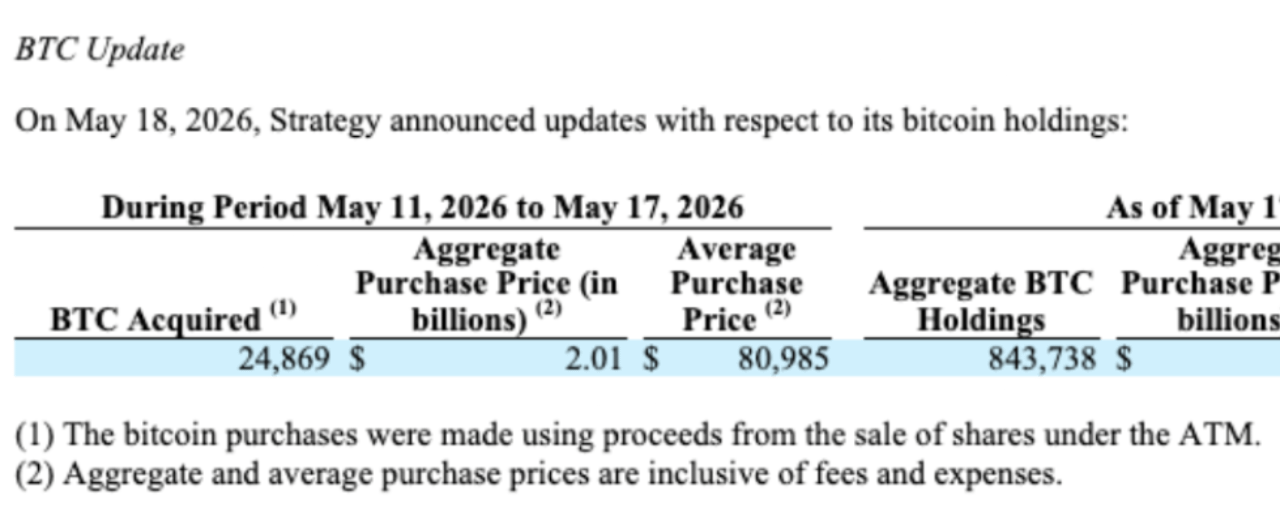

Michael Saylor's Strategy made another massive Bitcoin acquisition last week, purchasing 24,869 BTC for $2.01 billion as the asset traded around $80,000 — lifting total holdings to 843,738 BTC and extending the company's lead over BlackRock as the largest institutional Bitcoin holder in the world.
The purchases were disclosed in an 8-K filing with the US Securities and Exchange Commission on Monday, covering acquisitions made between May 11 and May 17 at an average price of $80,985 per Bitcoin. The buy raises Strategy's aggregate cost basis to $75,700 per BTC. Total holdings of 843,738 BTC were acquired for approximately $63.87 billion and were valued at roughly $65.3 billion at the time of filing, according to CoinGecko data.
STRC preferred stock funded 97% of the purchase
Nearly the entire $2.01 billion acquisition was funded through sales of Strategy's STRC perpetual preferred stock rather than its common equity. According to the SEC filing, Strategy raised approximately $1.95 billion through the sale of around 19.5 million STRC shares — accounting for roughly 97% of total proceeds. Strategy's Class A common stock contributed a smaller share, generating $83.7 million in net proceeds from the sale of 430,344 shares.
The funding structure mirrors previous large Bitcoin purchases this year, including Strategy's third-largest acquisition on record — a 34,164 BTC buy — which was also financed primarily through preferred securities rather than common equity. STRC recorded a single-day trading volume record of 15.1 million shares during the week, with estimated purchases of around 15,466 BTC tracked by STRC Live ahead of the official disclosure.
Strategy now holds more Bitcoin than BlackRock
Strategy's 843,738 BTC now surpasses BlackRock's approximately 817,000 BTC held on behalf of clients through its iShares Bitcoin Trust — making Strategy the single largest institutional Bitcoin holder globally by a meaningful margin. The gap between the two has widened with each successive acquisition as Strategy continues its aggressive accumulation strategy while BlackRock's ETF holdings fluctuate with investor flows.
The latest purchase comes one week after Saylor raised the possibility of selling Bitcoin during Strategy's earnings call — a comment that generated significant market attention. Saylor framed potential sales as a mechanism to better protect Bitcoin's long-term value rather than a retreat from the company's accumulation thesis, arguing that rigidly adhering to a never-sell approach could over time work against the asset the company is built to hold. The $2 billion purchase disclosed Monday suggests the selling comment was a philosophical observation rather than a near-term operational signal.
Saylor had also previewed the acquisition ahead of the filing by posting a chart of Strategy's purchase history — spanning 109 Bitcoin acquisition events since 2020 — a signal the market has come to recognize as a reliable precursor to an imminent buy announcement.
The Broader Context
The timing of the purchase is notable. Strategy bought 24,869 Bitcoin at an average of $80,985 during a week when Bitcoin faced significant macro headwinds — back-to-back hot CPI and PPI prints, surging global bond yields, and a sharp repricing of Federal Reserve expectations from rate cuts to potential rate hikes. Rather than pulling back in the face of that uncertainty, Strategy accelerated its accumulation, deploying $2 billion into a market that was simultaneously seeing $1 billion in weekly outflows from spot Bitcoin ETFs.
The divergence between Strategy's continued buying and the broader institutional retreat visible in ETF flow data illustrates the fundamental difference between the two types of Bitcoin holders. ETF investors respond to short-term macro conditions and adjust exposure accordingly. Strategy, by design, does not — treating every price level as an opportunity to accumulate rather than a reason to reassess.
With 843,738 BTC on its balance sheet and a funding mechanism in STRC preferred stock that allows continued accumulation without diluting common equity at scale, Strategy appears structurally positioned to keep buying regardless of where macro sentiment sits in any given week.