
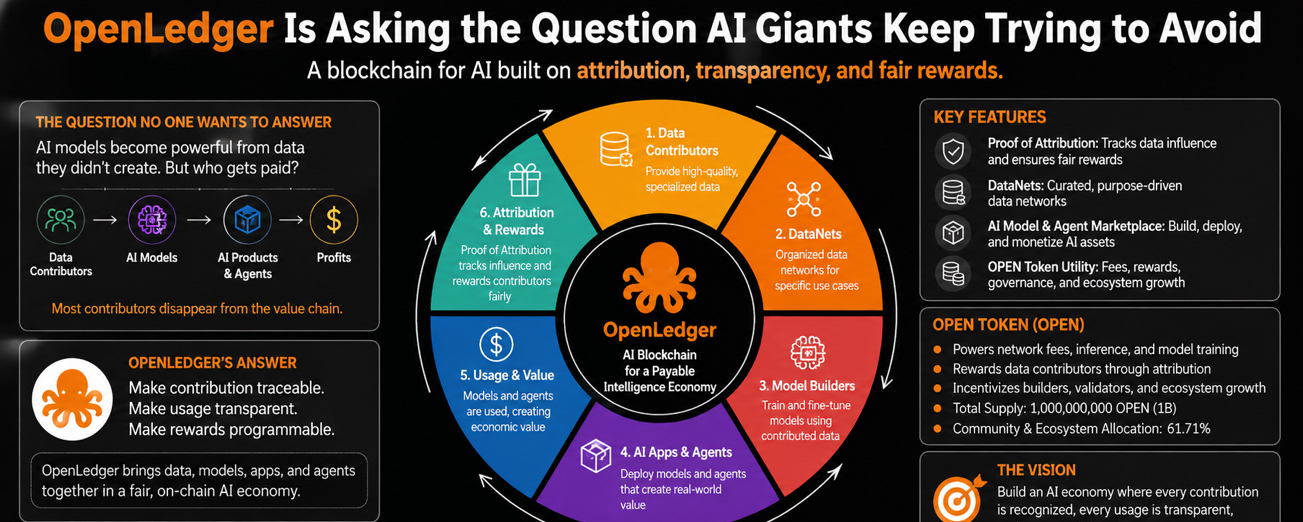
OpenLedger is trying to do something that sounds simple on paper: make AI value traceable, and make the people behind that value earn from it.
That is the clean version.
The messier version is this: AI has been feeding on data for years, and most of the people who created, cleaned, organized, labeled, or supplied that data never saw a real payment path. They became invisible. Their work got absorbed into models, those models became products, and the money moved somewhere else. I’ve seen this pattern before. Different sector, different branding, same grind.
OpenLedger is stepping into that gap with an AI blockchain built around data, models, apps, and agents. The project is not only trying to store things on-chain or throw a token into the AI noise. Its real bet is that intelligence itself needs an economic layer. Data should not just sit there. Models should not just be closed tools. Agents should not just run tasks in isolation. OpenLedger wants all of them connected inside a system where usage, contribution, and rewards can be tracked.
That is the part I actually find interesting.
Not exciting. I’ve become careful with that word.
Interesting.
Because the AI market has already started recycling the same language. Every second project says it is building the future of agents, data ownership, model monetization, or decentralized intelligence. Most of it blends together after a while. You read enough decks and everything starts sounding like someone fed old narratives into a blender. OpenLedger at least has a sharper center: attribution.
That means the project is trying to answer a very uncomfortable question. If an AI model becomes useful because of certain data, can the original contributors be recognized and rewarded?
Sounds fair.
Hard to do.
Very hard.
AI attribution is not clean accounting. A model does not look at one data point, produce one answer, and hand you a receipt. Outputs are shaped by patterns, repeated examples, hidden relationships, and training processes that are not always easy to unpack. Some data overlaps. Some data is copied across the internet. Some value comes from the weight of thousands of tiny signals, not one obvious source. So when OpenLedger talks about rewarding contributors through attribution, I’m not just nodding along. I’m looking for the friction. I’m looking for where the system bends, where it gets gamed, where the reward logic starts to feel too abstract for normal builders to care.
That is usually where these projects break.
Still, the problem is real. That matters.
AI needs better data. Not more random data. Better data. Cleaner data. Specialized data. Data that actually fits a use case instead of filling a model with sludge. Finance, law, health research, gaming behavior, local-language knowledge, robotics feedback, agent interactions — these are not the same as scraped public noise. Good data has weight. And if OpenLedger can help turn that weight into something usable and payable, then the project has a reason to exist.
The idea of organized data networks makes sense in that context. Instead of data being scattered everywhere, OpenLedger wants contributors to gather around specific needs and create usable pools of intelligence. If those pools help models perform better, the contributors should have a path to earn. That is the theory. A good one, honestly. But a good theory is still cheap in crypto.
Execution is the expensive part.
OPEN, the token, only becomes interesting if the network has real activity behind it. Fees, rewards, model deployment, inference, agent usage, ecosystem participation — all of that needs to become more than words on a page. I’ve watched too many tokens survive on narrative fumes for a few months and then fade when the market asks for usage. The chart may move before the product proves itself. That happens all the time. But eventually the question comes back: who is actually using this, and why?
OpenLedger’s strongest angle is that it connects crypto to a problem AI cannot avoid forever. Data ownership is not going away. Contributor payments are not going away. Model transparency is not going away. The current AI economy has too many hidden inputs and too many unpaid sources of value. At some point, someone will try to build payment rails around that. Maybe OpenLedger gets it right. Maybe it becomes one of many attempts that taught the market what not to do.