
The internet feels different now.
Not in some dramatic “the world is ending” way. Just… off. Weird. Artificial sometimes. You scroll through Twitter, Reddit, blogs, comment sections, even news sites now, and there’s this strange feeling that half the content wasn’t written because somebody actually had something worth saying. It was generated because the machine needed engagement. Needed traffic. Needed content volume. Needed SEO clicks. Needed to feed another machine somewhere else.
And honestly it’s getting harder to tell what’s real anymore.
That’s the part people don’t talk about enough when discussing AI. Everybody focuses on capability. Faster models. Smarter outputs. Better image generation. Better video generation. But almost nobody talks about what happens when the internet itself becomes flooded with synthetic junk created at industrial scale.
Because that’s already happening.
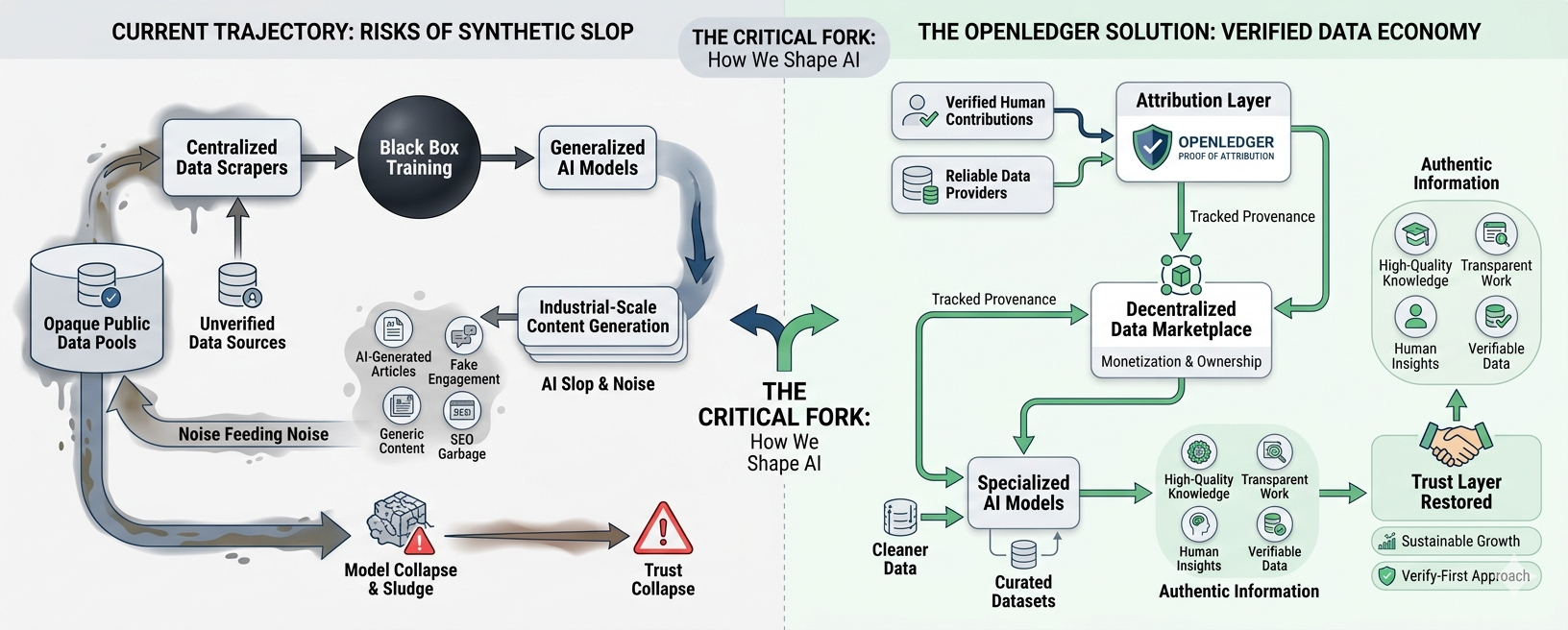
AI-generated articles everywhere. AI-generated replies. AI-generated videos. AI-generated “experts” posting fake insights. Entire websites built from machine-written garbage designed only to farm search traffic before disappearing into the void. The internet slowly becoming this giant loop where machines generate content for other machines to scrape later.
Feels unhealthy honestly.
And the scary thing is AI models themselves depend on internet data to improve. So eventually you get this weird feedback loop where systems start learning from synthetic content created by previous systems. AI training on AI. Copies training copies. Noise feeding noise.
That sounds like a disaster waiting to happen.
Which is partly why OpenLedger’s whole focus on attribution and data quality actually feels more important than most crypto AI narratives right now. At least they seem aware that the future AI economy probably breaks if nobody can track where information came from anymore.
Because right now the internet runs on trust more than people realize.
You trust articles are written by humans with actual knowledge. You trust datasets weren’t polluted with garbage. You trust AI outputs came from reliable training pipelines. You trust information still has some connection to reality underneath all the algorithmic noise.
But that trust layer is weakening fast.
And honestly centralized AI companies aren’t exactly helping. Most of them operate like giant black boxes. Massive datasets go in. Massive models come out. Nobody fully understands what data shaped specific outputs or how much synthetic junk got absorbed during training. Everything moves so fast now that scale became more important than cleanliness.
Which feels reckless.
OpenLedger’s approach seems built around the idea that future AI systems need traceable contribution layers underneath them or the entire information economy eventually becomes polluted beyond repair. Their Proof of Attribution model is basically trying to create infrastructure where data sources, contributions, and outputs remain connected instead of disappearing into opaque machine-learning systems nobody can properly audit.
And honestly that sounds less like crypto hype and more like basic survival for the internet long term.
Because the current trajectory feels unstable.
The incentive systems online are completely broken already. Platforms reward volume over quality. AI makes volume infinitely cheaper. Which means low-quality synthetic content spreads faster than humans can realistically compete with manually. Entire sections of the internet already feel like ghost towns filled with machine-generated engagement pretending to be real human activity.
You can feel it sometimes.
Replies that technically make sense but feel emotionally empty. Articles that say a lot while saying nothing. Fake expertise everywhere. Generic “thought leadership” flooding every platform nonstop. People using AI to summarize AI-generated articles based on AI-generated discussions written for algorithms instead of humans.
The whole thing starts feeling spiritually dead after a while.
That’s why I think OpenLedger focusing on community-owned datasets and specialized models matters more than people realize. The internet probably doesn’t need infinitely larger universal AI systems trained on increasingly polluted public data forever. It probably needs cleaner specialized ecosystems where contribution, verification, and provenance actually matter again.
Smaller focused intelligence systems might end up becoming more valuable than giant generalized models drowning in synthetic noise.
Because quality matters.
Especially once AI moves deeper into serious industries. Healthcare. Finance. Research. Law. Infrastructure. You can’t build reliable systems forever on top of polluted information environments where nobody knows what’s authentic anymore.
That’s where OpenLedger’s infrastructure angle starts making more sense to me.
Not because blockchain magically fixes truth. It doesn’t. Crypto people exaggerate constantly. But transparent attribution systems do matter once AI economies scale large enough. You need ways to verify contribution. Track provenance. Reward reliable data sources. Otherwise the internet slowly turns into this giant synthetic sludge factory where trust completely collapses.
And honestly we’re closer to that point than people think.
The scary part is AI companies themselves are trapped too. They need enormous amounts of data to stay competitive. But the more AI-generated content floods the internet, the harder it becomes to maintain clean training environments. Eventually everyone starts training on increasingly synthetic information unless new infrastructure emerges around attribution and verification.
That’s partly why OpenLedger’s broader vision keeps sticking in my head.
They aren’t really trying to compete in the flashy “our chatbot is smarter” race dominating AI headlines every week. They’re focused on the layer underneath AI itself. Data ownership. Contribution tracking. Monetization infrastructure. Verification systems. Economic participation.
The boring stuff basically.
Which usually ends up mattering the most long term.
Still risky obviously. Very risky.
Most crypto AI projects will probably disappear eventually because the market is overloaded with hype and very little real infrastructure. And centralized companies still have massive advantages. Better compute. Better funding. Better engineering talent. Better distribution.
That’s reality.
But centralized systems also created the current mess. The internet became optimized for engagement farming and scale at the expense of quality and trust. AI is now accelerating those problems instead of fixing them.
So maybe the next phase of AI actually depends less on making models bigger and more on cleaning up the information economy underneath them.
Maybe attribution matters more than hype.
Maybe provenance matters more than endless scaling.
Maybe people eventually get tired of living inside an internet flooded with synthetic noise generated by machines optimizing for clicks while reality slowly disappears underneath algorithmic sludge.
And honestly I think projects like OpenLedger are basically betting that moment eventually arrives whether the industry is ready for it or not.
