One thing I realized pretty late while observing AI and crypto cycles over the years is that most tech failures aren't due to weakness, but because they're trying to tackle the wrong layer of the problem. The internet once thought the problem was a lack of information. Crypto once thought the problem was a lack of trust. AI seems to currently think the problem is a lack of intelligence. But if you take a closer look at user behavior, it seems that what people lack the most is the ability to handle too many abstractions at once. We're living in an era where everything is becoming 'smarter,' yet human experience is becoming increasingly fragmented. AI generates content faster than humans can consume it. Crypto creates coordination faster than humans can understand what they're participating in. And ultimately, users start to outsource almost the entire thinking process to recommendation systems, automation, and prediction. The interesting part is: the more tools emerge to reduce friction, the cognitive friction increases in different ways. You no longer have to search for yourself, but in return, you constantly have to evaluate which is the signal and which is the synthetic signal created by the attention algorithm. That's also why I think many people are missing the point about the concept of 'AI-native blockchain' when discussing OpenLedger. Most of the market still sees it as a new narrative to tie tokens to AI. A familiar 'AI + blockchain' blend that we've seen repeated over several cycles recently. But it seems the more noteworthy aspect lies in the architecture of behavior. Traditional blockchain optimizes for transactions. Traditional AI optimizes for predictions. Then systems like OpenLedger seem to be optimizing for another layer: contribution intelligence. It sounds a bit abstract, but if you closely observe how the internet is evolving, you'll see a clear pattern: data is no longer scarce, but quality context is. AI models are becoming stronger not just because of compute but because they absorb vast amounts of behavioral data from humans, which is how we write, react, click, debate, and even hesitate. Ironically, most users don't really 'own' the value from the behaviors they create every day. Attention becomes the raw material. Behavior becomes training data. But ownership has almost disappeared behind the platform layer. Perhaps that's the layer of issues OpenLedger is trying to touch upon. It's not just about 'putting AI on the blockchain.' It's about turning blockchain into a coordination layer specifically for the AI economy — where data contributions and inferences are recorded as an economic primitive. At least from my observation, this is the reason it's called 'AI-native' rather than just a blockchain with integrated AI features. The difference sounds small, but philosophically within systems, it's quite significant. A normal blockchain usually assumes that people are actively making decisions, but in the AI era, most behaviors are occurring in the form of assisted cognition. Humans are no longer just 'using tools'; they are starting to think through tools, and when that happens, the issue isn't who owns the infrastructure anymore but who owns the intermediary layer between cognition and action. That's where I think many people are overlooking. AI isn't just reshaping productivity. It's reshaping how people form conviction. Recommendation systems influence perception. AI copilots influence decision flow. Automation influences whether we truly understand the process we just engaged in. The more we automate, the harder it seems for people to distinguish between 'I think that' and 'the system led me to that thought.' And perhaps that's why projects like OpenLedger are interesting not just because of the individual technologies but because of the larger question behind them. If AI becomes the new intermediary layer of the internet, who will recognize the value created by billions of invisible interactions every day? I don't think the market has a clear answer to that yet, but the longer I watch, the more it seems the next game won't center around how smart AI is, but which systems understand human behavior deeply enough to become the default layer for how people think, collaborate, and make decisions. $OPEN @OpenLedger #OpenLedger

مقالة
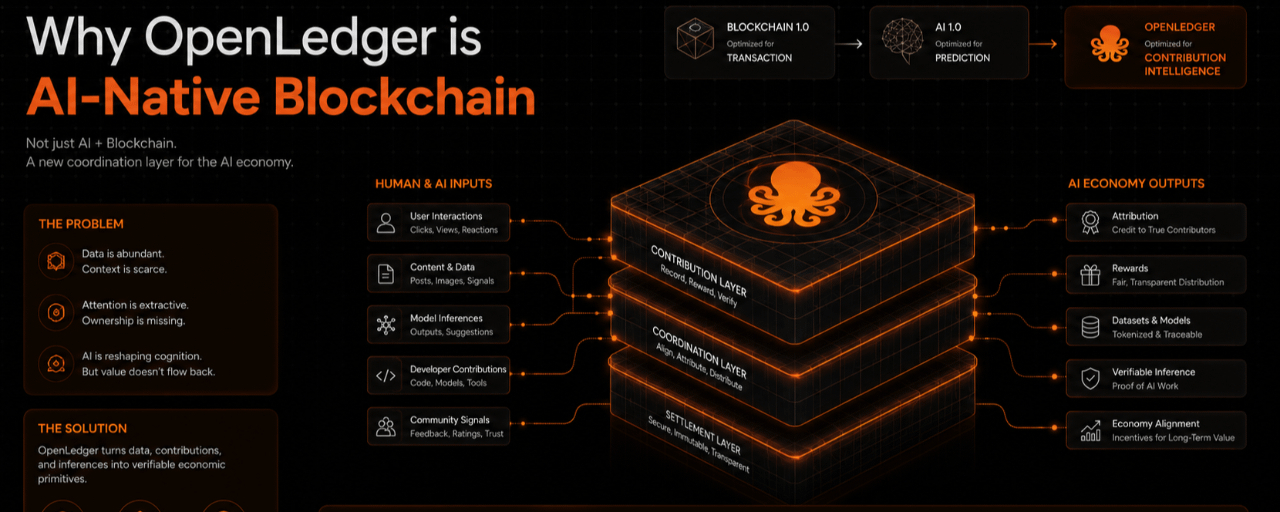
Why is OpenLedger considered the 'AI-native blockchain'?
إخلاء المسؤولية: تتضمن آراء أطراف خارجية. ليست نصيحةً مالية. يُمكن أن تحتوي على مُحتوى مُمول. اطلع على الشروط والأحكام.