
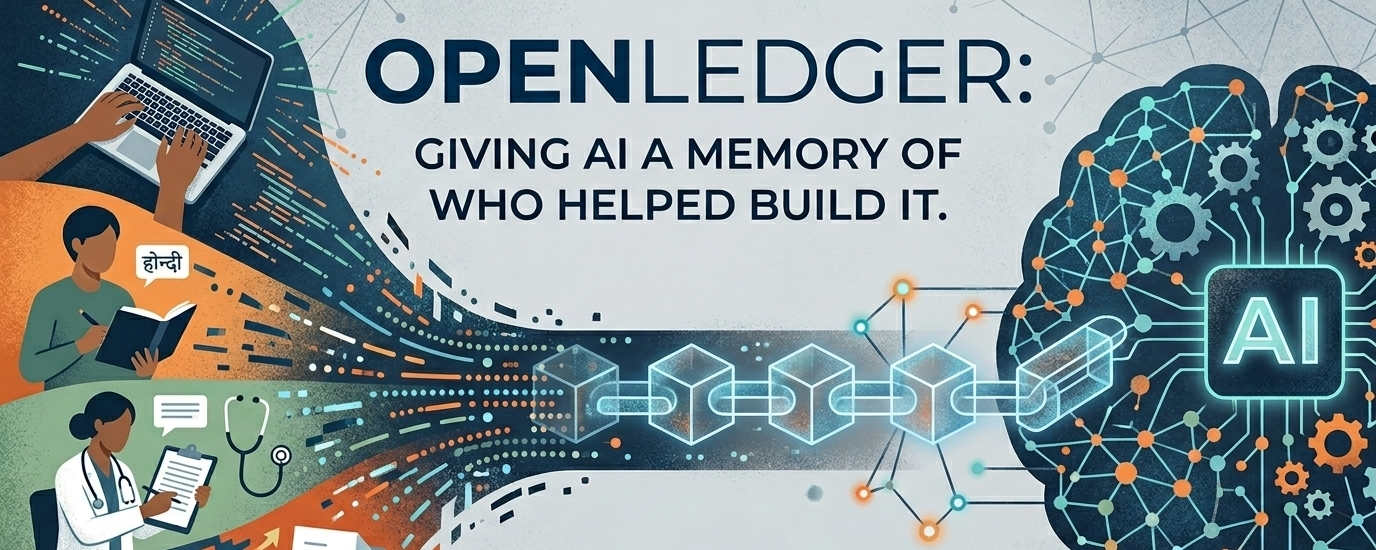
OpenLedger is trying to solve a problem most people feel before they can explain it.
You post online. You write. You share ideas. You answer questions. Maybe you publish research, upload code, review products, translate documents, or build small tools that help people. Then, years later, an AI system appears that seems to know the same things people like you spent time creating.
It feels strange.
Not always wrong. Not always theft. But strange.
Because AI does not learn from nothing. It learns from human work. From public websites. From documents. From code. From expert notes. From all the small pieces of knowledge people leave behind every day.
And usually, those people disappear from the story.
OpenLedger’s idea is simple: if your knowledge helps make AI valuable, maybe there should be a way to prove it. And maybe, if money is made from that value, you should not be completely left out.
That is the heart of it.
The project uses blockchain, but you do not need to be a crypto expert to understand the point. Think of blockchain here as a public receipt book. Not magic. Not a cure for everything. Just a shared record that can help show who contributed what, who used it, and where value moved.
OpenLedger wants to use that record book for AI.
The things it cares about are data, models, and agents.
Data is the raw material. A doctor’s notes. A teacher’s lessons. A farmer’s crop records. A programmer’s code. A local language dataset. Boring on its own, maybe. But extremely valuable when it teaches an AI how the world actually works.
Models are the trained systems. They are like workers who have practiced a skill. One model might be good at law. Another at medical research. Another at customer support. Another at trading. The better the training, the more useful the model.
Agents are the digital workers that do tasks. Not just “answer this question,” but “find this information, compare these options, write the report, monitor the dashboard, send the update.” That is where AI starts to feel less like a chatbot and more like a junior employee who never sleeps.
OpenLedger wants all of this to become easier to track and reward.
That sounds fair. It also sounds very hard.
AI attribution is messy. If a model gives a good answer, how do you know exactly which data made it good? That is like tasting a bowl of soup and trying to identify which carrot changed the flavor. You can make educated guesses. You can design systems. But perfect fairness is a dangerous promise.
There are privacy questions too. Some data should never be sold casually. Medical records, financial files, private messages, company documents — these are not just “assets.” They belong to people’s lives. Any project that wants to build a market around data has to take that seriously.
Then there is the crypto side.
Crypto has a long history of taking a good idea and burying it under hype. A project starts by talking about fairness, ownership, and the future of the internet. A few weeks later, everyone is staring at a price chart and arguing about candles. That could happen here too.
So no, OpenLedger is not automatically important just because it combines AI and blockchain. That combination alone is not enough.
But the question it raises is important.
Who gets paid when AI gets smarter?
Right now, the answer is usually the company that owns the platform. The data contributors are invisible. The experts are invisible. The communities whose knowledge shaped the model are invisible.
OpenLedger is saying: maybe they should not be.
That is why the OPEN token exists. It is meant to power activity inside the network, including payments and rewards. In simple terms, OPEN is supposed to be the fuel of this AI economy. But beginners should be careful here. A useful idea does not guarantee a successful token. Price is not the same as purpose. A project can sound smart and still fail. A token can rise for bad reasons and fall even when the idea is good.
The future OpenLedger imagines is more interesting than the chart.
Imagine a small group builds a high-quality dataset for a local language that big AI companies usually ignore. Imagine a medical team contributes approved research data. Imagine a developer creates an AI agent that helps businesses handle invoices. Imagine a legal expert trains a model to understand local regulations.
In today’s system, those contributions might get swallowed by a larger platform.
In OpenLedger’s version, they could be tracked, used, and rewarded.
That is the promise.
Maybe it works. Maybe it does not. The hardest part will be trust. People will need to trust that the system measures contributions fairly. Developers will need a reason to build on it. Data owners will need confidence that their information is protected. Users will need tools that are actually useful, not just another crypto dashboard with fancy words.
Still, I understand why this project exists.
AI is becoming one of the most powerful industries in the world, and it is being built from human knowledge. That creates a moral problem, not just a technical one. If millions of people help create the value, should only a few companies collect the reward?
OpenLedger is one answer to that question.
Not the final answer. Not a guaranteed winner. But a serious attempt to make AI less like a locked room and more like a marketplace where contributors can be seen.
And maybe that is the simplest way to explain it.
OpenLedger wants to give AI a memory of who helped build it.