
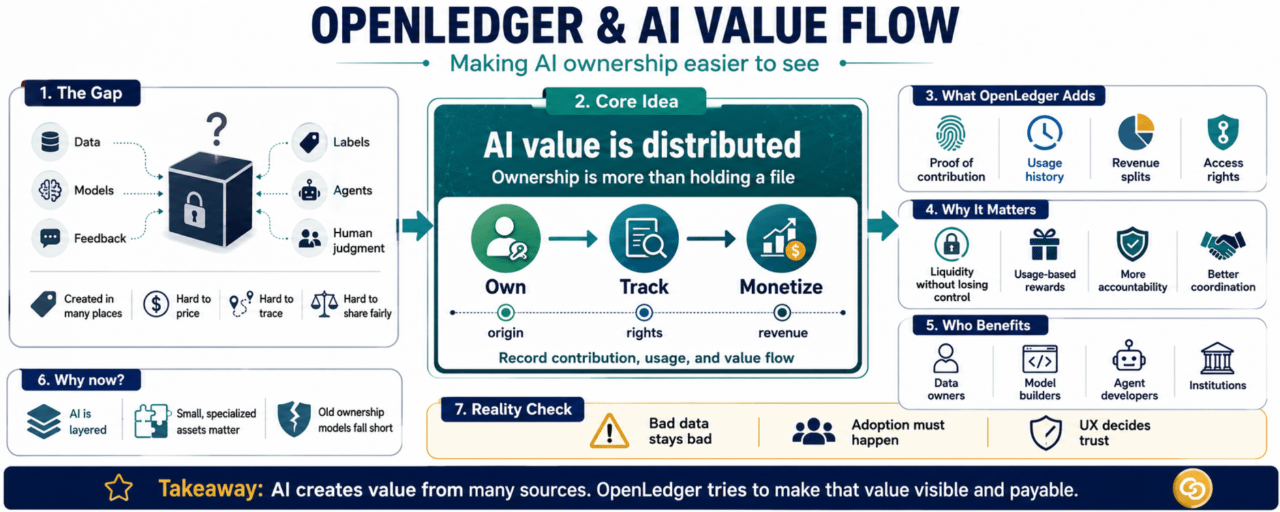
I will be honest, AI needs data. That part is obvious. It also needs models, feedback, labels, small corrections, human judgment, and now even agents that can act across different tasks. But most of this value still moves in a strange way. It gets created in many places, by many people, and then often ends up locked inside a few systems where it is hard to price, hard to trace, and even harder to share fairly.
You can usually tell when a market is still early by how messy its ownership feels.
Data is like that right now.
A company may have useful data sitting in old files. A developer may train a small model that solves one narrow problem very well. A community may create feedback that makes an AI system better over time. An agent may learn how to complete a process more efficiently than a human could. All of these things have value, but the value is not always liquid. It does not move easily. It does not always have a clear market. Sometimes it is used once, hidden away, or absorbed into a larger model without much visibility.
That is where OpenLedger’s idea starts to make sense.
The simple way to look at it is this: @OpenLedger is trying to make AI-related assets easier to own, track, and monetize onchain. Not just tokens for the sake of tokens. More like a record of who contributed what, how that contribution is used, and how value can flow back when it creates something useful.
It sounds simple when said that way. But the details matter.
In AI, contribution is not always clean. One dataset may improve a model by a small amount. One model may become part of a bigger system. One agent may use several tools, several models, and several sources of data to produce an outcome. The question changes from “who owns the AI?” to something more layered: who helped make the output possible, and how should that be recognized?
That is where blockchain can be useful, at least in theory. Not because it magically fixes AI. It does not. But because it can give structure to things that are usually hard to see. Ownership records. Usage history. Revenue splits. Access rights. Proof that a dataset, model, or agent came from somewhere specific.
OpenLedger seems to be working around that gap between AI creation and AI monetization.
And that gap is real.
A lot of people talk about data as the new oil, but that phrase feels tired now. Data is not oil. It is not one thing. It ages differently. It has context. It can be sensitive. It can be copied. It can lose value when removed from the environment that gave it meaning. A customer support dataset, for example, is not just rows of text. It reflects how a company talks to users, where users get confused, what problems repeat, and what kind of tone actually helps.
That kind of data can make an AI model better. But the owner of that data may not have a simple way to turn it into a usable asset without giving up control.
So the idea of unlocking liquidity here is not only about selling data. It is also about making it usable without making ownership disappear.
The same thing applies to models.
Most people think of AI models as either huge public systems or private tools inside companies. But there is a lot of room between those two points. Smaller models, specialized models, fine-tuned models, models built for one industry or one workflow. These can be valuable even if they are not famous. Maybe especially because they are not trying to do everything.
After a while, it becomes obvious that not every useful AI asset needs to be massive. Some of the most useful ones may be narrow. Quiet. Built for a specific type of work.
OpenLedger’s angle seems to be that these smaller, specific assets should not just sit in isolation. They should be able to connect to a wider economy. A model could be contributed. A dataset could be made available under certain rules. An agent could earn from the work it helps complete. Contributors could receive value based on actual use, not only upfront sale or vague credit. #SuiMainnetResumes
That is the part that feels worth watching.
Because AI is moving toward systems made of many pieces. A single answer may involve a base model, a retrieval layer, a private dataset, a ranking model, a workflow agent, and a human feedback loop. In that kind of world, value becomes more distributed. But payment and ownership systems have not really caught up.
#OpenLedger is trying to build around that distributed value.
There is also a trust side to it.
People are becoming more aware of where AI systems get their inputs. They want to know whether data was licensed, whether contributors agreed, whether outputs are tied to reliable sources. This does not mean every user will inspect every record. Most will not. But the presence of a record can still matter. It gives builders something to point to. It gives contributors something to rely on. It creates a little more accountability in a space that often feels blurry. $PTB
Of course, none of this is automatic.
A blockchain layer does not make bad data good. It does not make weak models useful. It does not guarantee adoption. The hard part is still whether people actually want to bring their data, models, and agents into this kind of system. The market has to care. Developers have to care. Contributors have to feel that the benefits are real enough to justify the extra structure.
That is usually where these ideas either become practical or remain interesting from a distance.
Still, the direction makes sense.
AI is creating new kinds of assets faster than old systems can describe them. Data is no longer just something stored in a database. A model is no longer just software. An agent is no longer just a script. Each can carry some kind of economic value, but that value needs a way to move, split, and return to the people or systems that created it. $LAB
OpenLedger is one attempt to build that layer.
Not in a loud way, at least not if you strip away the usual crypto language around it. The more grounded version is simple: AI creates value from many sources, and those sources need better ways to be recognized and paid.
Maybe that is the real shift.
The question is not only how powerful AI becomes. It is also who gets to participate in the value it creates, and whether the pieces behind it can become visible enough to matter.
That part is still unfolding.
$OPEN

مقالة
OpenLedger Tackles the Quiet Data Problem Shaping the Future of AI
قد يخضع الرمز المميز المذكور في هذه المقالة لتقلبات عالية. قم بإجراء بحثك الخاص.
إخلاء المسؤولية: تتضمن آراء أطراف خارجية. ليست نصيحةً مالية. يُمكن أن تحتوي على مُحتوى مُمول. اطلع على الشروط والأحكام.