
To be honest, That sounds a little strange at first.
Most people still think of AI as a tool. You ask, it answers. You give it a task, it helps. You connect it to a workflow, and maybe it saves a bit of time.
But agents make the picture less simple.
An agent is not just waiting for one prompt. It can act across steps. It can call tools, check information, make choices, pass work to another system, and sometimes come back with a result that feels less like a reply and more like completed work.
That is where the old way of thinking starts to feel thin.
Because once agents begin doing work, the next question is not only whether they are useful.
It is how that work is valued.
And who owns the pieces that made the work possible.
This is where @OpenLedger becomes interesting from a different side.
Not just as a place for data or models. More as a possible economic layer for AI work itself.
You can usually tell when a new market is forming because the language around it feels unfinished. People borrow old words because the new ones are not ready yet. Is an agent a product? A service? A worker? A piece of software? A network participant?
Maybe it is a little of all of those.
An agent that helps with customer support may depend on a private dataset. Another agent that does research may depend on search tools, ranking models, and domain-specific knowledge. A trading agent may depend on signals, backtesting data, and risk rules. A coding agent may depend on models, repositories, testing environments, and human corrections.
From the outside, the result looks like one action.
Inside, it is a small economy.
That is the part that matters.
OpenLedger’s idea of unlocking liquidity for data, models, and agents starts to make more sense when you look at AI this way. The goal is not only to make these things visible. It is to let them participate in value creation without being fully absorbed or forgotten.
An agent could be useful because of the model behind it.
A model could be useful because of the data behind it.
The data could be useful because of the people or systems that created it.
And the final work may depend on all of them at once. $PLAY
So the question changes.
It is not just, “Did the agent complete the task?”
It becomes, “What helped the agent complete the task, and how should value move through that chain?”
That is a very different kind of internet.
The early internet moved information.
Crypto tried to move ownership.
AI agents may start moving work.
And work has value.
Not in a loud or abstract way. In a very plain way. If an agent saves time, makes a process cheaper, finds something useful, or completes a task someone would have paid for, then some value has been created.
But if the work depends on many hidden inputs, value sharing becomes complicated.
This is where a ledger can become practical.
Not because everything needs to be financialized. That would be too much. But because some AI work will need records. It will need proof of what was used, who gave access, what rules applied, and how rewards should be split when the work creates revenue. $AIA
Without that, the default path is simple.
The platform wins.
The agent may run on a platform. The model may belong to a platform. The data may get absorbed into a platform. The workflow may become part of a platform. And after some time, everyone else becomes a supplier with very little visibility.
That is not new. It has happened before.
But AI makes it faster.
#OpenLedger seems to be pushing toward another option, where the pieces behind AI work can stay connected to their own value. A dataset does not have to disappear into the system. A model does not have to be treated as a one-time file. An agent does not have to be only a feature inside someone else’s app.
Each can become something with usage, history, and earning potential.
Of course, that raises hard questions.
How do you measure the contribution of one dataset?
How do you price a model that is useful only in certain contexts?
How do you know when an agent created real value?
How do you stop the system from becoming too complex for normal builders?
These are not small problems.
And maybe the answers will be uneven for a while.
But the direction still feels important because AI is already moving toward multi-agent systems and specialized workflows. The more that happens, the less sense it makes to treat every useful input as invisible infrastructure. #BNBBreaks740USDTUp12Percent
There is a quiet shift here.
AI used to be about access to intelligence.
Now it is becoming about coordination between many forms of intelligence. Human knowledge. Machine learning. Private data. Domain models. Autonomous agents. Tool networks.
When these things work together, they do not just produce content. They produce outcomes.
And outcomes are where economics begins.
That is why OpenLedger’s focus on data, models, and agents feels more grounded than it may first appear. It is not only trying to monetize static assets. It is looking at the pieces that may power AI labor in the future.
Maybe that is the better way to frame it.
Not AI as a single brain.
Not blockchain as a magic solution.
More like a record system for a world where work is done by many invisible parts.
Some human.
Some machine.
Some owned.
Some shared.
Some still difficult to define.
And somewhere between all of them, value will have to move.
$OPEN

مقالة
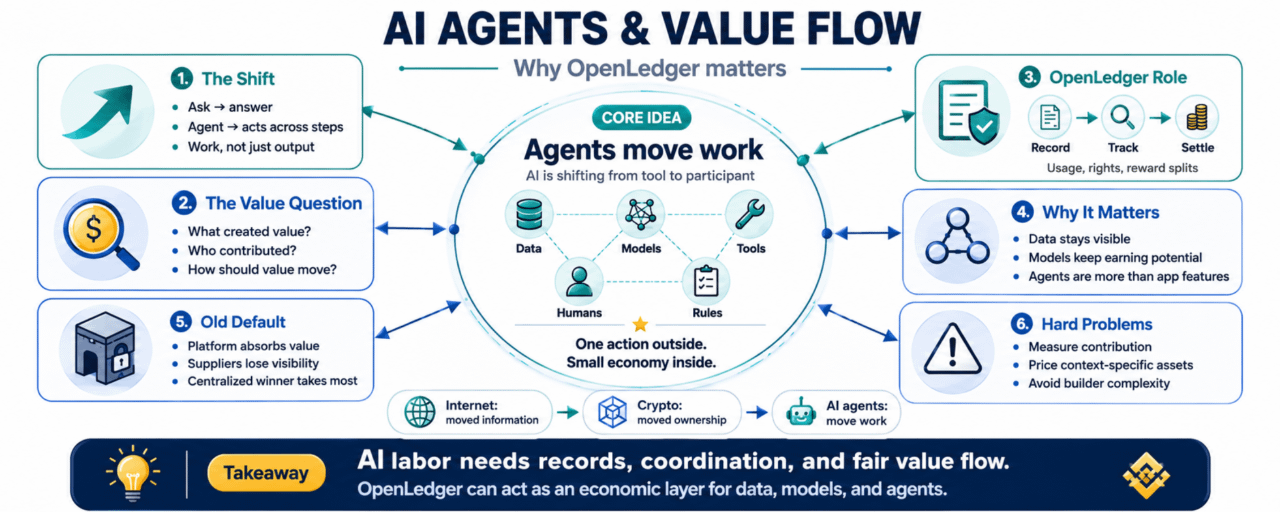
AI is slowly changing from something we use into something that participates.
إخلاء المسؤولية: تتضمن آراء أطراف خارجية. ليست نصيحةً مالية. يُمكن أن تحتوي على مُحتوى مُمول. اطلع على الشروط والأحكام.