
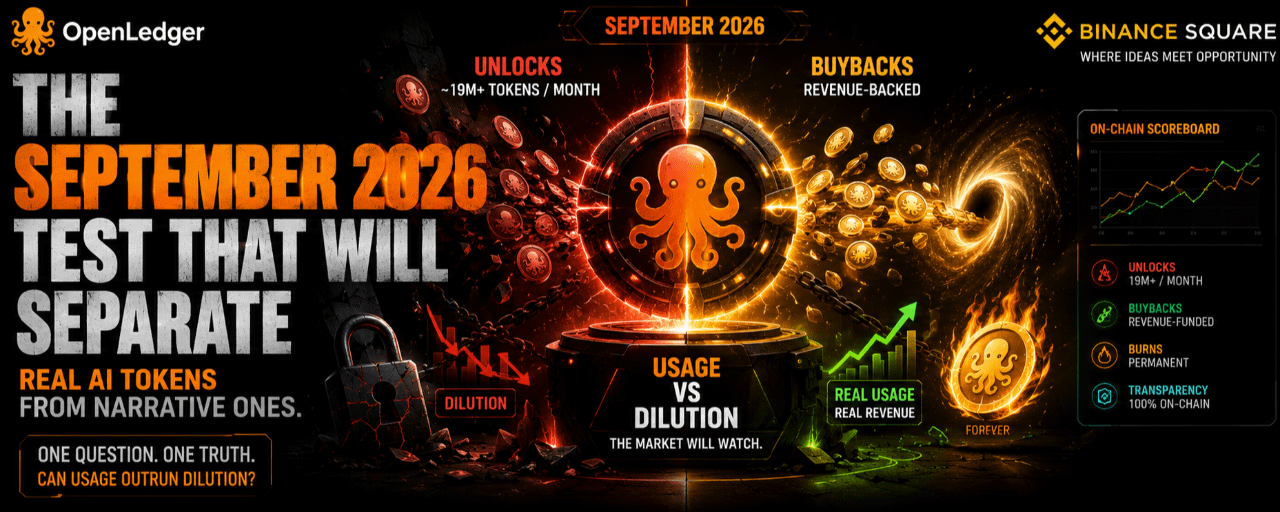
You keep watching unlocks and pretending they don’t matter.
But what happens when a project has both a major unlock cliff and active revenue-backed buybacks happening at the same time?
Most tokens either hide their dilution or have no real revenue to fight it. @OpenLedger is walking straight into both at once.
Starting September 2026, monthly unlocks are expected to ramp significantly — roughly 19 million tokens or more per month across schedules. At the exact same moment, the project continues executing revenue-funded buybacks that permanently burn tokens.
This isn’t background noise.
This is a live, on-chain experiment the entire market will be able to watch in real time.

The hidden problem almost nobody discusses is simple.
Most AI crypto projects treat unlocks as something to downplay and revenue as something to promise later. They launch with heavy emissions, run farming campaigns, then hope narrative carries them through dilution. When reality hits, there is no clear mechanism tying actual usage back to token supply.
You end up with tokens that dilute while usage stays theoretical.
Now imagine this instead.
Every month after September 2026, two forces move in opposite directions on the same chain:
A visible wave of new tokens entering circulation from unlocks
A visible stream of tokens being removed forever through revenue-backed burns
The market gets a transparent scoreboard.
If real AI service revenue, attribution usage, and enterprise activity grow fast enough, buybacks can absorb or exceed the dilution. If they don’t, the imbalance becomes impossible to ignore.
That public “Usage vs Dilution” tension is rare. Most projects never create conditions where both sides are this measurable at the same time. 🔥

OpenLedger’s setup forces a higher standard. $OPEN
Because buybacks are funded by actual corporate and enterprise revenue (not treasury speculation), the burns carry real weight. Because attribution is native, usage can be traced back to specific value creation. Because everything settles on-chain, the data is public.
This combination turns September 2026 into something most tokens will never face: a genuine stress test of whether the business model can outrun its own supply schedule.
Here is what makes this dynamic sharper than it first appears:
The unlocks are not abstract.
They represent real tokens that can hit the market. The buybacks are not marketing. They are tied to revenue that must actually be generated from AI services, data usage, and agent activity. When these two forces collide in full view, price discovery becomes brutally honest.
This is both a strength and a risk.
Strength: It aligns incentives at the highest level. Teams cannot rely on narrative alone. Real usage must show up in buyback volume. Contributors and holders get a direct signal of whether the ecosystem is monetizing faster than it is diluting.
Weakness: Visibility cuts both ways. If AI adoption or revenue ramps slower than expected, the market will see the gap clearly every month. There is nowhere to hide the imbalance. For a project that chose radical transparency through attribution, this unlock period becomes the ultimate proof point.
Most projects in this cycle still operate with one-sided mechanics.
They have unlocks or emissions.
They promise future utility.
They rarely run simultaneous, revenue-funded burns that the market can track against dilution in real time.
OpenLedger is different.
✅ Revenue-backed buybacks that permanently remove tokens from circulation
✅ Significant unlock cliff beginning September 2026 creating measurable dilution pressure
✅ On-chain transparency letting anyone track Usage vs Dilution month by month
✅ Native attribution linking real activity to potential revenue that funds burns
✅ Closed-loop utility where $OPEN pays for gas, services, and rewards while burns fight supply growth
✅ Public stress test that forces the market to price actual monetization velocity instead of narrative
This setup rewards projects that can generate real cash flow from AI infrastructure. It punishes those that cannot.
Retail will still focus on short-term unlock FUD or buyback headlines in isolation.
Smart money will watch the relationship between the two numbers over time. They will treat the post-September period as a live experiment: Can OpenLedger’s actual AI usage generate enough revenue to meaningfully counter its own dilution schedule?
That single question carries more weight than most token narratives being sold right now.
Because when the dust settles, the projects that survive won’t be the ones with the loudest stories. They will be the ones where usage visibly outpaced dilution on-chain.
September 2026 is not just another unlock date.
It is the moment OpenLedger either proves its model works under pressure… or shows everyone exactly where the gap still exists.
The market finally gets to watch in real time.
Which side of that equation are you betting will win? ⚡📊🧠
#OpenLedger
#IBITLiquidation$1.26B
#StrategyHintsNewBTCBuy
#TrendingTopic