
Every time I open X, I see the same conversation.
A new AI model.
A new benchmark.
A new company claiming to build the future.
And don't get me wrong—those things matter.
But lately I've found myself paying attention to something else.
The people behind the systems.
AI often feels magical when you use it. You type a question, and seconds later an answer appears. You generate an image, summarize a report, or automate a task that used to take hours.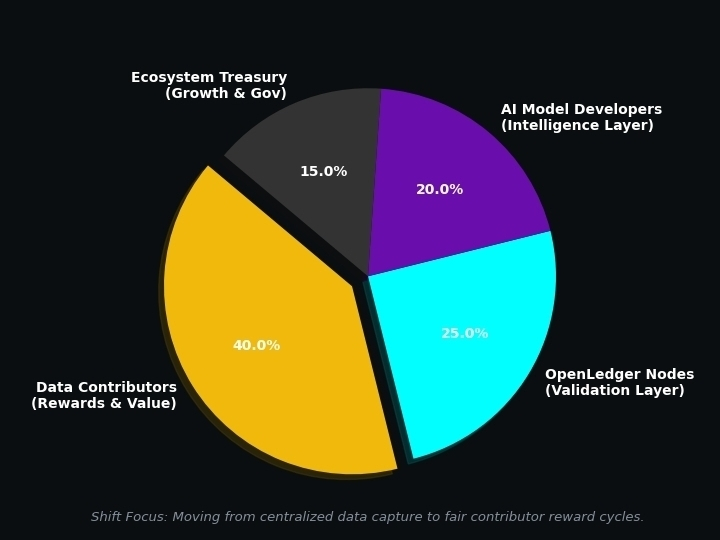
What we don't see is everything that happened before that moment.
The datasets.
The testing.
The feedback loops.
The contributors.
The countless hours spent improving performance.
None of that appears on the screen.
Yet without it, the technology wouldn't exist.
That's why I think one of the most important questions in AI isn't about how smart models become.
It's about how value is distributed.
As artificial intelligence grows, so does the value created around it. Companies benefit. Platforms benefit. Investors benefit.
But what happens to the people who helped build the foundation?
That question keeps bringing me back to projects like @OpenLedger.
Not because I think they have solved every problem.
Far from it.
What interests me is that they're exploring a different direction—one where contribution, attribution, and transparency become part of the conversation.
The idea sounds simple.
If people help create value, should that contribution be recognized?
In practice, it's probably much harder than it sounds.
Data moves through multiple layers.
Models learn from countless sources.
Outputs are influenced by information gathered over long periods of time.
Tracking contribution accurately is a challenge that may take years to solve.
Still, I think it's a challenge worth attempting.
Because AI is no longer just another software category.
It's becoming infrastructure.
Businesses depend on it.
Researchers depend on it.
Developers depend on it.
Students depend on it.
As that dependence grows, questions about ownership and incentives become more important.
Maybe that's the real story unfolding behind the AI boom.
Not just smarter systems.
But new economic systems.
Systems that determine who creates value, who captures it, and who benefits from it.
I don't pretend to know how all of this ends.
The industry is still young.
The technology is still evolving.
And many of today's assumptions will probably look different a few years from now.
But I do think we're moving toward a future where transparency matters more than ever.
And the projects exploring those questions today may end up playing a bigger role than people currently expect.
For now, I'm watching, learning, and staying curious.
Because sometimes the most important shifts happen quietly, long before the rest of the market notices them.
