
From a Radical Idea to a Global Financial Force
Few assets in modern history have sparked as much debate, excitement, skepticism, and curiosity as Bitcoin. What started as an obscure experiment created by an anonymous developer has evolved into one of the most closely watched financial assets in the world. Over the years, Bitcoin has gone from being dismissed as internet money to becoming a serious topic of discussion among investors, corporations, fund managers, and policymakers.
The journey has been anything but smooth. Bitcoin has survived brutal market crashes, regulatory pressure, exchange failures, and countless predictions of its demise. Yet every time critics declared the experiment over, Bitcoin found a way to recover and attract a new generation of believers. That resilience has become one of its defining characteristics and a major reason why it continues to dominate the cryptocurrency market.
The Origins of Bitcoin and the Vision Behind It
Bitcoin was introduced in 2009 by the mysterious creator known as Satoshi Nakamoto. The timing was significant because the world was still dealing with the fallout from the global financial crisis. Confidence in traditional banking systems had been shaken, and many people were beginning to question the way money was created and controlled.
Against that backdrop, Bitcoin offered something completely different. It introduced a decentralized financial system that did not rely on banks, governments, or financial intermediaries to operate. Instead, transactions would be verified by a distributed network of computers spread across the globe. The idea was simple yet revolutionary: create a form of money that belonged to everyone and was controlled by no single entity.
At the time, very few people understood the significance of what had been created. Looking back now, Bitcoin's launch can be seen as the beginning of a new chapter in the history of finance.
Why Bitcoin Continues to Stand Above Every Other Cryptocurrency
Thousands of cryptocurrencies have entered the market since Bitcoin was launched, each claiming to offer faster transactions, better technology, or more advanced features. Despite this competition, Bitcoin remains the benchmark against which every other digital asset is measured.
The reason is not simply that it was first. Bitcoin earned trust over time by proving that it could survive and operate under extreme conditions. Its network has processed transactions continuously for years, securing billions of dollars in value without relying on a central authority.
For many investors, Bitcoin represents certainty in a market filled with uncertainty. While newer projects come and go, Bitcoin continues to demonstrate the strength of its network, its security model, and its ability to attract long-term demand.
The Scarcity That Drives Its Value
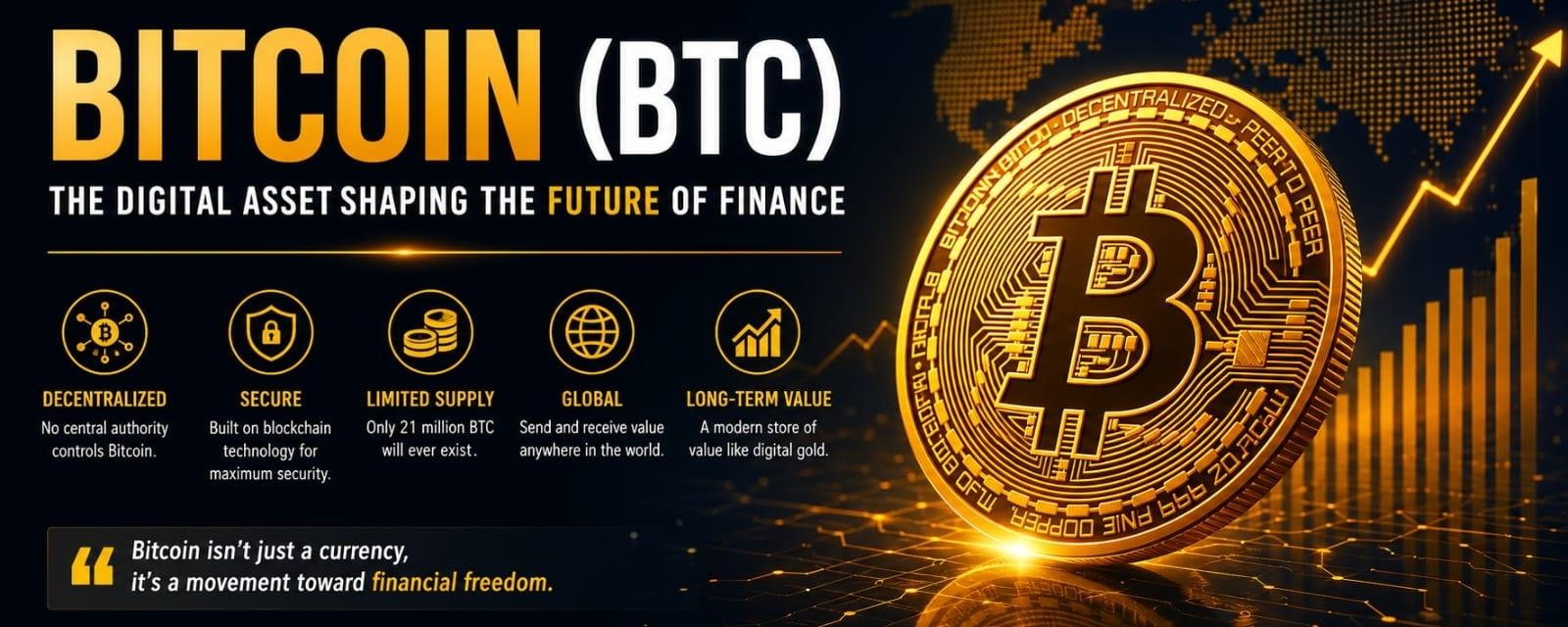
One of the most important aspects of Bitcoin is its limited supply. Unlike traditional currencies, which can be printed whenever central banks decide to increase the money supply, Bitcoin has a strict cap of 21 million coins.
This fixed supply has become one of the strongest pillars supporting Bitcoin's long-term investment thesis. Investors know exactly how many coins will ever exist, and no government, company, or institution can change that rule.
Scarcity has always played a major role in determining value. Precious metals such as gold have maintained their appeal partly because they are difficult to obtain. Bitcoin applies that same principle to the digital world by creating an asset whose supply cannot be expanded regardless of demand.
As more individuals and institutions seek exposure to Bitcoin, the limited supply becomes increasingly significant. This dynamic is one of the primary reasons many investors believe Bitcoin could continue appreciating over the long term.
Bitcoin's Evolution Into Digital Gold
Over the years, Bitcoin has earned the nickname "digital gold," and the comparison is not difficult to understand. Both assets are scarce, widely recognized, and viewed by many investors as stores of value.
However, Bitcoin offers advantages that traditional gold cannot match. It can be transferred across borders within minutes, stored digitally, and divided into extremely small units without losing value. These characteristics make Bitcoin uniquely suited for an increasingly digital global economy.
Supporters argue that Bitcoin combines the scarcity of gold with the efficiency of modern technology. This narrative has gained momentum as more investors look for alternatives to traditional financial assets during periods of economic uncertainty.
The Growing Interest From Institutional Investors
Bitcoin's reputation changed dramatically once large institutions began entering the market. For years, cryptocurrency was viewed as a niche industry dominated by retail traders and technology enthusiasts. Today, that perception has shifted considerably.
Major investment firms, publicly traded companies, asset managers, and financial institutions now recognize Bitcoin as a legitimate asset class. The launch of regulated investment products has further opened the door for institutional participation, making it easier for traditional investors to gain exposure.
Institutional adoption has provided Bitcoin with an additional layer of credibility. While volatility remains a concern, the involvement of large financial players has reinforced the idea that Bitcoin is no longer an experiment operating on the fringes of the financial system.
Understanding the Role of Bitcoin Mining
Bitcoin's security depends on a process known as mining. Miners use powerful computers to validate transactions and secure the network. In return for their work, they receive newly created Bitcoin as rewards.
Mining serves as the backbone of the Bitcoin ecosystem because it ensures that transactions remain accurate and resistant to manipulation. Without miners, the decentralized nature of Bitcoin would not be possible.
Over time, mining has grown into a global industry involving sophisticated infrastructure and substantial investment. As the network continues to expand, competition among miners has increased, further strengthening the security of the blockchain.
The Volatility That Continues to Define the Market
No discussion about Bitcoin would be complete without addressing volatility. Price swings remain one of the asset's most recognizable characteristics. Periods of explosive growth are often followed by sharp corrections that can test even the most experienced investors.
While critics view volatility as a weakness, supporters often see it as a natural part of Bitcoin's evolution. Emerging assets frequently experience significant price fluctuations as markets attempt to determine their long-term value.
Despite these dramatic movements, Bitcoin's long-term trajectory has consistently attracted attention from investors willing to tolerate short-term uncertainty in pursuit of long-term potential.
Challenges That Could Shape Bitcoin's Future
Although Bitcoin has achieved remarkable success, it still faces important challenges. Regulatory frameworks continue to evolve, and governments around the world remain divided on how digital assets should be integrated into the financial system.
Environmental concerns surrounding mining operations have also sparked debate, prompting the industry to explore cleaner and more sustainable energy solutions.
Additionally, Bitcoin must continue proving its utility and resilience as competition within the broader digital asset sector increases. While its leadership position remains strong, maintaining that position will require continued innovation and adoption.
Why Bitcoin Remains One of the Most Important Assets of the Digital Age
More than a decade after its creation, Bitcoin has grown far beyond its original purpose as a peer-to-peer digital currency. It has become a symbol of financial independence, technological innovation, and the growing demand for decentralized systems.
Whether viewed as digital gold, a hedge against monetary uncertainty, or simply a groundbreaking technological achievement, Bitcoin has already left a permanent mark on the global financial landscape.
The future remains uncertain, as it does with any transformative technology. However, one thing has become increasingly clear: Bitcoin is no longer a fringe experiment. It is a global asset that continues to influence conversations about money, value, and the future of finance.
Final Thoughts
Bitcoin's story is not just about price charts, market cycles, or investment returns. It is the story of an idea that challenged traditional assumptions about money and succeeded in capturing the attention of the world.
Its rise has reshaped financial markets, inspired an entire industry, and created opportunities that were unimaginable when the project first launched. Whether the next decade brings greater adoption, increased regulation, or entirely new use cases, Bitcoin has already secured its place as one of the most significant financial innovations of the modern era.