Binance’s recent program that rewards users with WLFI tokens for holding USD1 has sparked widespread discussion.

Many are asking why a relatively new stablecoin like USD1 is being promoted, while USDT—the largest stablecoin in the market—receives no such incentive.
To answer this, it is crucial to understand that although both USDT and USD1 are pegged to 1 USD, they represent two fundamentally different concepts within crypto architecture.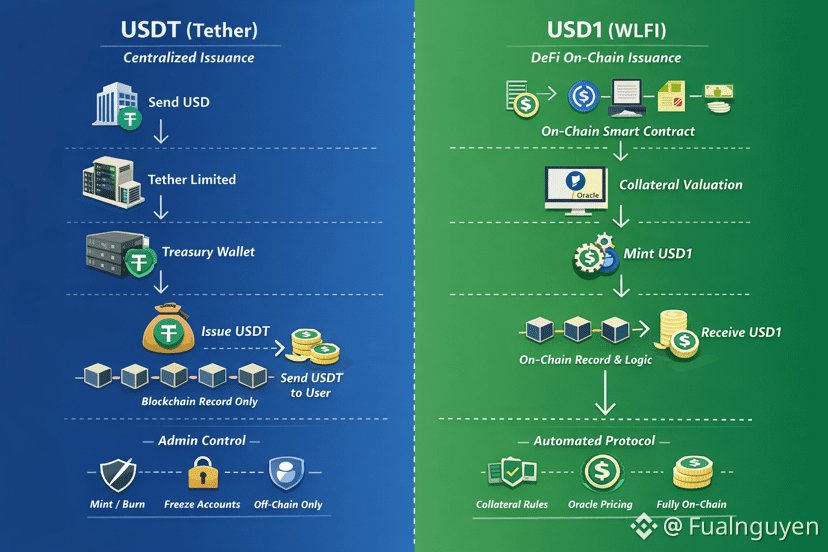
One functions purely as money, while the other is part of a broader on-chain financial system.
USDT, issued by Tether, follows a centralized issuance model in which minting and burning occur off-chain and are fully controlled by the company.
In this setup, the blockchain merely records transactions and does not participate in issuance logic or risk management. As a result, USDT is essentially a digitized version of the US dollar, optimized for liquidity, trading, and fast capital movement within CeFi.
USD1, by contrast, is designed with a DeFi-first mindset.
It is minted directly on-chain through smart contracts, based on collateral and transparent, pre-programmed rules. This design means USD1 is not just a stable medium of exchange, but the output of an on-chain financial system.
Technically, USD1 is still an ERC-20 stablecoin token, but it does not represent ownership or growth potential.
It is not used for governance, not intended for speculation, and its value lies solely in price stability and liquidity provision.
In other words, USD1 is the bloodstream of the system, not the place where economic value accumulates.
That value is captured by the WLFI token.
WLFI is the governance token of the World Liberty Financial ecosystem and is responsible for defining how USD1 operates.
WLFI holders can vote on key parameters such as accepted collateral types, collateralization ratios, and system risk limits. WLFI also serves as a backstop in stress scenarios, playing a role similar to MKR in the DAI model.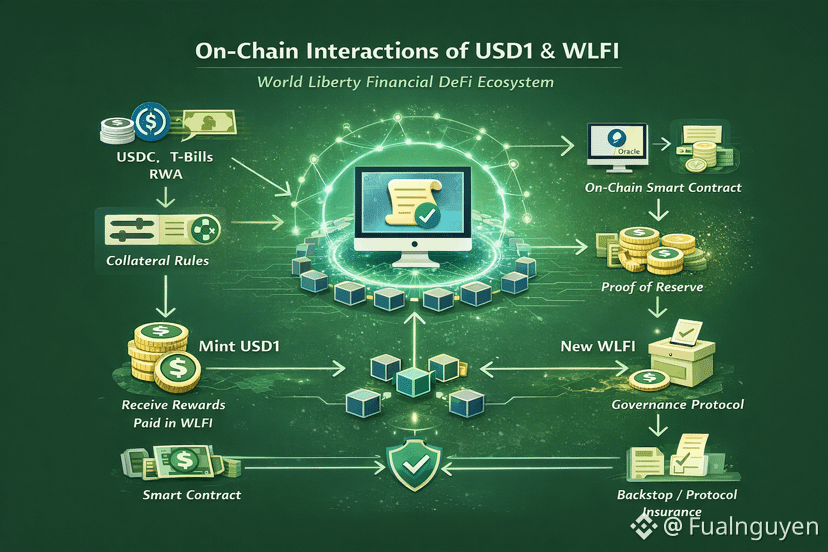
For this reason, USD1 and WLFI are complementary but not interchangeable.USD1 expands liquidity, while WLFI captures the upside of system growth.
Binance’s decision to reward WLFI to USD1 holders is a mechanism to bootstrap liquidity while distributing ownership and governance power.
Understanding this distinction helps investors clearly separate holding stablecoins for capital preservation from holding governance tokens as a bet on protocol growth.
As new liquidity cycles emerge, the difference between “money” and “systems” will become increasingly important.