In a financial world that is rapidly moving on chain, the biggest challenge is no longer whether blockchain works, but whether it can fit within real regulatory and institutional boundaries. Public blockchains have proven their ability to transfer value and execute smart contracts, yet they remain poorly suited for regulated finance. Complete transparency conflicts with data confidentiality, and rigid decentralization often ignores compliance requirements that financial institutions cannot avoid. This growing mismatch has slowed meaningful adoption across capital markets, asset tokenization, and compliant decentralized finance. Founded in 2018, Dusk was created to solve this problem by building a Layer 1 blockchain specifically designed for regulated, privacy focused financial infrastructure, where confidentiality and auditability coexist rather than compete.
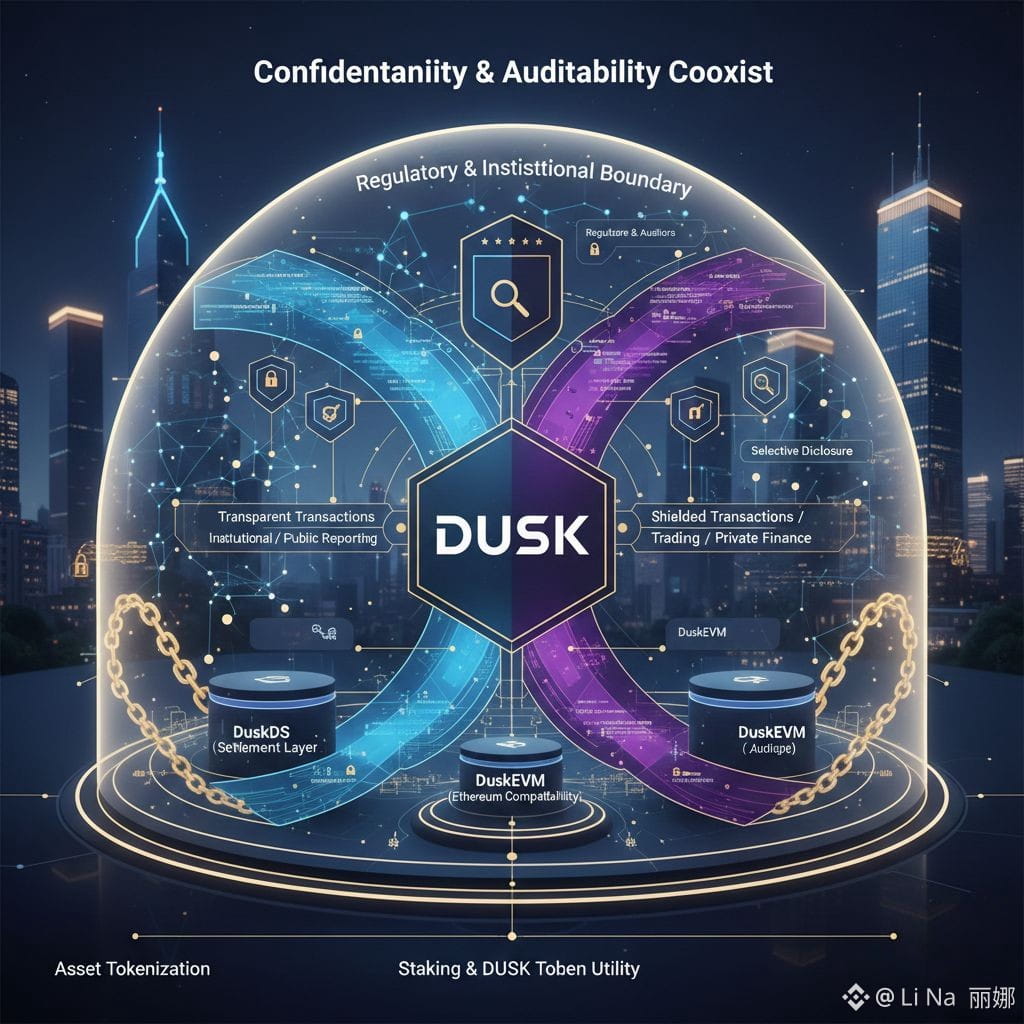
At the heart of Dusk lies a simple but powerful idea. Financial transactions should be private by default but verifiable when legally required. In traditional markets, sensitive information such as trading positions, balances, and settlement data is not broadcast publicly, yet regulators and auditors retain access. Dusk mirrors this structure at the protocol level through a modular blockchain architecture that separates settlement, execution, and privacy. The settlement layer, known as DuskDS, handles consensus, finality, and data integrity. It is optimized for fast and deterministic settlement, an essential requirement for financial instruments that demand certainty and precise timing.
Built on top of this foundation are multiple execution environments that allow developers and institutions to choose the level of privacy and programmability best suited to their applications. DuskEVM brings full Ethereum Virtual Machine compatibility, enabling developers to deploy existing smart contracts using familiar tooling while inheriting Dusk’s privacy preserving settlement layer. This reduces friction for adoption and supports interoperability with the broader blockchain ecosystem. Alongside this, DuskVM is designed for applications that require stronger confidentiality. It enables smart contracts that leverage zero knowledge cryptography, allowing transaction logic and sensitive data to remain hidden while still producing verifiable outcomes. Together, these environments create a flexible framework capable of supporting both transparent and confidential financial workflows.
One of Dusk’s most defining features is its support for both transparent and shielded transactions within the same network. Transparent transactions are available for use cases where visibility is appropriate, such as public reporting or non sensitive data flows. Shielded transactions protect transaction amounts, balances, and participants, making them suitable for institutional trading, asset issuance, and proprietary financial activity. Crucially, privacy on Dusk does not come at the expense of accountability. The protocol enables selective disclosure, allowing authorized parties such as regulators or auditors to access required information without exposing it to the public. This balance between confidentiality and compliance remains one of Dusk’s strongest differentiators in the blockchain landscape.
Development progress across the Dusk ecosystem reflects a steady focus on usability and real world readiness rather than speculative momentum. The launch of the DayBreak testnet opened the network to public participation, allowing developers, validators, and partners to interact with the core infrastructure. The rollout of the DuskEVM testnet further expanded developer access, enabling smart contract deployment and cross environment token functionality. These milestones indicate that the project is moving toward practical deployment while actively refining the developer and user experience. In parallel, Dusk has positioned itself within broader privacy and compliance focused initiatives, reinforcing its intention to align with evolving regulatory standards rather than operate outside them.
The DUSK token underpins the network’s economic and security model. It is used for transaction fees, smart contract execution, and staking within the proof of stake consensus mechanism. Validators stake DUSK to participate in securing the network and are rewarded for honest behavior, creating a direct alignment between network security and long term participation. The token’s utility is closely tied to actual network usage, which supports economic sustainability and reduces dependence on speculative demand. For institutional users, this predictable and purpose driven economic design is particularly important, as it mirrors the incentive structures found in established financial systems.
When compared with existing blockchain alternatives, Dusk occupies a distinct position that few networks effectively address. General purpose blockchains offer openness and composability but lack native privacy and regulatory alignment. As a result, compliant applications often require complex external solutions that add cost and risk. Privacy focused blockchains, while strong in confidentiality, typically struggle with auditability and institutional trust. Dusk bridges these two extremes by embedding compliance friendly privacy directly into the protocol, making it suitable for financial markets that operate under legal and supervisory oversight.
The real world implications of Dusk’s design extend across capital markets, decentralized finance, and asset tokenization. Institutions can issue and manage tokenized securities on chain, reducing operational complexity while maintaining regulatory control. Compliant DeFi applications can be built with enforced rules around participant access and data visibility. Digital representations of real world assets and stable value instruments can operate with privacy protections that mirror traditional finance while benefiting from blockchain efficiency. Scalability is supported through the network’s layered architecture, while security is reinforced through cryptographic proofs and validator incentives, creating an environment suitable for institutional scale usage.
Looking forward, Dusk’s long term potential lies in its ability to serve as a bridge between traditional financial infrastructure and decentralized systems. As regulations around digital assets continue to mature and institutions seek compliant blockchain solutions, platforms designed from the ground up for privacy, auditability, and regulatory alignment are likely to play a central role. Rather than chasing short term trends, Dusk focuses on solving structural problems in financial infrastructure. By combining technical rigor with a pragmatic understanding of institutional finance, it positions itself as a credible foundation for the next generation of regulated on chain markets.