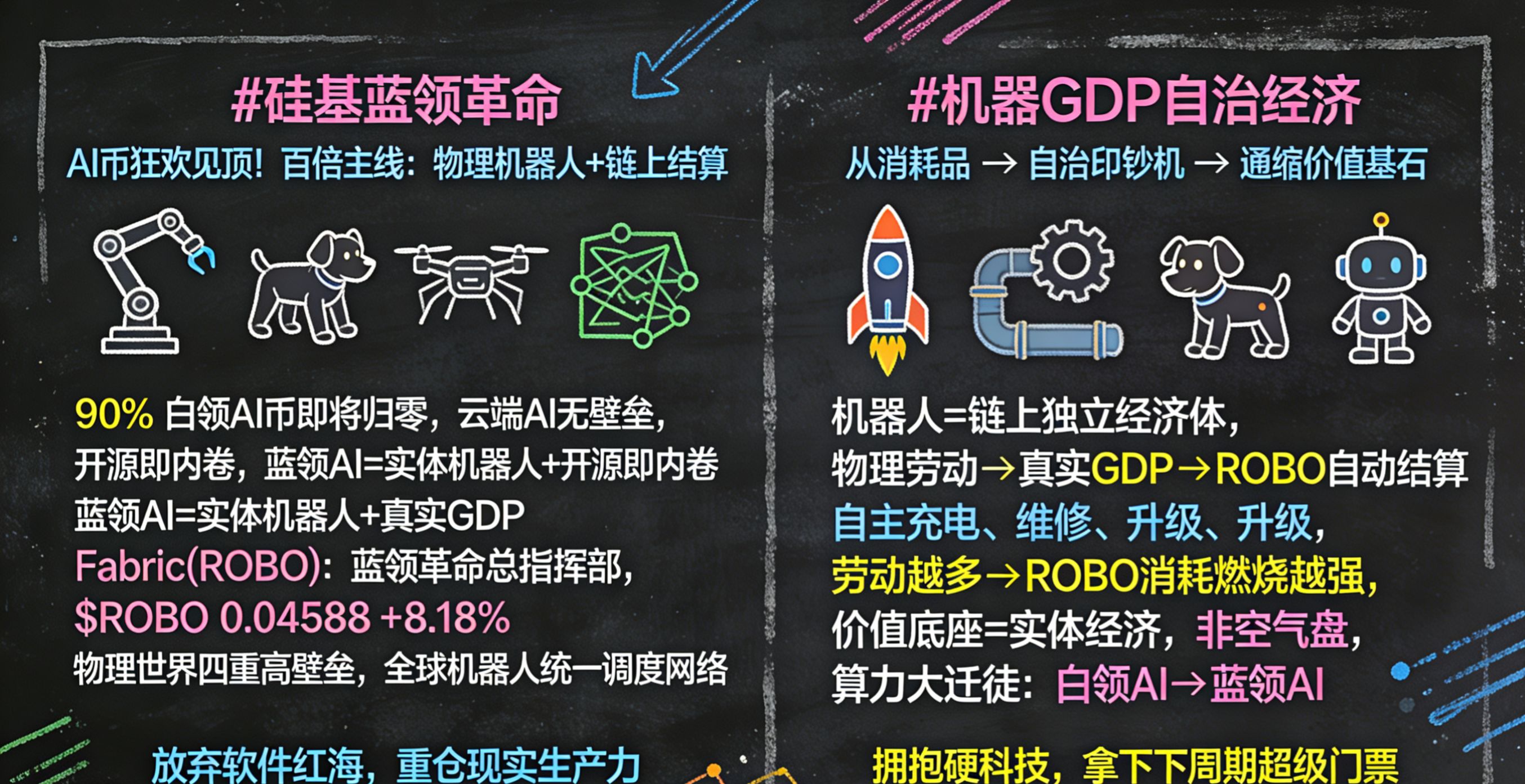
AI concepts are everywhere, 90% of AI coins are heading towards zero.
Don't be fooled by cloud-based large models anymore—white-collar AI that writes copy, creates images, and makes PPTs is open-source and over-saturated, with no barriers to speak of. When big companies step in, small projects go straight to zero; this is the harsh reality of the virtual world.
The next round of wealth transfer is not on the screen, but in the steel and gears of the real world.
Only blue-collar AI (physical robots) that can replace heavy physical labor, create real GDP, and have extremely high engineering barriers is worth a hundred thousand.
1. Dimensionality reduction in the field: white-collar AI is a red ocean, blue-collar AI is a no-man's land.
Making a chat AI is very simple; anyone can copy it.
But having a mechanical dog carry 50 pounds of cement on a rainy construction site, automatically avoid obstacles, and work stably is supported by the quadruple barriers of hardware, algorithms, data, and scenarios.
Fabric directly abandons the software red sea and heavily invests in the physical world.
It provides a unified underlying scheduling network + on-chain collaboration system for global logistics drones, cleaning robots, warehouse robotic arms, and industrial automation equipment.
While others are coding, it rolls up the productivity of the real world.
2. Economic revolution: from depreciable consumables to autonomous money printers.
Traditional machines: depreciate upon purchase and become older with use.
Fabric machines: possess on-chain accounts + independent economic identities, transforming into autonomous economic entities.
Every time a robot completes a transport, inspection, or sorting task, it is creating real physical GDP.
Smart contracts automatically settle labor earnings using $ROBO , allowing robots to pay for their own electricity, maintenance, and upgrades.
This is not automation; this is the rise of machine civilization.
What you create is not a tool, but an on-chain laborer that can make money, survive, and evolve on its own.
3. The cornerstone of deflation: supporting token value with real demand.
White-collar AI is replaceable, but physical necessities are irreplaceable.
Logistics, manufacturing, sanitation, inspection, warehousing... as long as human society operates, robots must work.
Every task, every settlement, every scheduling will produce a consumption and burn of $ROBO .
Its value base is the continuous operation of the real economy, not a bubble, not a fund scheme, and not a financial game of stepping on one foot with the other.
The more aggressively the robots work, the more on-chain settlements occur, and the stronger the demand becomes.
This is the hardest value support for Web3.
4. Conclusion of the era: The great migration of computing power has already begun.
When automated trucks run through the streets, when factories become unmanned, when robots become the main force in society.
That invisible control network, settlement network, and collaboration network is Fabric.
Stop playing virtual games that create data out of thin air.
Embrace the hard tech infrastructure that changes the real world.
Understanding the paradigm shift from white-collar AI to blue-collar AI.
You just got the super ticket for the next cycle.@Fabric Foundation