In the current context of accelerating global macroeconomic restructuring, the supply chain systems of large multinational enterprises are undergoing an unprecedented digital migration. Supply Chain Finance, a massive sector worth trillions of dollars, has long been choked by 'information silos' and 'trust erosion.' Small and medium-sized suppliers often face severe liquidity crises because they cannot prove the authenticity of their accounts receivable to core enterprises or multinational banks.
In the past few years, countless blockchain projects have attempted to enter this sector, trying to solve the trust issues in the supply chain with 'distributed ledgers.' But the reality is extremely harsh: the vast majority of Fortune 500 companies fundamentally refuse to put core business data on the blockchain. The reason is incredibly simple and cold-blooded: trade secrets. In the highly competitive global trade, a multinational manufacturing giant's supplier list, procurement price floor, and capital flow cycle are its highest-level trade secrets for survival. Exposing these underlying business data nakedly on public ledgers for global competitors to scrutinize, in pursuit of so-called 'decentralized trust,' is tantamount to commercial suicide.
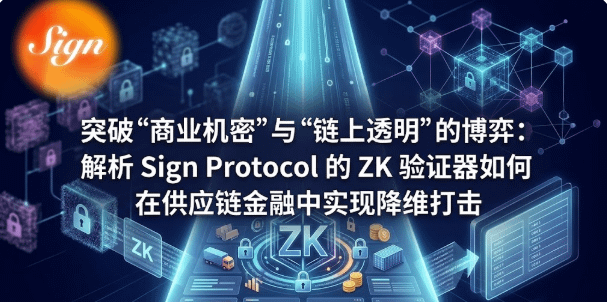
This is the 'impossible triangle' that has long plagued large-scale enterprise Web3 commercial applications: achieving decentralized mutual trust across institutions, meeting financial compliance audit requirements, and ensuring absolute privacy of core business data. After deeply analyzing the developer documentation of @SignOfficial , I discovered a remarkably shocking engineering breakthrough hidden in its underlying architecture — deeply integrating ZK (zero-knowledge proof) technology into a dynamically programmable Hooks mechanism. This technological innovation provides a nearly perfect solution for global supply chain finance.
Let's conduct a geek-level enterprise application simulation:
Assuming a precision instrument manufacturer located in Asia holds a huge accounts receivable from a core automotive giant in Europe and urgently needs low-cost financing through global decentralized liquidity pools (DeFi). However, this automotive giant strictly prohibits its suppliers from disclosing procurement contracts and unit price information.
Under the full-chain proof framework of Sign Protocol, this Asian manufacturer can perform complex mathematical calculations on a large and sensitive batch of commercial invoices, logistics bills of lading, and procurement contracts in a locally secure server environment using ZK circuits. The core of this process lies in extracting and proving that this data meets the compliance requirements necessary for financing (for example: invoices are authentic and valid, not pledged multiple times, and meet specific commercial credit scoring standards), but absolutely does not disclose the specific amount of the invoice, detailed names of both parties, or categories of procurement.
Subsequently, this extremely streamlined ZK proof (ZK Proof) is packaged and submitted to the Sign chain network, triggering the preset Hooks function. The smart contracts on the chain only require a minimal amount of computation to instantly verify the validity of this mathematical proof. Once verified, the network will directly generate a global state confirmation representing that 'the entity possesses high-quality compliant accounts receivable.' Global funding sources (such as decentralized lending protocols or multinational credit funds) can directly provide loans upon seeing this valid state endorsed by the Sign protocol.
Business data stays within the high walls of the enterprise, while credit certificates and value settlements circulate frictionlessly on the public chain. This enterprise-level data isolation firewall built using ZK verifiers has completely shattered traditional enterprises' fears of blockchain transparency. It not only complies with the world's top commercial confidentiality standards but also perfectly aligns with large institutions' ultimate pursuit of asset risk control.
As the Sign Protocol gradually becomes the default 'trust gateway' between multinational supply chains with this solution, its token economics flywheel will demonstrate extremely terrifying explosive power. To ensure the secure operation and high-frequency invocation of this ZK proof network, large financial institutions and multinational core enterprises involved must stake an extremely large amount of $SIGN tokens as consensus validators. This passive locking driven by the real-world B2B business operation is the ultimate chassis to resist all market cycle fluctuations.