
Good evening, brothers. A few days ago, I went to the used car market with my good buddy to buy a car. The seller was a stranger who insisted that my buddy prove his ability to pay in full first. My buddy couldn't just show him the bank statement for fear of privacy leakage. The traditional method is to print the reconciliation statement + handwritten declaration, and the other party still has to verify it at the bank. It took two days, and we couldn't finalize the deal.
In the end, my buddy had no choice but to run to the notary office and spent two hours obtaining a fund capability certificate with an official seal. The seller took a glance at the official stamp and felt at ease right away. The transaction was completed on the day of the deal.

Isn't the stamp from the notary office just the SIGN's Attestation? What Sign does, to put it simply, is to stamp it on the blockchain for you. Who you are and whether you have the qualifications for this information to be packaged into a blockchain proof can be verified by anyone, and no one can change it. You don't need to expose all your private data, just a yes or no conclusion is needed.
This is exactly the same logic as a notary office; it just replaces the stamped seal with an on-chain signature, replaces paper documents with on-chain records, and replaces regional restrictions with global traceability. I didn't expect to realize this while buying a car, but that's indeed the case.

The SIGN project is not just a protocol; it is actually a combination of three layers. The underlying layer is the Sign Protocol, which is specifically designed to generate and verify Attestation and currently supports over 30 chains, with on-chain Attestation exceeding 20 million. The middle layer is EthSign, a practical application of the signing protocol that allows signatures to be recorded on-chain, with black and white text etched on the chain, so no one can deny it. The top layer is TokenTable, specifically addressing the issue of token issuance, which is the most commercially mature part of the entire SIGN Stack.
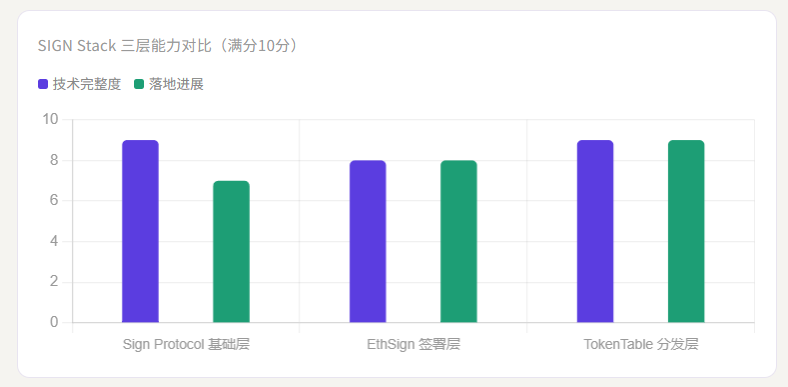
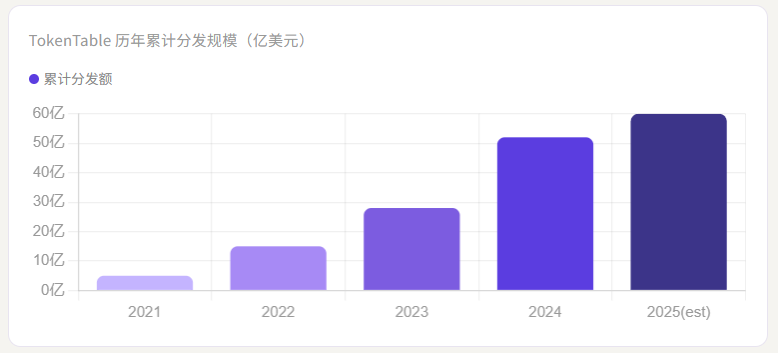
This is where I think SIGN is more pragmatic than many infrastructure projects. Most protocol layer projects talk about the future where people will use them. TokenTable is already charging fees. For every Token unlock and every Vesting plan execution, the platform takes a certain percentage as a service fee. The distribution volume of $6 billion is backed by actual business revenue that has occurred, not just predictions on paper. This has given the project a certain level of resilience even in a bear market, at least it's not completely reliant on financing for survival.
The recent OBI plan is an on-chain basic income experiment that SIGN is conducting, meaning that real users are identified through Attestation, and token rewards are continuously distributed to them. Currently, over 100,000 users are participating, and I also joined in. The experience has been quite smooth. The support for sovereign entities to deploy their own Attestation nodes with their own rules for issuing proofs is even more surprising to me, but this proof can still be verified by a global network. There is a lot of potential for on-chain KYC, degree verification, and cross-border compliance, but the difficulty of implementation is also very high. In the short term, I remain cautious.

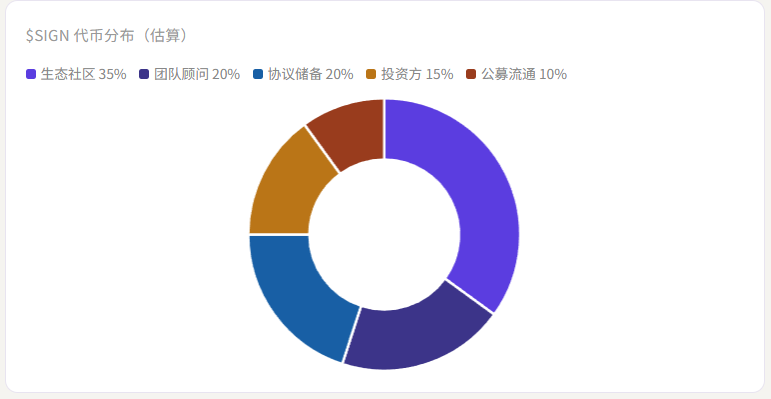
This cannot just be said to be good. I researched the unlocking rhythm of the SIGN token, and I even made a pie chart. In this structure, the public offering circulation only accounts for 10%, meaning that the majority is actually in the hands of various institutions. The ecosystem and community portion accounts for 35%, which is the most likely source of ongoing selling pressure. The team and advisors hold 20%, and investors hold 15%. Both of these areas will be variables once the lock-up period ends.
Another pressure point is competition. It's not just SIGN that is working on on-chain identity and Attestation; other similar protocols are also in the race. What is SIGN's moat? I believe the most solid answers at present are the actual revenue and user stickiness of TokenTable, followed by the breadth of multi-chain coverage. These two points truly exist and are not just empty promises.
I can't give you a conclusion on whether to buy or not; that's not something my research article should say, nor am I confident enough to say it. My own judgment is that the three-layer logic of the SIGN Stack is coherent, and the revenue of TokenTable proves that the business model is effective. The direction of Attestation is likely to be important infrastructure in the long term.
Just like buying that used car, a notarized certificate can only prove that my buddy has money; whether the car itself is good or not, I still have to verify myself. On-chain proof can tell you what a project has done, but whether it's worth it, you still have to judge for yourself.