

Years ago, I really learned a lesson. The company negotiated a major collaboration, and the other party's executives had resumes as impressive as a textbook, with overseas prestigious schools and top investment banks. We conducted background checks for three months and couldn't find any flaws. What happened? Three months later, they nearly wiped out our core client's orders. It was only through connections that we found out that all that glamorous stuff was fake, from degrees to transactions, completely custom-made. During that time, I wasn't feeling well; it wasn't about the money, but the suffocating feeling of having someone tear apart the bottom line of your trust right in front of you. After that, I started to stubbornly focus on foundational credibility agreements. That's when I entered the realm of m-12. Many people think it's just an on-chain notarization tool, but I believe it's doing something much tougher. It uses cryptography to confront the human impulse of 'I bet you can't figure it out.'
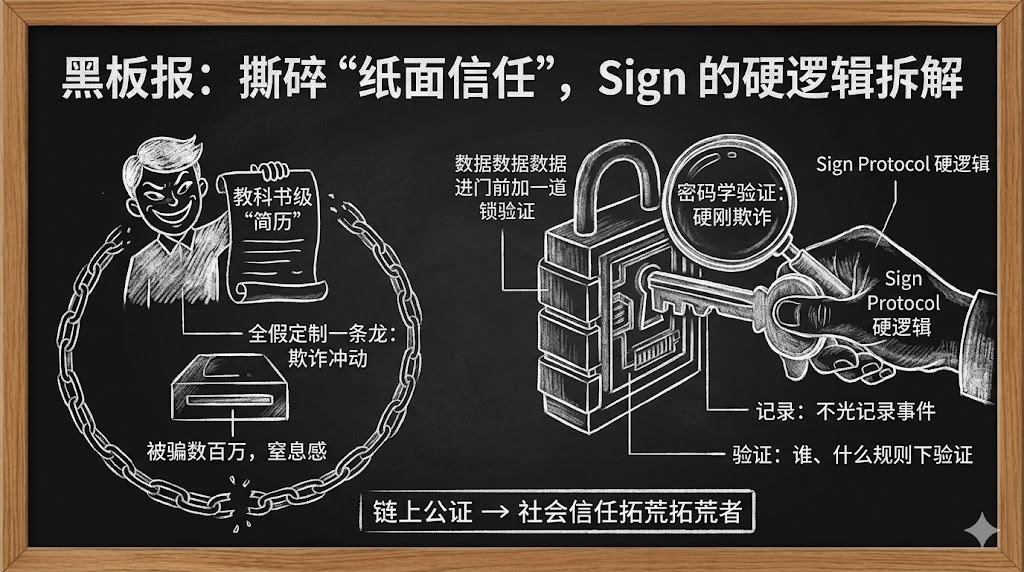
Let me pour some cold water on this. There’s a common misconception in the blockchain space: once data is on-chain, it automatically becomes an indisputable truth. This is absurdly wrong. No matter how perfect the Ethereum Virtual Machine is, it only faithfully executes the logic you write down, even if that is a scam. It can guarantee that “data has not been tampered with,” but it cannot guarantee that it was true at the time of entry. We have essentially built a solid vault, but it might be filled with fake materials. What Sign wants to do is add a layer of verification before the data comes in, not just record events, but also lock in “who verified this event and under what rules” on the chain.
But if you really look into it, it is still far from perfect. The schema for that authentication model gives too much freedom. Anyone can define their own verification standards; technologically, it is quite decentralized, but in reality, it is likely to become chaotic. For instance, in the future, if you have an on-chain proof under protocol A, and I have one under protocol B, the employer would first need to set up a translator to understand it. Without underlying consensus, this kind of freedom ultimately results in a bunch of isolated islands that cannot communicate.
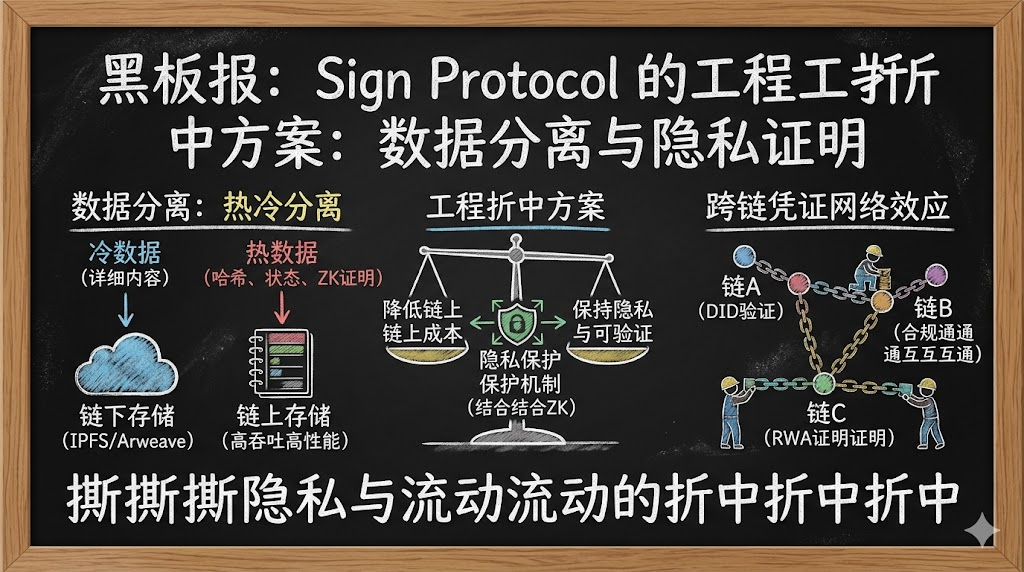
ZK zero-knowledge proofs sound very appealing; they can prove that you meet certain conditions without revealing your bank card password. However, in practical tests, the performance overhead of generating complex proofs can cause anxiety when running on a mobile device. To speed things up, you might have to outsource part of the process, which leads back to trusting others. This is an unavoidable real-world problem. There's also a risk I call the “null pointer.” It only stores hash fingerprints on-chain, while the original data is kept off-chain (IPFS or Arweave). If one day the off-chain data is lost, the on-chain proof becomes an empty shell. Sign has implemented multiple copies, tiered storage, and node constraints to mitigate this, but as long as it follows the path of hybrid storage, this issue will always linger.
I have recently focused on testing its cross-chain credential interoperability and have run quite a few scenarios. The official claims support for multiple chains and fast verification, but my tests showed that different chain combinations still have fluctuations in latency, success rates, and stability. Some chains do not support a complete closed loop as smoothly as advertised, the decentralization level of the relay mechanism also needs improvement, and there is room for refining security protections in certain edge cases. These are all growing pains that early projects should experience.
On the storage level, Sign's approach is to separate raw data from proofs: cold data (detailed content) is stored off-chain and structured, while hot data (hashes, states, conclusion proofs) is stored on-chain, in conjunction with ZK to address privacy scenarios. This is an engineering compromise that can significantly reduce on-chain costs while maintaining verifiability and a certain level of privacy protection. It standardizes structure, ensures cross-chain compatibility, and connects several key points for data traceability, making it suitable for large-scale applications like on-chain credit and identity.
So to summarize, $SIGN is not a savior; it is merely a pioneer carving a path in a mess. It aims to bite into the hard bone of trust with code, making compromises and trade-offs at every step. I will continue to keep an eye on it because compared to pure hype, this relentless focus on “social trust costs” is worth the time. Right now, I only look at hard metrics: whether cross-chain latency and success rates are stable, whether the available chain coverage is substantial, whether the security mechanisms can withstand blows, and whether decentralization has taken root. If these numbers continue to rise, then today’s shortcomings will be stepping stones for its growth. Conversely, it is just another passerby in the Web3 trust experiment. I neither hype it nor downplay it; I only trust in data and time. Whether Sign can ultimately succeed hinges on one thing—can it help us uphold that unforgiving bottom line of trust in the real world? (This article is a platform task and does not constitute any investment advice.) #Sign地缘政治基建