
Looking a bit positioned$SIGN , I stayed up late last night going through white papers and forums, trying to dig up some solid information to convince myself to hold on. I found that the whole internet is praising its full-chain proof as 'invincible', yet no one has delved into the true mastermind behind the scenes: the Schema (data architecture) management mechanism.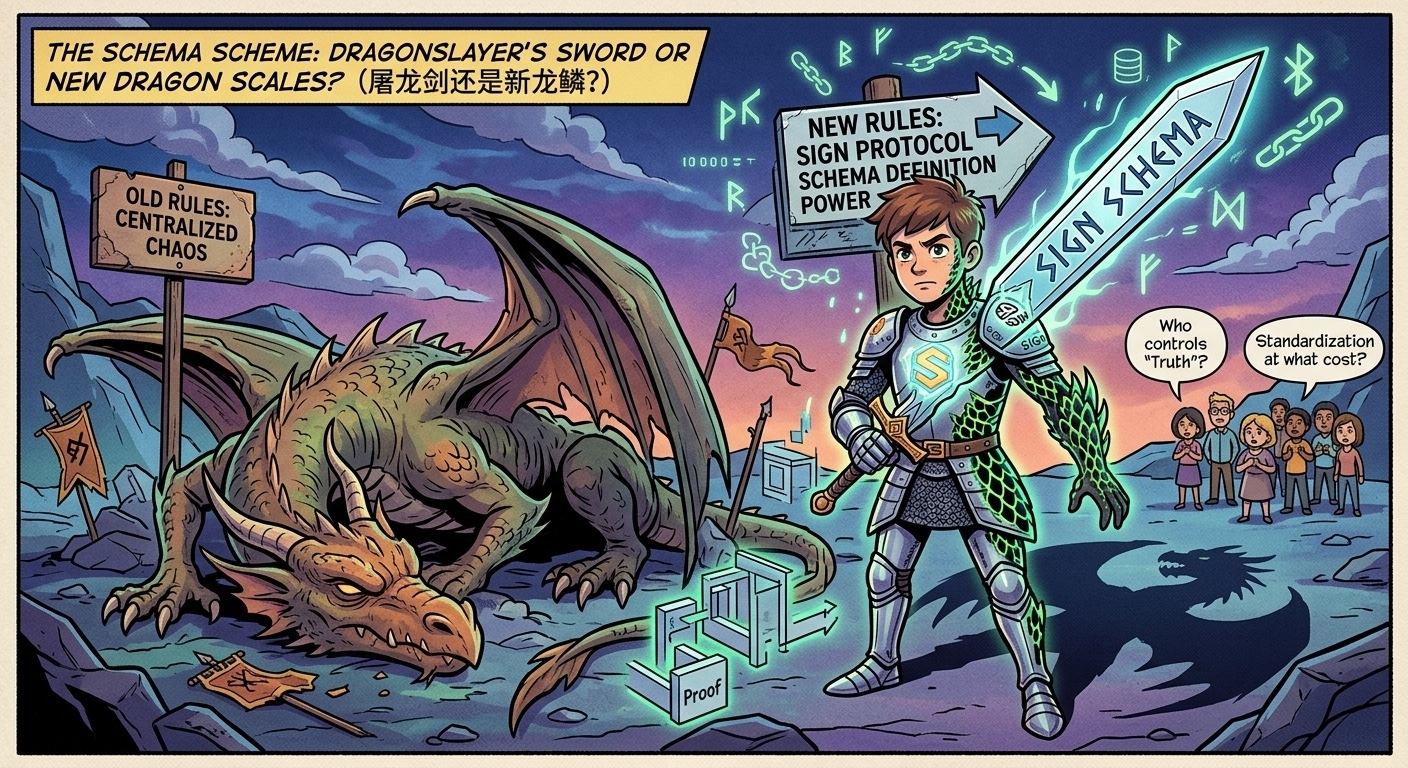
This thing sounds just like a cold, hard code vibe; I almost skimmed past it at first glance. But I gritted my teeth and got through it, because I suddenly realized that this is the real key to the Sign project that can choke everyone by the neck.
I have to talk about my own old stories to clarify. Many years ago, when I just started working at an internet company, HR held an 'Employee of the Year' selection. The criteria? All determined by the department head themselves. Today, 'overtime hours' is the core metric, and tomorrow it changes to 'customer feedback score'. In the end, who can win the award? It's always those few who play basketball with the boss on weekends. A word from the rule-maker can directly turn others' hard work into waste paper. At that moment, I completely understood: the power to define the rules is much more ruthless than the power to work by the rules every day.
The current Web3 is just as chaotic as that broken selection scene back in the day, no one cares about the standards. The ambition of Sign Protocol's Schema is to be the 'rule maker.' It allows any project team or developer to throw a proof template onto the chain. For example, a GameFi team can define a Schema for a 'qualified competitive player' that has strict requirements: there must be a battle record on a specific chain, it must be bound to a specific wallet address, and it must pass their internal whitelist. Once this template goes live, all proofs regarding 'player qualifications' across the network must obediently follow this format; otherwise, they will not be recognized.
From this perspective, I have to give a thumbs up to @SignOfficial . It is indeed laying tracks in the muddy swamp of Web3. With a unified Schema, different protocols can finally understand each other's proofs, and cross-chain credit can truly flow. This kind of friction reduction and enhancement of interoperability is indeed a contribution at the infrastructure level.
But as a seasoned veteran who has been cut by various 'standards' multiple times, I must make it clear: who will oversee these Schema creators? Will this concentration of 'definitional power' directly turn into a new power monopoly?
Sign Protocol claims to be decentralized, but the birthright of the Schema is basically controlled by a few project teams and developers. It's like the highway of the entire Web3 has been built, but it’s still those few initial mapmakers who decide which road is the 'main road' and what the speed limits are.
Think about it: if Sign really becomes the underlying base of on-chain credit, a top lending protocol suddenly defines a 'high-quality collateral' Schema that secretly includes a clause saying 'must have had over 1000U historical transactions in our associated sub-protocol.' Even if ordinary retail investors have solid collateral and clean credit, as long as they haven't 'paid tuition' in their system, they won't get this proof, and the lending door will be closed to them. Isn’t this just rent-seeking and class locking dressed in code?
What’s more fatal is that once the Schema is widely adopted, making changes is almost impossible. What if there’s a small bug buried in the initial template, or if the market environment changes and the rules become outdated? The full-chain data has already spread like a virus; should we grit our teeth and let the mistakes continue, or should we implement a full network 'Schema upgrade' that throws everyone into chaos? The rigidity of the code is gradually grinding away the flexibility that human society should have.
So now when I look at Sign Protocol, it feels like watching a dragon-slaying youth wielding the 'Schema' blade. I admit this blade can pierce through various false proofs on the chain, but what I fear more is that after defeating the old dragon, the youth quietly grows new dragon scales in their hands because they hold the ultimate power to define 'what is true.'
In this market worth 76000, everyone is frantically searching for a reliable narrative. Sign has given us a 'truth template', but we must always keep our eyes peeled: whose truth is this template really serving? #Sign地缘政治基建
Don’t let the halo of impressive technology fry your brain; pay more attention to how power flows quietly within these seemingly neutral mechanisms. In this circle, protecting the principal is fundamental, but safeguarding that little flame of independent judgment is the essence of survival.