
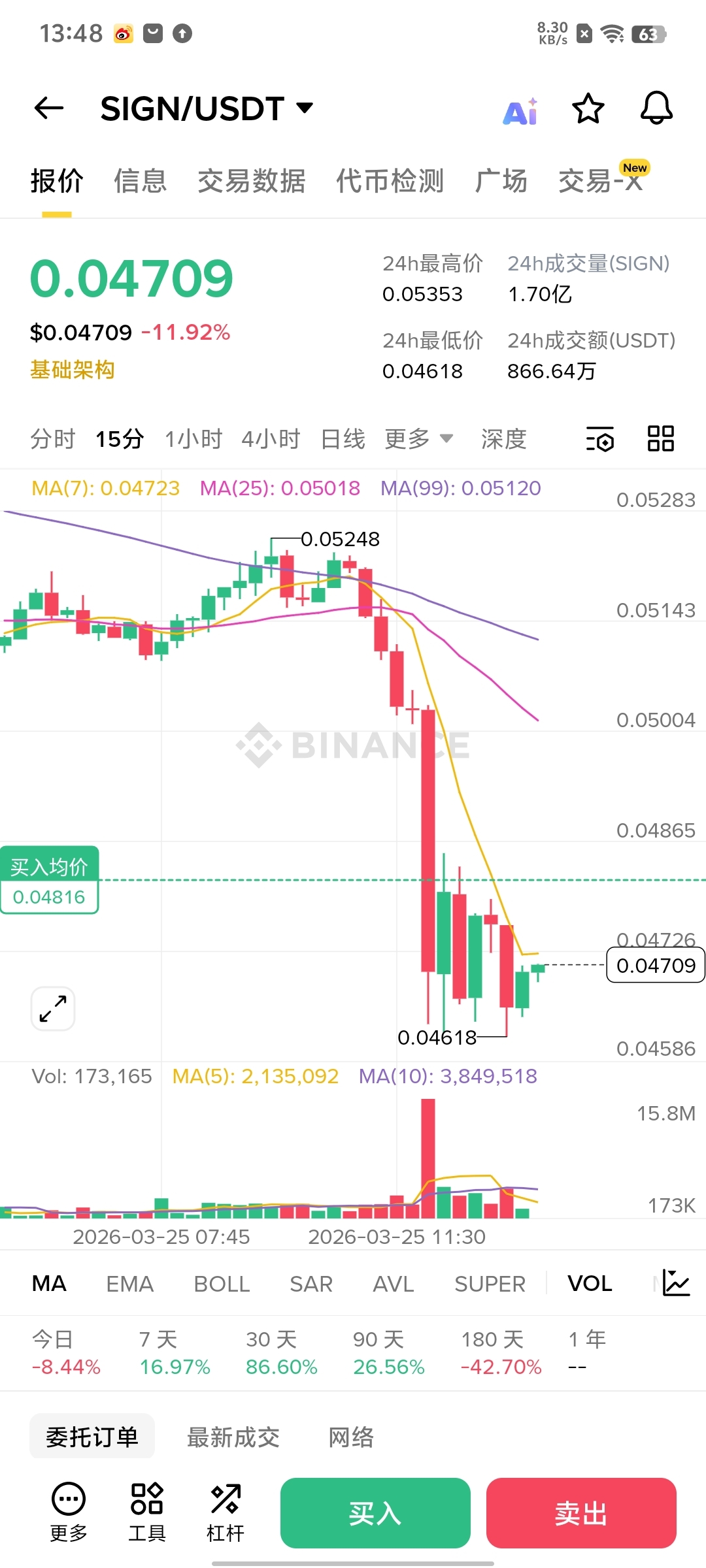
On the morning of April 2nd, @SignOfficial I noticed that the SIGN dropped from 0.053 to 0.0462; I was taken aback. This wave went from 0.02089 to 0.05278, peaking at a 150% increase, then retracing almost 22 points, gone in three days.
My watchlist now has the RSI dropping to 59.7, the MACD hasn't given a clear signal, and the price is still above the 50-period EMA but being pressed down by the 200-period EMA—typical 'bounce confirmation phase'. The intraday support level is at 0.0465; if it breaks, it might go to 0.045, with resistance between 0.051 and 0.052. I've been staring at the Bollinger Bands for a while, with the upper band at 0.0594, the lower band at 0.0251, and the price sitting slightly below the midline, not oversold and not overbought, a typical 'waiting for the next catalyst'.
To be honest, the narrative logic behind this wave of increase is coherent. On March 10th, founder Yan Xin directly stated on Saudi television that 'the geopolitical crisis in the Middle East has just begun.' SIGN has been seen by the market as a geopolitical hedge asset — the weaker the traditional financial channels, the stronger the demand for this national-level blockchain operating system. TokenTable has distributed over 4 billion USD in assets, covering over 40 million addresses. Sign has already signed agreements with the Abu Dhabi Blockchain Center and the Central Bank of Kyrgyzstan; this is not just a PPT narrative, but a national-level project that has entered the implementation phase.
But I come from a trading background, and I have to look at the chips. The total supply of SIGN is 10 billion pieces, and only 1.64 billion pieces have been unlocked, with a circulation rate of only 16.4%. On April 28th, the next batch of unlocks will be given to Backers. The FDV exceeds 400 million USD, and over 80% of the tokens have not been released. This structure makes me cautious for any altcoin.
I tried to break down the K-line. The volume spike on March 24th, the bearish candle, saw the 15-minute volume rise to over 15 million, confirming seller dominance. The daily trading volume shrank from over 40 million during the rally to just over 10 million in the recent days, showing clear signs of momentum exhaustion. The weekly ADX is still above 38, indicating trend strength, but the direction is unclear. This aligns with past review patterns — Sign's price fluctuates less in the 7 days before and after the unlock event, but there is often pressure one to two weeks before the unlock.
I do not deny that the technical design of Sign is indeed solid. The combination of Attestation and Schema Registry standard framework addresses the core issue of on-chain proof interoperability. The hybrid storage architecture uses Arweave/IPFS for big data, with only hashes stored on the chain, ensuring data does not leave the country, is verifiable, and compliant. Cross-chain verification uses a TEE node network combined with BLS signature aggregation, with 2/3 consensus and threshold signature protection. However, the implementation of these technical aspects in the actual scenarios of sovereign countries requires time. The sales cycle for government projects is measured in years, and if policies change, three years of work can be wasted. Although TokenTable's distribution of 4 billion USD is large, the daily consumption scenarios for the tokens are still not frequent enough.
Talking about K-line. The price is fluctuating around 0.046 now, with support at 0.0439 (Fib 38.2% retracement), the next strong support at 0.0395 (Fib 50%), and resistance above at 0.0494 (Fib 23.6%) and around 0.0541. Those holding positions are watching the unlock on April 28th — I don't know if it will drop first or rebound after the bad news is fully released. I don't know either. Trading is like this; you can analyze the fundamentals, you can break down the K-line, but at critical moments, no one can say for sure.
My judgment is that the geopolitical narrative of Sign is correct at the macro level, but the real consumption of on-chain data needs time to materialize. I won't heavily invest at this position; I will add it to the top of my watchlist for now. I will consider it when the token consumption scenarios are clearer and the unlocking pressure has been digested. The K-line says it is waiting for the next catalyst, and I am waiting too. Don't ask me how SIGN will perform next — I really don't know. But I know there aren't many projects that can keep me focused from dawn till now.