
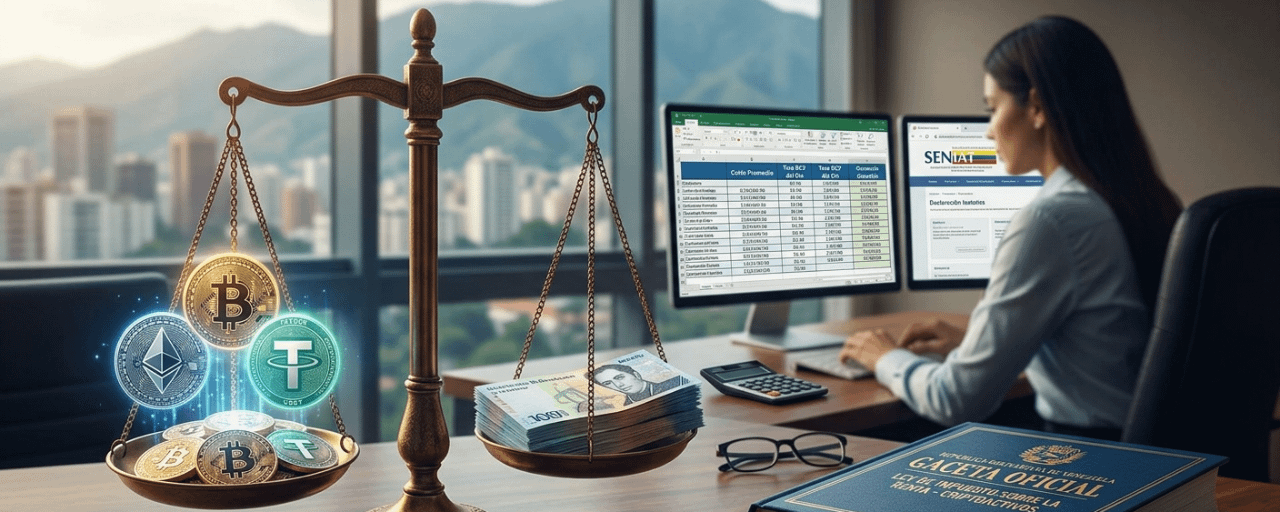
Many believe that having their assets in a cold wallet or in an international exchange keeps them off the radar. But the reality is different: In Venezuela, profits from cryptocurrencies are indeed subject to taxes.
If you do P2P, receive payments in USDT, or simply trade, this article is for you. Avoid bank account blocks and unnecessary fines. 👇
1. The legal framework: Who issues it and what does the Official Gazette say?
There are three fundamental pillars that regulate your cryptos before the tax authority:
Income Tax (ISLR): It is the main one. It is based on the Constituent Decree of the Reform of the ISLR Law and the regulations of SUNACRIP (such as Provision 098 in Official Gazette N° 41.788). The issuing body is the National Assembly/Executive and the collecting body is SENIAT.
IGTF (Tax on Large Financial Transactions): Regulated in Official Gazette No. 6,687 Extraordinary (25/02/2022). This taxes payments made with cryptocurrencies other than Petro.
Accounting: Decree No. 4,025 requires accounting in crypto assets (even if presented in Bolívares) so that the SENIAT can audit traceability.
2. From how much money do you need to declare?
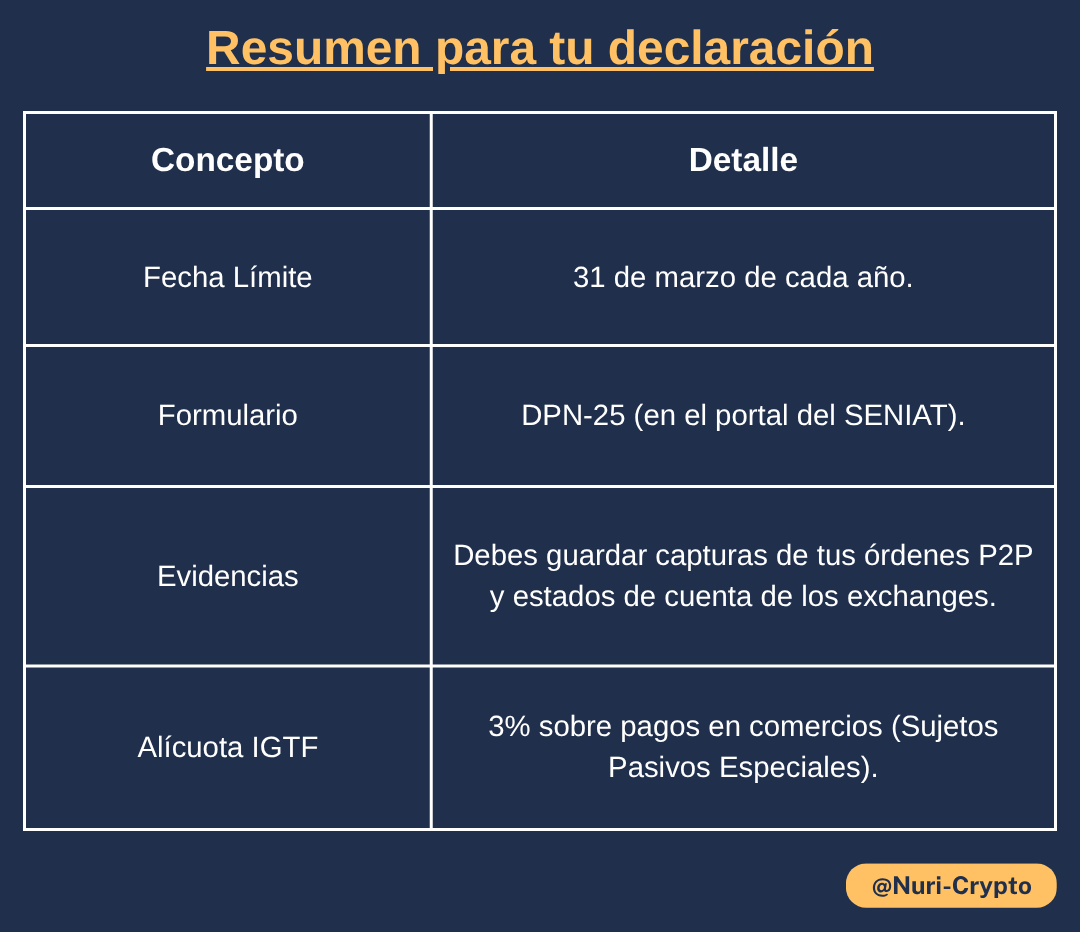
For the current fiscal year (declaration due by March 31 of each year), the thresholds are:
Natural Persons: You are required to declare if your annual net income exceeds 1,000 Tax Units (U.T.) or if your gross income exceeds 1,500 U.T. * Real Data: Due to the current value of the U.T., practically any net gain exceeding $40 - $50 USD annually (depending on the official exchange rate) requires you to declare.
What is declared? Not the total you have in the wallet, but the net gain.
Formula: $Selling Price - Acquisition Cost = Taxable Gain.
3. How does it affect Venezuelans?
The main impact is divided into two scenarios:
When buying/paying (IGTF): If you go to a business that is a "Special Contributor" and pay with USDT or Bitcoin, they will charge you an additional 3% on the total invoice.
When selling (ISLR): If you do P2P to obtain bolivars, that favorable difference is an income that the SENIAT considers "net enrichment".
Banking Risks: Banks in Venezuela share information with the SENIAT. If you receive constant P2P transfers without a declaration of ISLR to justify them, you risk account blocking for "funds inconsistency".
4. Are there exemptions?
There are some important exceptions, although the landscape has changed:
The Petro: Historically, transactions with Petro (PTR) were exempt from IGTF and had benefits in ISLR, although after the restructuring of Sunacrip in 2023-2024, its use has practically fallen into disuse.
Securities: According to Official Gazette No. 6,821 (July 2024), the IGTF rate for transactions in bolivars was reduced to 0%, but the 3% rate for payments in foreign cryptocurrencies and currencies remains.
Unique Deduction: As a natural person, you can apply a deduction of 774 U.T. to reduce the amount of tax payable, which helps small users end up paying minimal or zero amounts, despite being required to declare.
The essence of the calculation
For the SENIAT, it doesn't matter how many dollars you earned, but how many Bolívares (VES) those cryptos represent according to the Central Bank of Venezuela (BCV).
The Official Rate: You must mandatorily use the BCV rate of the same day you made each operation (purchase and sale). The use of parallel rates (like "Monitor") is not allowed.
The Formula:
Gain = Sale in Bs (BCV Rate)} - Purchase in Bs (BCV Rate)
Average Cost: If you bought cryptos on different dates at different prices, you must average those costs in Bolívares to know what your "base" is at the time of selling.
Losses: If the market fell and you lost money, those losses are deducted from your gains, which reduces the amount of tax payable.
What should you do in practice?
Download your history: Keep the report from Binance or your exchange for the entire year.
Organize an Excel: Record each transaction with its respective BCV rate of the day.
Supports: Keep screenshots of your P2P operations and bank receipts. They are your only defense in an audit.
Note: Transparency is your best investment: The bank and the SENIAT only see Bolívares. If your bank account receives P2P transfers, make sure each one is justified with the official rate of the day in your control chart.
And you? Did you already know that the 3% of the IGTF also applied if you pay with Bitcoin at the supermarket? 💸 👇 Leave your question in the comments and share this with your "crypto-enthusiast" friend who thinks they don't have to declare.
#CriptoVenezuela #Seniat #venezuela #Binance #nuricrypto $USDT
Sources consulted:
Official Gazette No. 6,687 Extraordinary (Reform of the IGTF Law).
Income Tax Law (Official Gazette No. 6,210).
Value of the U.T. Provision SNAT/2025/000048 No. 43,140
Cryptos Registry Provision SUNACRIP 098-2019 No. 41,788

