
DOGE is stuck 'in the cloud': the market has entered the most tangled stage
Recently, the movement of Dogecoin (#DOGE ) seems to be 'trapped'. From a 4-hour perspective, the price has already entered the Ichimoku cloud, oscillating between the upper and lower boundaries of the cloud. This state usually indicates one signal - the market has no direction, and momentum is clearly weakening.
In simple terms, we are currently in a typical phase of 'no one has won', neither a strong bull market nor a bear market.
Cloud chart internal oscillation: The textbook pattern of a standoff between bulls and bears
According to trader Tardigrade's analysis, DOGE has been moving within the cloud since it retreated from the upper boundary of the cloud. This trend is actually quite 'standard': entering the cloud represents that the market has entered a consolidation period.
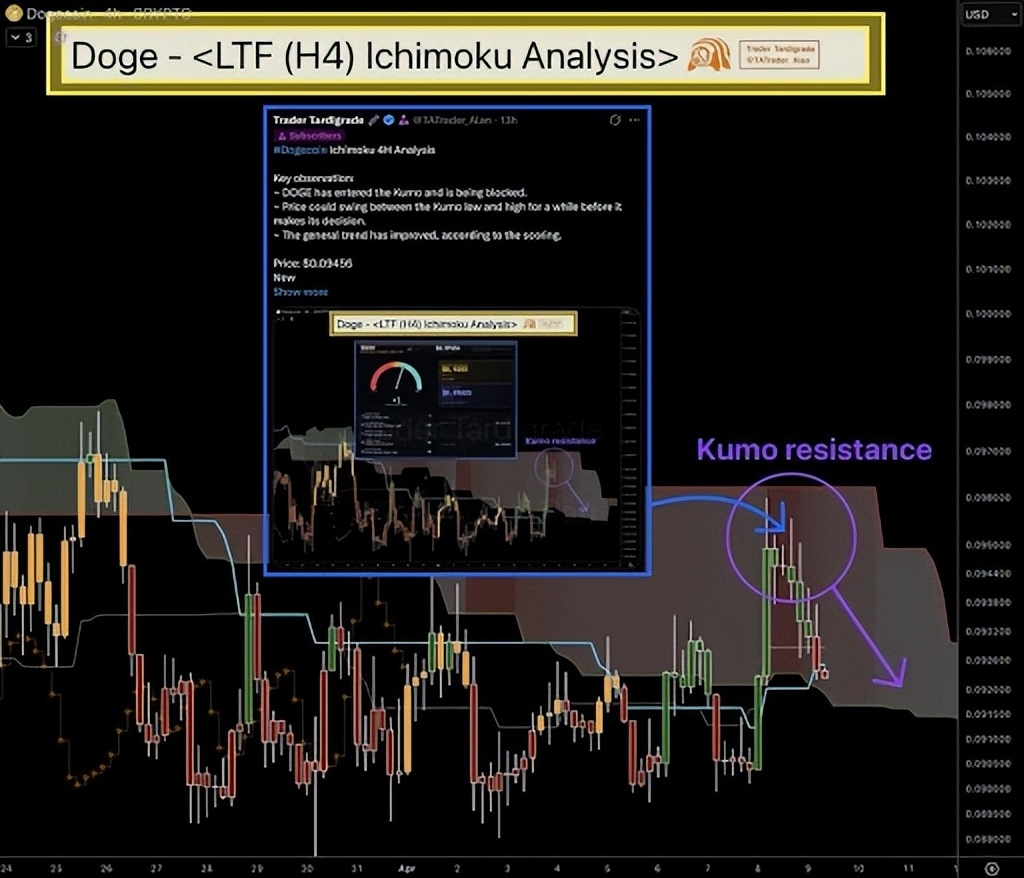
In the Ichimoku system, the cloud acts like a buffer zone. On one hand, it can provide support; on the other hand, it creates resistance. You can think of it as a 'sandwich space' - with support underneath, resistance above, and oscillating in between.
The current situation is similar: the lower edge of the cloud is like a safety net, temporarily supporting the price; while the upper edge acts like a ceiling, making it difficult for prices to rise. The result is that prices are stuck in the middle, oscillating repeatedly.
Why is this stage critical?
Many people feel that sideways movement means 'no market', but in fact, it is quite the opposite - this stage is often preparing for the next big market.
The key point is: the price must exit the cloud to provide a real direction.
If DOGE can break above the top of the cloud and stabilize above the cloud, it likely indicates that the trend is starting to strengthen, even initiating a decent rebound.
But if the price breaks below the bottom of the cloud and closes below, it basically confirms that the bears have regained control, and a new round of decline may follow.
One detail: this time the 'cloud' is a bit thin
Another noteworthy detail is that the current layer of cloud is actually quite 'thin'.
What does this mean? Simply put, the support and resistance are not as strong. Compared to those heavy clouds, this structure is easier to break.
In other words, once the market chooses a direction, whether up or down, the speed is likely to be faster than expected, even carrying a sense of 'sudden outbreak'.
Advance signal capture: Focus on two key lines
If you don't want to wait for a breakout to react, you can pay attention to two key indicators in advance: the baseline (Kijun-sen) and the conversion line (Tenkan-sen).
These two lines actually represent short to medium-term momentum. When they form a 'golden cross' (upward crossing), it often means buying power is strengthening; while a 'death cross' (downward crossing) may indicate that selling pressure is beginning to increase.
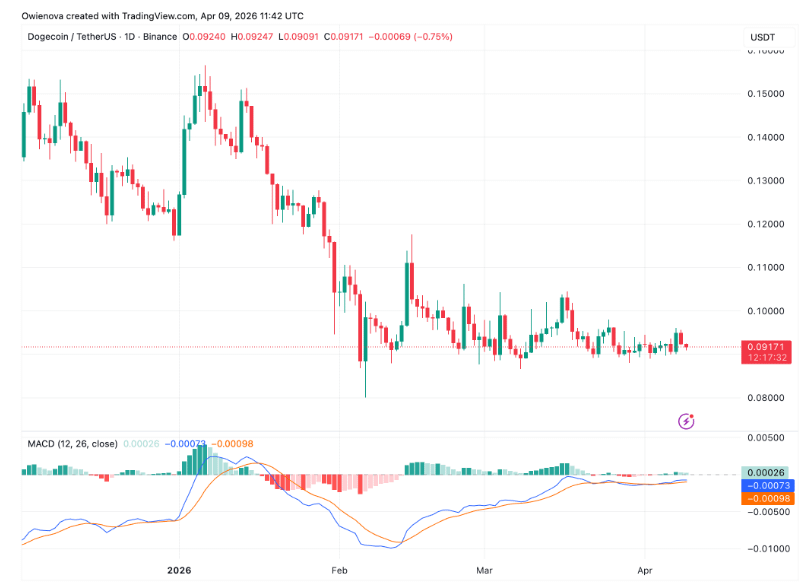
More importantly, these signals often appear before a real breakout, serving as a 'trailer'. Therefore, closely monitoring the changes in these two lines can sometimes help you sense shifts in market sentiment in advance.
Summary: Don't be fooled by sideways movement, a big market may be on the way
Overall, DOGE is currently in a typical 'direction selection period':
The price is trapped inside the cloud, with a temporarily neutral trend
Both bulls and bears are at a standstill, and the market is entering a digestion phase
A thinner cloud means the breakout could be more rapid
The key is: whether to move up or down out of the cloud
So, this seemingly dull oscillation might actually be the most noteworthy phase. Once the direction is confirmed, the market is likely to unfold rapidly.
At times like this, patience and observation are often more important than frequent operations.