
Increasingly heated economic and political tensions, threatening a literal outbreak of war (again), are being stirred by the actions of the Iranian authorities, whose central element is $BTC . Iran has announced, as is well known, that it is annexing the Strait of Hormuz and intends to exercise sovereign control over the maritime route connecting the Persian Gulf with the rest of the world. The most visible element of this control is the fees the Iranian state demands from ships sailing this route.
These fees were formally introduced in mid-March, although at the time they were more declarative in nature (intensive bombardment of Iran, especially its naval assets, had already brought all traffic in the Strait to a standstill). This changed this week with the announcement of a two-week ceasefire. Although the ceasefire is extremely fragile, and both sides have already accused each other of violating it, it has allowed the "Strait of Hormuz Management Plan," formally passed by the sham Iranian parliament on March 30, to officially come into effect.
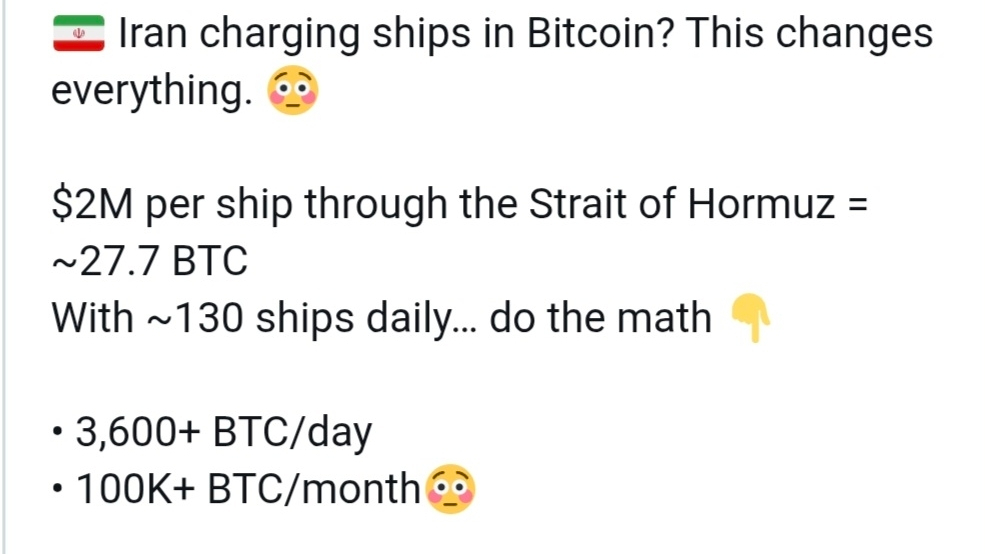
Initially, back in March, it was reported that the fees would be collected in Chinese yuan. However, this has now changed, and these duties—though settled in terms of the dollar equivalent—will be collected in cryptoassets. This refers, of course, to Bitcoin or stablecoins. Tehran wants tankers to pay the equivalent of $1 for each barrel of oil. A full-size VLCC supertanker with a capacity of 2 million barrels would cost around $2 million, which at a BTC exchange rate of around $72,128. (as of April 9th – Bitcoin strengthened amid reports of a ceasefire) would be equivalent to 27.7 BTC.
Ships with empty cargo holds can theoretically pass free of charge – however, Iran continues to demand compliance with the cumbersome process of obtaining permission for passage, which in itself is a significant burden. Permission must be granted by Iran's Supreme National Security Council, a ridiculously high-level body. The procedure requires emailing Iranian authorities with cargo details, a crew list, and the port of destination no later than 96 hours before the planned entry. After verification, the tanker receives instructions to pay in BTC within seconds of approval. After the transaction, a one-time access code is generated, and the vessel is taken over by an "escort" from the Islamic Revolutionary Guard Corps navy.
The daily limit is approximately 12 ships, varying according to a five-level classification, depending on nationality and the country's "friendliness" towards Iran – ships with ties to the US or Israel are to be denied passage at all. Meanwhile, according to data from the Kpler Observatory, before the conflict, 100–120 commercial vessels passed through the Strait daily, including tankers carrying approximately 20% of the world's oil and liquefied natural gas supply. After the introduction of the fees, traffic dropped to a few vessels per day, and oil tankers did not pass at all during the first hours of the ceasefire.
On top of all this, there are costs – as mentioned, significant ones.
Naturally, Washington considered the introduction of fees to be completely out of the question. The White House emphasizes that the primary condition for the ceasefire was the "unconditional" and "complete" reopening of navigation in the Strait of Hormuz, adding that attempts to collect fees constitute a violation of the ceasefire. Iran maintains that the system is technical in nature and serves to protect against the confiscation of assets under sanctions – the lifting of which, loosely envisaged as one element of a possible final peace agreement, seems even more unlikely under the circumstances.
There is currently no information on whether the United States would be prepared to resume military action due to attempts to charge ships with Bitcoin. Some observers point out that while the US has no pressing interest in unblocking the route (the US doesn't use it anyway, and the complications are affecting China), the Arab states of the Persian Gulf do – whose economies depend for over 90% on oil exports through the Strait of Hormuz. These countries do not accept Iran's de facto annexation of the crucial route and could potentially be willing to use force to force its opening.
Regardless of the political storm the attempted to introduce fees has caused, it is also significant for another reason. It would constitute the first such significant instance in which Bitcoin has been treated by a major state, which Iran undoubtedly is, as a sovereign currency in international transactions. The full spectrum of consequences of this development could also be interesting. It's worth realizing that, assuming a flow of 130 ships per day, the system would generate over 3,600 BTC per day—over eight times more than the global production of new Bitcoins (450 BTC/day). Admittedly, these are exciting times for BTC. Do you think these events will positively impact the BTC price or the opposite? Let us know in the comments.