There are approximately 195 countries in the world, but only eight of them have developed atomic bombs. Pakistan is one of these eight countries.
The first nuclear test was conducted by the United States on July 16, 1945. Then Russia did it on August 29, 1949. After that, the United Kingdom on October 3, 1952, followed by France on February 13, 1960. China conducted its test on October 16, 1964, then India on May 18, 1974, Pakistan on May 28, 1998, and finally North Korea on October 9, 2006.
Among these 195 countries, these eight possess the most dangerous weapons. If all their atomic bombs were detonated at once, millions of people would die within seconds and minutes. It is fortunate that we developed the atomic bomb, because nowadays it is not only difficult but nearly impossible to build one. Due to the United States, no country dares to develop nuclear weapons—Iran is an example, as the U.S. is preventing it from doing so.
How does an atomic bomb work? First, it is important to understand that atomic bombs are dropped from aircraft. They are fitted inside planes and then released over the target area.
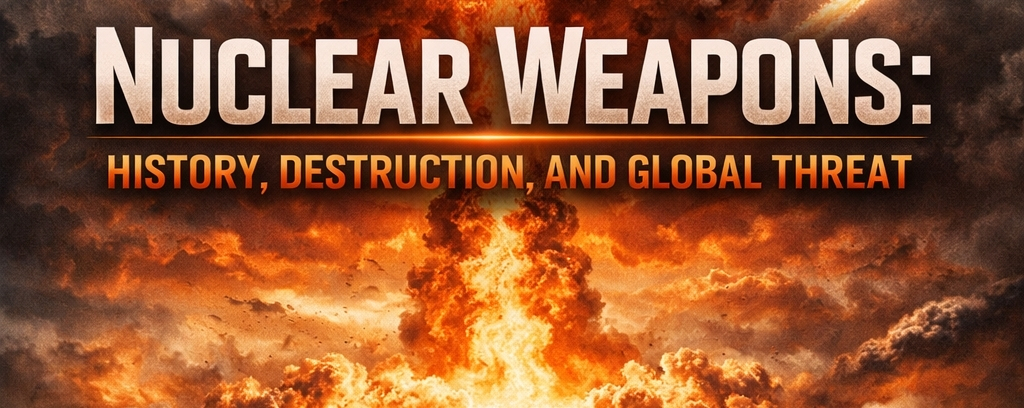
An atomic bomb explodes at a height of about 100 meters above the ground. Within a thousandth of a second after detonation, neutrons split all the atoms inside the bomb. This splitting produces an intense flash of light, forming a massive fireball so bright that it outshines the sun. The light is so intense that people lose their eyesight instantly before dying or being vaporized.
The fireball rapidly moves toward the ground, and the temperature at that moment becomes comparable to that of the sun. Within a radius of about two kilometers, humans, animals, trees, buildings, and vehicles are turned into smoke within a second. The destruction within a 2–3 km radius is so complete that it looks as if the area has been swept clean.
At the moment of detonation, a terrifying explosion occurs. A second shock follows when the blast wave hits the ground, which is said to be many times more powerful than the first. The initial explosion in the air creates a powerful shockwave, sending extremely hot winds outward at thousands of miles per hour. These winds are so strong that they can destroy even large trucks and reduce buildings several kilometers away to rubble.
Immediately after the first explosion, a second effect causes intense seismic waves, damaging buildings up to 9–10 kilometers away. The eardrums of people can rupture due to the blast.
The splitting of atoms also releases invisible radiation and neutrons, which pass through living bodies. These neutrons destroy white blood cells. Along with the heat spreading on the ground, a massive cloud of radioactive particles rises into the sky, forming clouds. Radioactive rain then falls over surrounding areas, and wherever these drops land, they can severely damage or destroy living tissue.
The radiation released from a nuclear explosion can make people infertile. Even if children are born afterward, they may suffer from severe physical disabilities. The area where the explosion occurs remains uninhabitable for a long time.
The destruction caused by an atomic bomb spreads in a circular pattern. The more powerful the bomb, the larger the area of destruction. If, God forbid, a world war begins, nothing would remain, because each country possesses more than a hundred atomic bombs. The United States and Russia alone have more than 3,000 each, while Pakistan has around 170.
Atomic bombs can be delivered to targets using aircraft (bombers), naval vessels (submarines), or missiles.