

To explore the possibility of BNB's price increasing tenfold from the current $620 level (reaching $6,000+), this goes beyond ordinary volatility and enters the realm of 'paradigm shift' discussions.
If BNB is to achieve a tenfold growth, its total market cap will surpass $900 billion (close to Bitcoin's current market size). Based on market logic and on-chain data for 2026, here are the core driving factors supporting this extreme pricing analysis:
1. Extreme deflation: Transitioning from 'buybacks' to a 'burn-driven' ultimate state.
Supply side exhaustion: As of April 2026, BNB has completed the 35th burn (approximately 1.57 million tokens, valued at around $1 billion). At the current Auto-Burn rate, the total supply is expected to drop to 100 million tokens by the finish line in 2027-2028.
Scarcity premium: The logical premise for tenfold growth is a total supply reduction of over 30%, while market demand doubles due to exploding application scenarios. This 'dual pressure' is the financial foundation for achieving exponential price jumps.
2. PayFi and RWA: Transitioning from 'speculative assets' to 'financial infrastructure'.
Global payment settlement hub: By 2026, Binance Pay will have over 20 million merchants. If BNB can successfully transition from a 'trading fee discount tool' to a native settlement currency for global cross-border payments and remittances (i.e., PayFi), the clearing value it handles per second will support its valuation aligning closer to Visa/Mastercard.
RWA asset anchor: BNB Chain is becoming the preferred public chain for RWA (real-world assets) on-chain in the Asia-Pacific region. If the TVL of on-chain government bonds and tokenized stocks breaks the $100 billion scale, BNB, as the underlying gas and security pledge asset, will capture value that leads to a qualitative change.
3. Institutional transformation: The entry of sovereign wealth funds.
Sovereign-level reserve asset: A research report from 2026 indicates that the market is shifting from retail speculation to institutional structuring. If BNB can be included in the spot ETF candidate pool by major regions or large asset managers (like BlackRock), or become a strategic reserve for sovereign nations, its valuation logic will elevate from 'project token' to 'digital reserve asset'.
4. Breaking through the 'ceiling' of ecological performance.
Technical premium: The BNB Chain's 2026 roadmap promises 20,000 TPS and 150ms latency. If this goal is achieved, it means it will have the capability to support 'millions of users online simultaneously'. In the 'application-driven growth' era of 2026, public chains that can run large-scale commercial applications often see their valuations experience non-linear growth due to network effects.
In-depth analysis: The challenges and realities of achieving tenfold growth.
Although there is a theoretical path to tenfold growth, attention must be paid to the following extreme challenges:
Market cap ceiling: A market cap of $900 billion means it must surpass Ethereum's current peak and even approach levels of silver or global tech giants.
Regulatory bottleneck: A tenfold price means Binance's penetration in the financial sector has reached unprecedented levels, which could trigger a higher-level global regulatory backlash.
Competitive pressure: If Solana or other emerging high-performance L2s monopolize the application layer (AI agents, decentralized social), it will dilute BNB's growth potential.
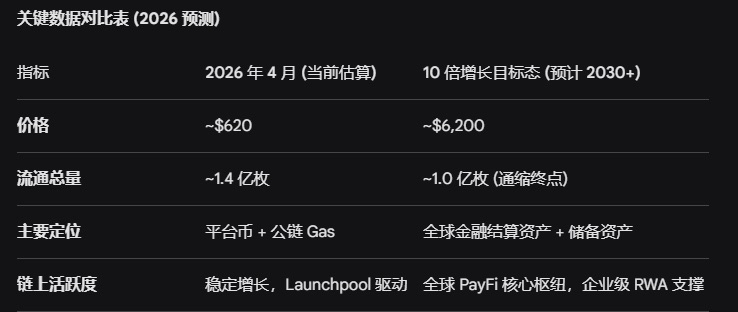
In-depth summary: The logic behind BNB increasing tenfold is no longer 'Binance grows larger', but rather 'cryptocurrency becomes mainstream finance'. Only when BNB fully transitions from an exchange token to 'digital oil' supporting trillions in asset flow does this price hold real significance.