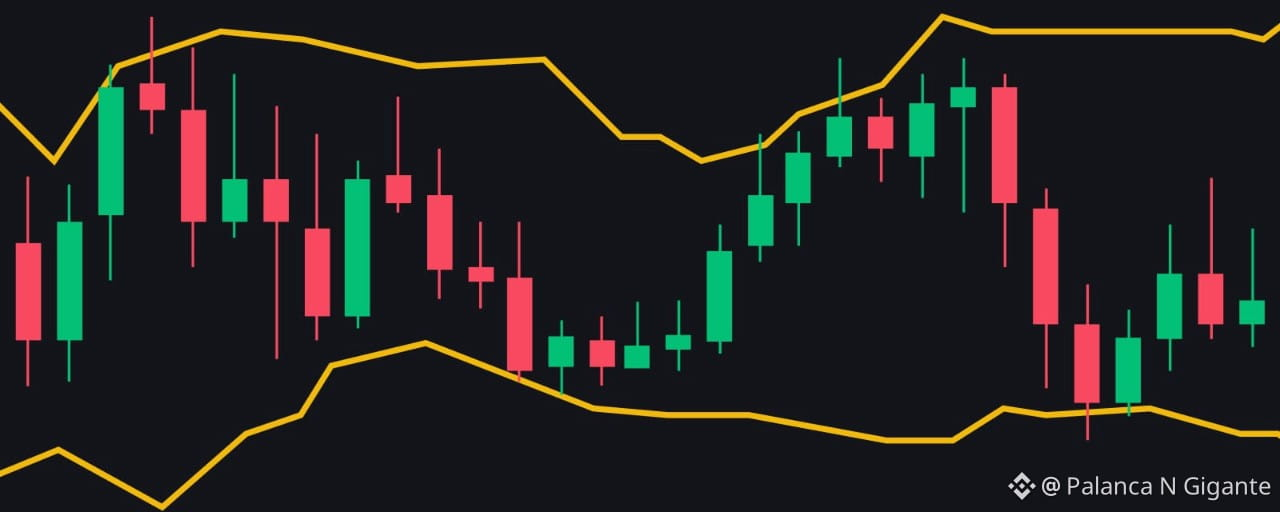
Bollinger Bands are a Technical Analysis indicator that show market volatility and help pinpoint potential reversal points. They consist of a simple moving average (usually over 20 periods) and two bands that sit above and below the moving average.
There are various indicators and mathematical and statistical tools to enhance the application of Technical Analysis in trading operations on the stock market.
One of the most popular among them is Bollinger Bands, a super handy tool for traders in their day-to-day operations.
Bollinger Bands can even be used to define supports and resistances and to interpret market volatility.
In this article, you'll learn what these bands are, how they work, the calculations involved in their setup, and the trades that can be made by observing these indicators to maximize your gains and manage risks better. Ready to dive in?
What are Bollinger Bands and what are they used for?
First, let’s understand what Bollinger Bands are and their utility in Day Trading and Swing Trading.
This is a volatility indicator developed in the 1980s by American financial analyst John Bollinger as a variation of envelopes (a graphical analysis measure that establishes moving averages above and below a simple moving average based on a percentage).
One of the most read authors in Technical Analysis, Flávio Lemos, defines Bollinger Bands as a
'Indicator for a moving average calculated with a default of 20 periods, from which two bands are added, one upper and one lower, that are positioned 2 standard deviations from the base moving average.'
To simplify, the idea is to 'envelop' the price variations within or near bands above and below the moving average with the aim of tracking volatility, anticipating tops and bottoms, and estimating if an asset is oversold or overbought.
By definition, these bands can also be useful as aids in detecting price support and resistance lines, increasing their range of applications.
Remember that to use Bollinger Bands and other technical indicators, it’s advisable to rely on the best trading platforms in the market.
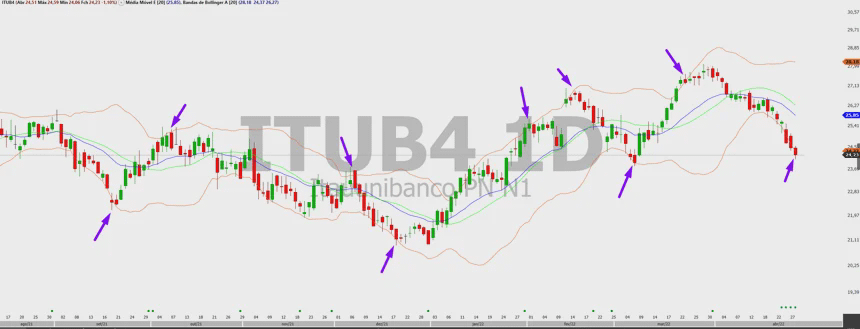
Example of Bollinger Bands on the chart
Check out a practical example of the application of Bollinger Bands below.
How to set up the Bollinger Bands?
To set up the Bollinger Bands, the trader should use the Simple Moving Average (SMA) or Arithmetic Mean (AM). According to the cited author, the use of the Exponential Moving Average has not shown good results and significant gains.
Formula and calculation of periods for Bollinger Bands
As we mentioned, by default, the chosen moving average is the 20-period one, as well as the 2 standard deviations.
However, these numbers can be configured to be adaptable to your trading style, timeframe, and objectives.
In summary:
Central line: Simple Moving Average (SMA) of 20 periods
Lower band: SMA (20 periods) – 2x standard deviation of 20 periods
Upper band: SMA (20 periods) + 2x standard deviation of 20 periods
Flávio Lemos also highlights that the difference from traditional envelopes is that Bollinger Bands use standard deviation instead of a fixed percentage like envelopes.
By proposing the use of standard deviation, Bollinger aimed to measure market volatility since this statistical indicator provides the dispersion of the set.
In other words, the higher the standard deviation, the greater the volatility, and the farther apart the upper and lower bands will be.
When market volatility is lower, the bands are closer to the central moving average.
By measuring price volatility, Bollinger Bands adjust to market conditions. This is what makes them so useful for traders. Thus, they can find almost all price values between the two bands.
As tools, you can also use the following indicators derived from Bollinger Bands:
Indicator %b: aims to highlight the price's position in relation to the bands. Its formula is %b = (closing price – lower band) ÷ (upper band – lower). The result is typically a value between zero (0), closer to the lower band, and one (1), closer to the upper band.
BandWidth (BW): aims to calculate the width of the bands and the distance from the 20-period average. It helps identify when market volatility increases, causing the bands to widen.
Additionally, it's always recommended to continue your studies to master the best strategies to apply in the market.
How to interpret and trade with Bollinger Bands?
Before we get into the practical use of Bollinger Bands, pay attention to what Flávio Lemos warns: 'this indicator doesn’t show which way the market will go, but only that a significant variation will occur.'
Additionally, they can signal the onset of a certain movement. That is, traders can use them to identify that when the lines expand, the price oscillation will be significant.
For example: after a strong uptrend or downtrend, the market may enter a stabilization zone, showing weak trading volumes, either above or below the crossing between price and the moving average.
To better monitor this behavior, traders use price bands that cover the trading spectrum around the trend.
We know that asset prices fluctuate randomly and irregularly in the short term. Analysts use moving averages as support and resistance lines to anticipate a stock's price.
Furthermore, they stipulate and extrapolate upper resistances and lower supports and then form bands within which they expect prices to remain contained.
Other traders often draw straight lines connecting both highs or lows of prices to identify the extremes of upper or lower prices and then add parallel lines to define the price movement bands.
As long as prices do not move outside these bands, traders can generally feel reasonably confident that quotes are moving and behaving as expected.
Possible sells
When a double top forms, meaning two consecutive highs of similar intensity, drawing an 'M' on the chart, it can signal exhaustion of the strength of a bullish trend.
When prices continuously touch the upper line of the Bollinger Bands, they are said to be overbought, signaling a sell.
Possible buys
However, when a double bottom forms, that is, two consecutive dips creating a 'W' shape, it might be an opportunity to study a buy of the asset, as it could indicate a potential loss of momentum in the bearish trend.
So, when they repeatedly hit the lower band, they are characterized as oversold, indicating a buy.
Moving average crossover
When using Bollinger Bands, traders usually set the upper and lower bands as price targets.
If the price deviates outside the lower band and crosses above the 20-day moving average (the middle line), the upper band represents the upper price target.
In a strong bullish trend, prices usually oscillate between the upper band and the 20-day moving average.
When this happens, a crossover below the 20-day moving average warns of a trend reversal to the downside.
Buying when stock prices cross below the lower band often helps traders take advantage of oversold conditions and profit when the traded asset's price moves toward the middle line of the moving average.
To wrap it up, Bollinger Bands are widely used in Day Trading, strategies with variable income assets that start and end on the same day.