
Honestly didn't plan to write this today, but after looking back at my portfolio over the past few months and seeing a pile of tokens just sitting there doing absolutely nothing, while the market has projects like OpenLedger already paying contributors per data point in real time — felt like I had to say something straight up.
People who let their money sleep — meaning they hold assets with zero strategy, no staking, not participating in any ecosystem, just "hold and pray" — are actually losing way more than they realize. And it's not just about missing out on price movements. It's about losing time to understand how the market is shifting, and honestly that's the scarier part.
I spent a good chunk of time digging into OpenLedger recently, and to be real, at first I wasn't that impressed because on the surface it looks complicated, all AI and blockchain terms mashed together. But when I actually read deeper into what they call Datanets, I started seeing something genuinely different from anything I'd come across before.
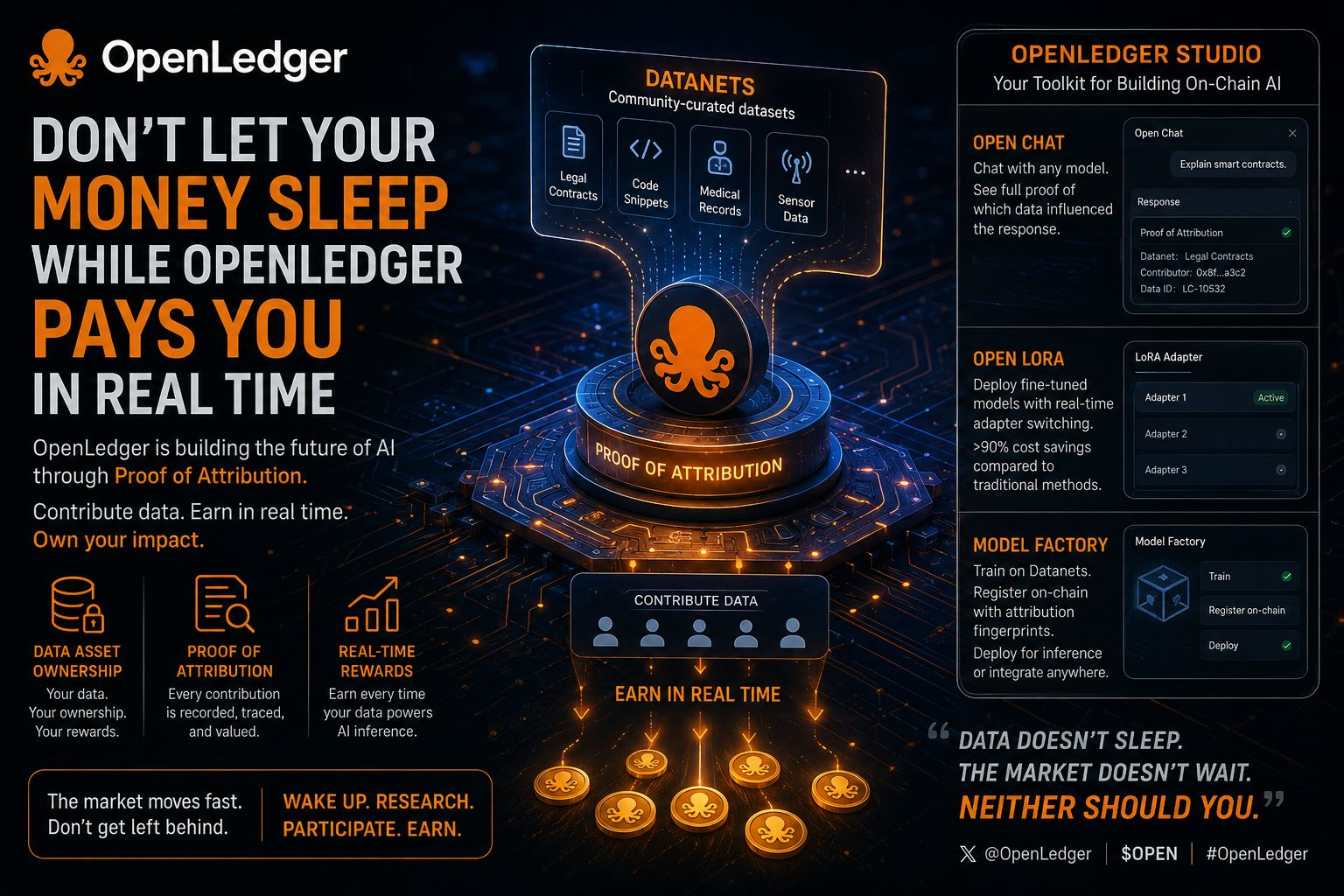
OpenLedger builds an ecosystem where data is treated as a real asset. Datanets — sounds technical but think of it simply as community-curated datasets managed on-chain — are organized by specific domains like legal contracts, code snippets, medical records, or sensor data. Every dataset inside OpenLedger has a fully traceable history: who contributed what, which model was influenced by that data, and when that model gets used for inference, the original contributors receive their corresponding share of the fees. Sounds simple enough but doing that in a fully transparent on-chain way is something not many projects have actually pulled off.
What caught my attention most about OpenLedger is the toolkit they call OpenLedger Studio. This is where users — even people with zero coding background — can get involved in building and deploying AI systems directly on the blockchain. Open Chat lets users interact with any model hosted on OpenLedger, and every response comes with proof showing exactly which data influenced that output. Open LoRA handles deployment of fine-tuned models and cuts costs by over 90% compared to traditional methods, through real-time adapter switching. Model Factory is where developers can train models using data from Datanets, register them on-chain with attribution fingerprints, then deploy straight for inference or plug into applications.
Back to the main point though. People who let their money sleep usually think they're being "safe" because they didn't buy the top, didn't get sucked into FOMO. But the reality is, when you're not participating in ecosystems like OpenLedger that are building new income mechanisms, you're sitting on the sidelines watching others stack long-term advantages. Not price advantages — understanding advantages, and positional advantages inside the ecosystem.
OpenLedger is building what they call Proof of Attribution — meaning every data contribution gets recorded and valued. This is completely different from how traditional AI operates, where millions of internet users contribute data and receive absolutely nothing in return. With OpenLedger, every Datanet is a unit of knowledge that can be traced, owned, and monetized.
Not saying you should throw everything at anything, including OpenLedger. But the point I want to drive home is this: if your money is just sitting there and you're not bothering to research which ecosystems are actually generating real value, then when the market turns around you'll be FOMOing into the top again like always. OpenLedger is the kind of project where early researchers have a clear edge — not just on asset value, but on the ability to participate meaningfully inside the ecosystem.
The market doesn't wait for anyone to wake up, and data definitely doesn't either. @OpenLedger $OPEN #OpenLedger