
I’ve been around crypto long enough to remember the 2017 ICO circus, when every whitepaper claimed it was building “the future of decentralized everything.” I remember sitting through conference panels where founders talked about TPS numbers like normal people discuss football scores. Half those projects vanished before their token unlocks even finished.
Then came the “Ethereum killer” era. Same story. Different branding.
Now the AI boom has arrived, and honestly? It feels weirdly familiar. Everyone suddenly has an AI roadmap. Every blockchain project is stuffing “agents,” “intelligence,” or “AI-powered infrastructure” into their pitch decks because venture money is flowing again and nobody wants to miss the next narrative wave.
Most of it feels hollow. You can smell it after a while.
That’s why OpenLedger stood out to me — not because it sounds flashy, but because it’s focused on a problem that’s genuinely becoming impossible to ignore.
Ownership.
Not in the abstract crypto sense. Real ownership. Human ownership.
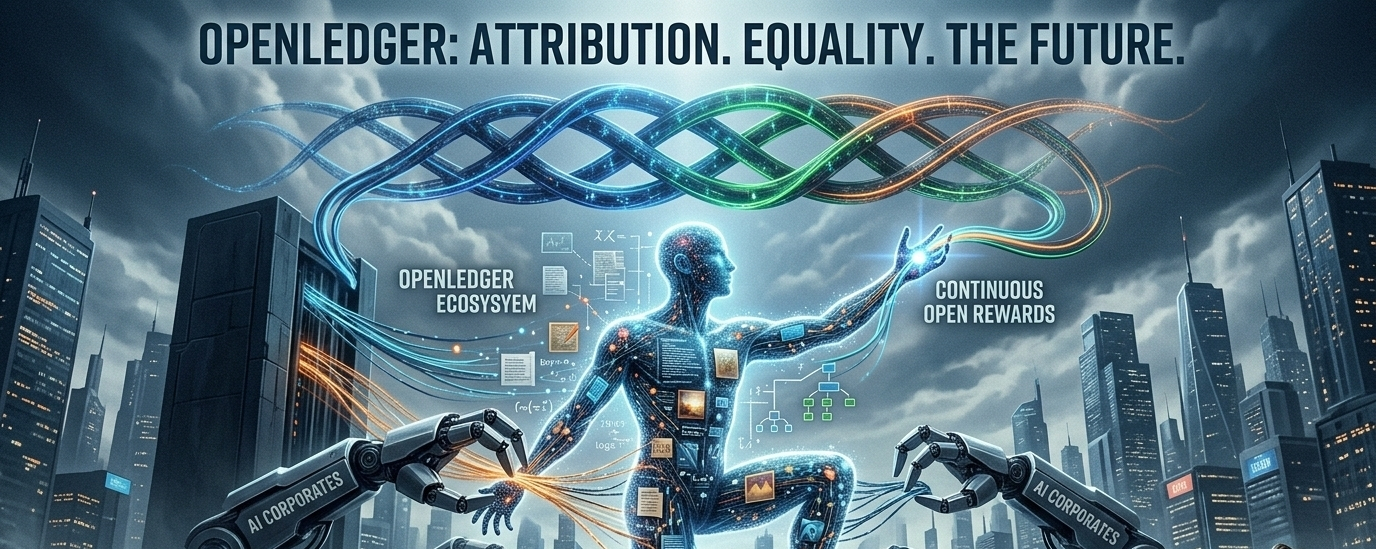
Right now, AI companies are building trillion-dollar ecosystems on top of data created by ordinary people who will probably never see a cent from it. Writers, artists, forum users, coders, researchers, even random people answering niche questions on Reddit ten years ago — all of that became training fuel.
I had a conversation with a photographer friend a few months ago who discovered AI-generated images mimicking styles suspiciously close to her own work. She wasn’t angry in the dramatic “robots are stealing art” way people frame online debates. She just looked tired. Her question was simpler.
“Wait… so they just took it?”
That’s the tension hanging over the entire AI industry right now. And most companies still don’t have a convincing answer.
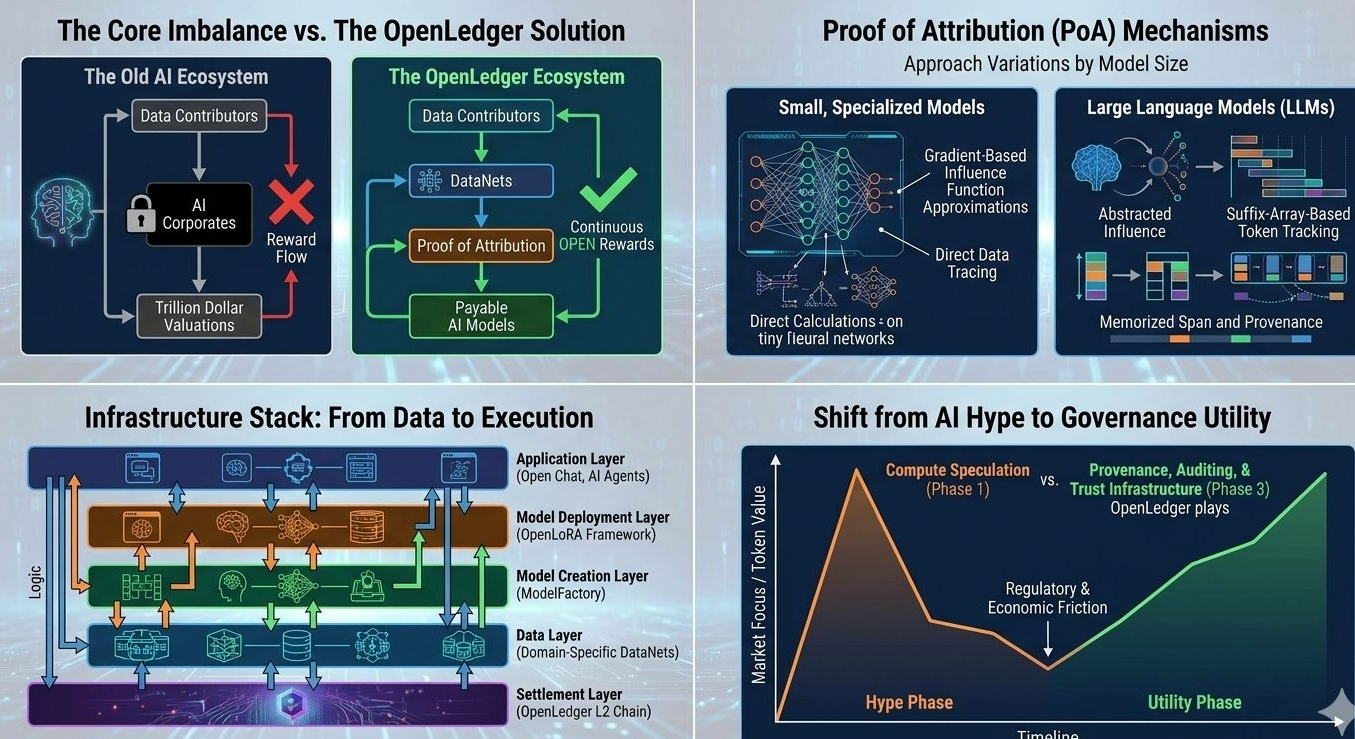
OpenLedger is basically trying to build infrastructure around that problem. The pitch sounds almost boring at first: create a system where data contributors, model builders, and AI agents can actually track and monetize the value they help create.
But boring infrastructure is usually where the real value ends up.
Nobody brags about TCP/IP anymore either. Doesn’t mean it wasn’t important.
The core mechanic here is something called “Proof of Attribution.” Yeah, the name sounds like it escaped from a whiteboard session in Silicon Valley. Ignore that part. Underneath the jargon, the idea is pretty human: if your data helped train an AI model, there should be some way to recognize and potentially compensate that contribution over time.
And honestly, I think the industry is heading toward this conversation whether Big Tech likes it or not.
Because the current setup feels increasingly unsustainable. AI firms scrape enormous amounts of public data, train models at industrial scale, then wrap the outputs inside subscription products worth billions. Meanwhile, the people whose work fed the machine mostly disappear from the equation.
That imbalance won’t stay politically invisible forever.
You can already feel regulators circling. Lawsuits are piling up. Newsrooms are starting to push back. Even musicians — who usually adapt faster than people expect — are getting uneasy. The Napster era taught the entertainment industry what happens when technology outruns ownership frameworks. AI feels like a much bigger version of that collision.
And this is where OpenLedger gets interesting.
Not because it has solved the problem. It hasn’t. Nobody has.
But because it’s at least attacking the right problem.
That matters more than crypto people sometimes admit.
I’ve seen plenty of projects with elegant technology chasing completely imaginary use cases. Incredible engineering pointed at markets nobody actually cared about. OpenLedger feels different because the underlying issue already exists in the real world. The pain is real. The legal uncertainty is real. The economic imbalance is real.
Now, to be fair, attribution inside AI systems is incredibly messy. Probably messier than many retail investors understand.
Neural networks don’t think like accountants. You can’t perfectly trace one output back to one training example the way people trace royalties in music licensing. Machine learning models are probabilistic systems. Patterns blur together. Influence becomes statistical rather than direct.
That’s why I get skeptical whenever projects claim they’ve “solved AI attribution.” Usually they haven’t even defined it properly.
OpenLedger, at least from what I’ve seen, seems more realistic about the difficulty. Their approach changes depending on model size and architecture. Smaller systems are easier to analyze. Massive language models? Different story entirely.
That nuance gave me some confidence. A little.
Because crypto has a terrible habit of pretending impossible infrastructure problems are already finished products. Usually right before a token listing.
And look, execution risk here is massive. Let’s not pretend otherwise.
Anytime you introduce financial incentives around data contribution, people will game the system. They always do. We saw it with click farms during the social media era. We saw it with SEO spam in the Google gold-rush years. We saw it with yield farming in DeFi, where “community participation” often became code for extracting token rewards as fast as possible before the music stopped.
Humans optimize incentives aggressively. Sometimes destructively.
OpenLedger will have to deal with that reality sooner or later.
Then there’s the computational side. Attribution sounds elegant in theory until you start imagining millions of users, thousands of models, endless inference requests, and giant datasets evolving in real time. Suddenly the infrastructure challenge becomes enormous.
Whitepapers are easy. Production systems are brutal.
Still… I think OpenLedger understands something important that much of the market still misses: the future of AI probably isn’t just one giant chatbot answering everything for everyone.
The real money will likely live in specialized systems.
Legal AI trained on regulatory data.
Medical models trained on verified clinical research.
Cybersecurity agents monitoring live threat intelligence.
Boring vertical stuff. Enterprise stuff. Expensive stuff.
That’s where provenance starts mattering. Because if an AI system gives dangerous medical advice or makes a compliance mistake that costs a bank millions, companies won’t just ask whether the output was “smart.” They’ll ask where it came from, what trained it, who validated it, and whether the entire pipeline can be audited after the fact.
Trust becomes infrastructure.
And infrastructure eventually becomes invisible.
That’s actually the part crypto people often struggle to accept. The best technology disappears into the background. Nobody opens Uber wondering which cloud provider routes the requests. Nobody taps a Visa card thinking about settlement architecture.
People care that the thing works.
That’s it.
If OpenLedger succeeds, normal users probably won’t even know they’re interacting with blockchain infrastructure. Developers will build AI applications. Contributors will receive compensation. Agents will transact with each other quietly in the background.
The chain itself becomes boring.
Honestly, that’s probably the healthiest outcome.
Because crypto spent too many years worshipping complexity for its own sake. Endless obsession over throughput numbers, consensus mechanisms, governance models — meanwhile normal people were just trying to send money without paying ridiculous fees or waiting twenty minutes for confirmation.
The same lesson applies to AI.
Nobody outside tech Twitter wants philosophical debates about decentralization. They want systems that feel fair, reliable, and useful. Preferably without needing a PhD or twelve browser extensions.
OpenLedger still has a long way to go. Competition is brutal. AI infrastructure is becoming crowded fast, and centralized players still hold most of the advantages — capital, compute access, distribution, talent.
That’s reality.
But I’ll give the project this: it feels aimed at something real instead of purely speculative theater. And after years of watching crypto build increasingly elaborate casinos disguised as ecosystems, that alone gets my attention.
Because eventually the market runs out of patience for narratives.
Utility is what survives.