

Quiet Infrastructure
After enough years watching crypto cycles rise and collapse into themselves, certain patterns become impossible to ignore. Every few years the internet discovers a new obsession, wraps it in futuristic language, throws billions of dollars at it, and suddenly everyone speaks as if history has already been decided. Most of the time, the loudest narratives revolve around visible things. Applications people can touch. Interfaces people can screenshot. Products people can show their friends.
But the systems that actually matter usually live underneath all of that.
That was the feeling I kept returning to while looking deeper into OpenLedger and the strange direction the $OPEN ecosystem is trying to move toward. Not because it feels polished or guaranteed to succeed. Honestly, the uncertainty around it is part of what makes it interesting. It feels less like a finished story and more like a difficult question nobody fully knows how to answer yet.
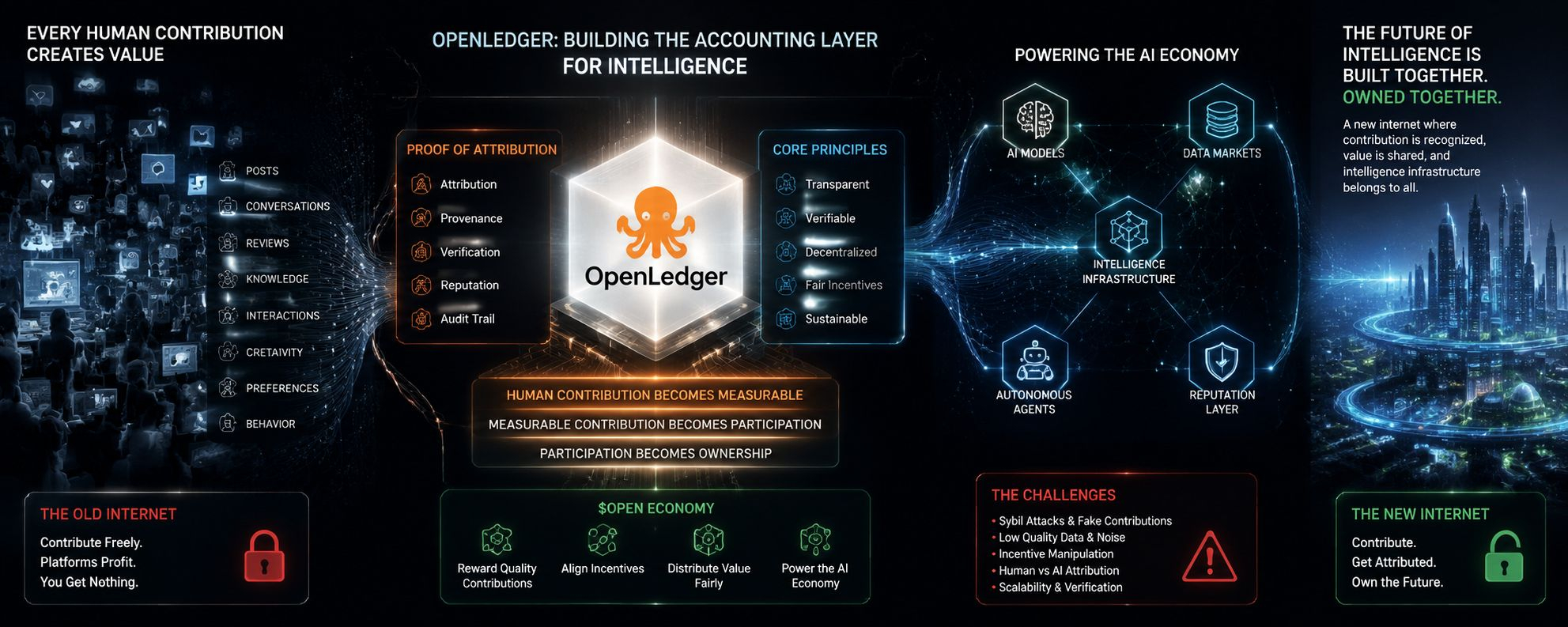
The internet has spent decades teaching people to contribute endlessly without ownership. Every post, conversation, correction, review, image, preference, and interaction slowly became fuel for platforms that grew richer while the people generating the raw material remained mostly invisible. Artificial intelligence didn’t invent that system. It simply intensified it to a level that suddenly feels impossible to ignore.
Most modern AI models are built on enormous layers of human behavior. Not just professionally curated datasets, but millions of scattered human moments collected over years. Language patterns. Reactions. Emotional tone. Specialized knowledge hidden inside forums, communities, archived discussions, and obscure corners of the web. Human contribution became infrastructure long before most people realized it was happening.
And yet almost none of those contributors own anything connected to the systems they helped shape.
That imbalance sits quietly underneath the current AI boom like a structural crack nobody wants to look at for too long.
OpenLedger seems focused on that hidden layer more than the surface-level excitement surrounding AI itself. The project keeps circling around ideas like attribution, data provenance, contribution tracking, and economic participation. Less attention on flashy outputs, more attention on the invisible mechanics underneath machine intelligence.
In theory, it sounds logical. If human contribution creates value, then maybe contribution should become measurable. Maybe data should carry traceable origins. Maybe intelligence production itself eventually becomes something people can participate in economically instead of simply feeding for free.
That’s where the idea behind Proof of Attribution starts becoming more interesting than it first appears.
Because once intelligence becomes infrastructure, the real battle stops being about who builds the most entertaining application. It becomes about coordination. Trust. Verification. Reputation. Accounting systems. Invisible architecture most people never think about until entire industries begin depending on it.
The difficult part is that human incentives tend to damage elegant systems very quickly.
Crypto history already proved that repeatedly. Strong ideas collapse all the time once real money enters the equation. Reward systems get manipulated. Low-quality participation floods ecosystems. Synthetic activity imitates authentic contribution. People optimize for extraction instead of usefulness. The internet has always been incredibly efficient at turning meaningful systems into incentive games.
AI ecosystems may become even more vulnerable to that problem.
If future intelligence networks rely on decentralized participation, then measuring quality becomes everything. Attribution sounds simple philosophically, but reality becomes messy fast. How do you verify whether data is meaningful? How do you prevent synthetic noise from overwhelming systems designed to reward contribution? What happens once autonomous agents begin interacting with other agents, generating endless feedback loops that blur the line between human and machine participation?
None of this feels easy to solve. And honestly, projects pretending otherwise usually make me suspicious.
Still, something about OpenLedger feels aimed at a real structural issue instead of simply attaching AI branding to another generic blockchain idea. The project seems more interested in the economic layers underneath artificial intelligence than in the usual spectacle surrounding AI products themselves.
That distinction matters.
Most people still think about AI as software they use occasionally. But underneath the surface, something larger is forming. Intelligence is slowly becoming networked infrastructure. Data flows are becoming economic systems. Reputation may eventually function like financial capital inside machine ecosystems. Contribution itself is turning measurable in ways the internet never fully achieved before.
And once contribution becomes measurable, people stop behaving like passive users.
They become participants.
That shift feels subtle now, almost invisible, but it changes the emotional structure of the internet over time. People begin interacting with systems differently once their participation carries ownership, rewards, or economic identity. AI coordination layers could eventually operate less like traditional platforms and more like massive invisible economies running quietly beneath ordinary online life.
Most people probably won’t notice when that transition starts happening. They’ll just see smoother products, faster outputs, more personalized systems. Meanwhile entire infrastructures around attribution, verification, and participation continue expanding underneath the surface.
That’s probably why infrastructure projects rarely receive attention early on. Useful systems usually look boring before they become essential. Nobody romanticizes the plumbing while the building still works.
I don’t know whether OpenLedger and the $OPEN ecosystem eventually become meaningful parts of that future or whether they disappear into the long graveyard of ambitious crypto infrastructure experiments. There’s still too much uncertainty around decentralized AI coordination systems for anyone honest to speak with confidence.
But late at night, after enough years watching technology reshape human behavior in slow motion, it becomes difficult to ignore the deeper questions emerging underneath artificial intelligence. Questions about ownership. About invisible labor. About who benefits from intelligence systems trained on countless human contributions spread across the internet like digital dust no one remembers leaving behind.
And somewhere inside that uncertainty, OpenLedger keeps trying to build accounting systems for a future that still feels blurry, unfinished, and strangely close at the same time.
Not loud systems.
Quiet ones.
The kind people barely notice until everything around them starts depending on them.