Honestly, guys, there haven't been many news pieces in the crypto space recently that even seasoned traders are stopping to check out. But on January 29th, I had to triple-check the date before I believed it wasn't an April Fool's joke—Story Protocol and @OpenLedger officially announced a partnership to create an automatic payment standard for AI training copyrights.
When this news dropped, my WeChat blew up. Several friends in the AI space were messaging me late at night asking for my take. They know all too well that the biggest headache in the AI industry over the past two years isn't about insufficient computing power or model parameters; it's about whether we should pay for training data, to whom, and how. In 2025, Anthropic faced forced data destruction and a massive settlement after illegally scraping 7 million pirated books to train their model. The New York Times sued OpenAI for $4 billion, and lawsuits regarding AI training data are exploding worldwide. These AI giants are drowning in legal issues while secretly scraping data.
So, the collaboration between Story and OpenLedger is essentially dropping a deep-sea bomb into this murky water.
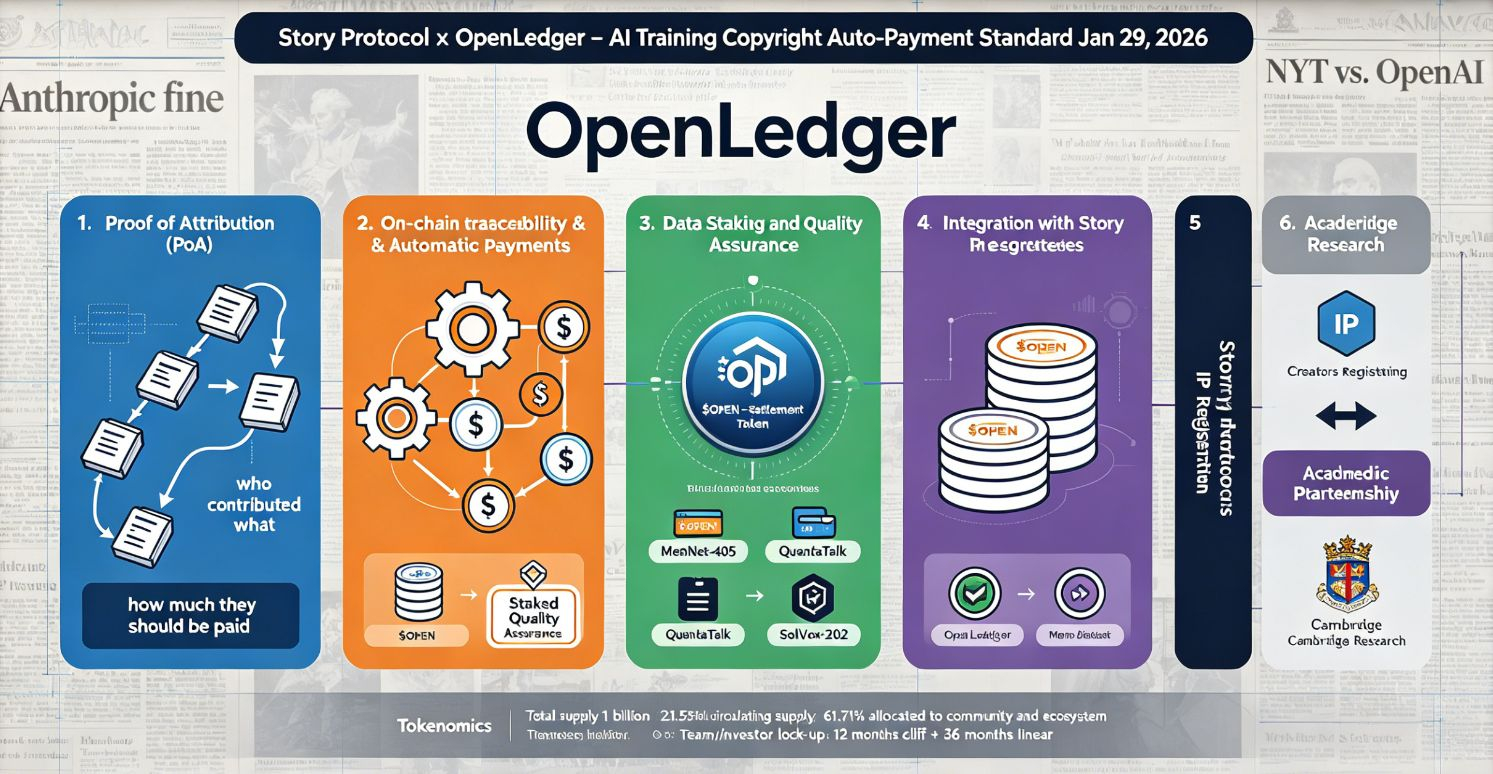
The gameplay is as follows: creators register their IP with Story Protocol, allowing AI systems to use it for training and output. @OpenLedger acts as an AI-native blockchain that enforces these authorization terms within the AI system and automatically transfers payments to the copyright holders. Both parties are also working together to establish an on-chain standard to record who owns the work, how it’s used, and who gets paid. My first reaction was that this is brilliant because it completely bypasses the outdated logic of 'sue first, ask questions later'—if you use someone else’s data, you’d better have your ticket ready before you even board.
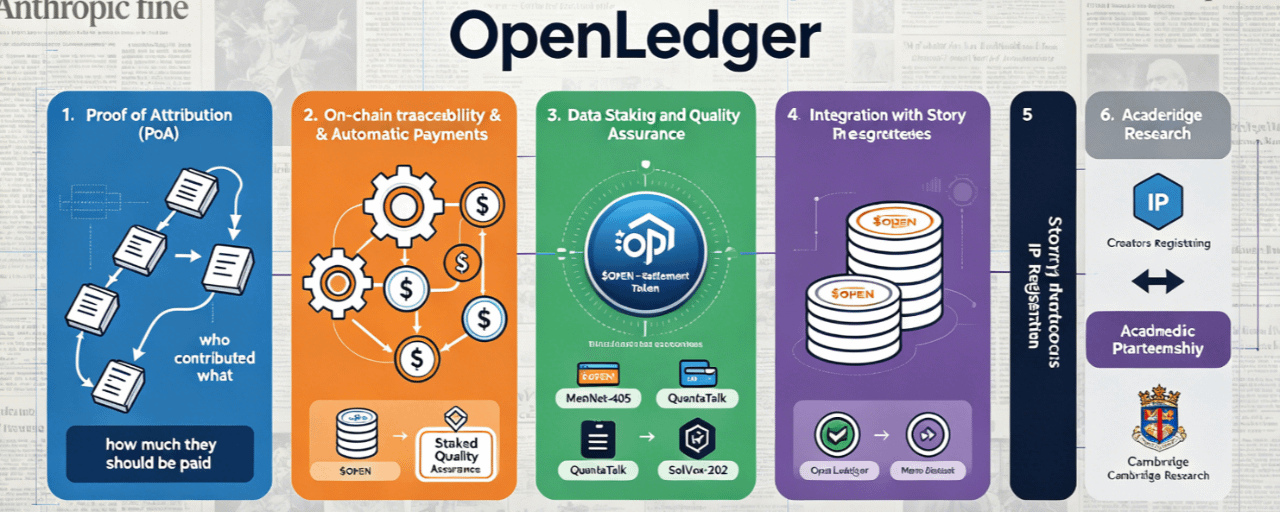
Now, we gotta talk about the core of OpenLedger: Proof of Attribution. In simple terms, every piece of data used by the AI model can be traced back on-chain. You can see who contributed, how much was used, and how much they should be paid, all clearly documented. From a technical standpoint, this mechanism uses cryptographic methods to trace each AI output back to the original data source and contributor, building a verifiable credit record, with payments automatically handled by smart contracts. OpenLedger’s team has made it crystal clear: 'AI cannot scale on scraped data and legal ambiguity.' In layman's terms, relying on stolen data and skirting legal issues won't get you far.
$OPEN This token plays a crucial role in that ecosystem. It’s not one of those governance tokens that promises the moon and you have to wait three years to see any action; it’s a real settlement tool within the ecosystem. Data providers in the ecosystem need to stake OPEN tokens to ensure data quality, model developers can earn revenue distributions through on-chain proof, and application users rely on traceable records to meet audit and compliance requirements. Interestingly, according to the latest on-chain data, OpenLedger's mainnet already has 20 datasets running, covering various verticals like medical imaging with MedNet-405 and Holohealth, financial markets with QuantaTalk and BankFlow-12, and governance in crypto with SolVox-202 and Ethra-401, even including a dataset specifically for collecting internet memes. This indicates that the demand logic for $OPEN isn't just stuck in a white paper; real-world scenarios are already consuming the token.
Let me point out something many overlook. @OpenLedger recently did something particularly 'academic'—they funded Cambridge University with $5 million specifically for decentralized AI research and prototype development. Just think about it—a crypto project investing in top-tier universities for long-term R&D. This changes the game completely. Short-term traders might not see the value, but those deeply rooted in the industry understand that this means OpenLedger's influence in the AI academic sphere is quietly taking off. Once the integration of industry, academia, and research takes shape, that moat won't be easily replicated by latecomers.
Let me break down the market cap data for you guys. As of May 19th, OPEN is priced at around $0.206, with a market cap of about $44.41 million. Over the last 90 days, it's seen a gain of 32.46%. The total supply is 1 billion tokens, with an initial circulating supply of 21.55%. The community and ecosystem allocation is a whopping 61.71%. The team's and investors' tokens are locked for 12 months, after which they'll be released linearly over 36 months. The design of this economic model is pretty clear—it’s not about letting early investors dump and run, but allowing enough time for the $OPEN ecosystem's value to solidify.
But to be frank, OpenLedger faces some serious challenges. Looking at the overall market, since the mainnet launched in September 2025, $OPEN has seen its trading price drop over 80% from its initial offering. The altcoins in the AI sector are generally under pressure; this is a systemic pullback across the entire space and can't be blamed on just one project. However, it poses a real issue for OpenLedger: while the Proof of Attribution mechanism is logically sound, convincing Web2 AI giants to voluntarily integrate on-chain tracing is as tough as getting traditional banks to fully embrace DeFi. There are friction costs in tech integration and deeper commercial interests at play—after all, some parties really don’t want data ledgers to become transparent.
Back to the initial point. OpenLedger made a statement that really stuck with me. They said this collaboration represents a shift from 'train now, litigate later' to 'use only what you can prove you're allowed to use.' We're moving from a chaotic era of jumping on the train without a ticket into a new phase where on-chain proof is the name of the game. The global IP market is estimated to be worth over $80 trillion, and the demand for compliant data in AI will only become more rigid. As this huge gap turns into real market demand, OpenLedger’s attribution and payment infrastructure won't just be a concept that crypto enthusiasts rave about; it'll become a fundamental component that the entire AI industry can't ignore.
$OPEN It's too early to say whether this token can become the settlement layer for a trillion-dollar market, but at the very least, it shows that someone has quietly set up the cash register. #OpenLedger