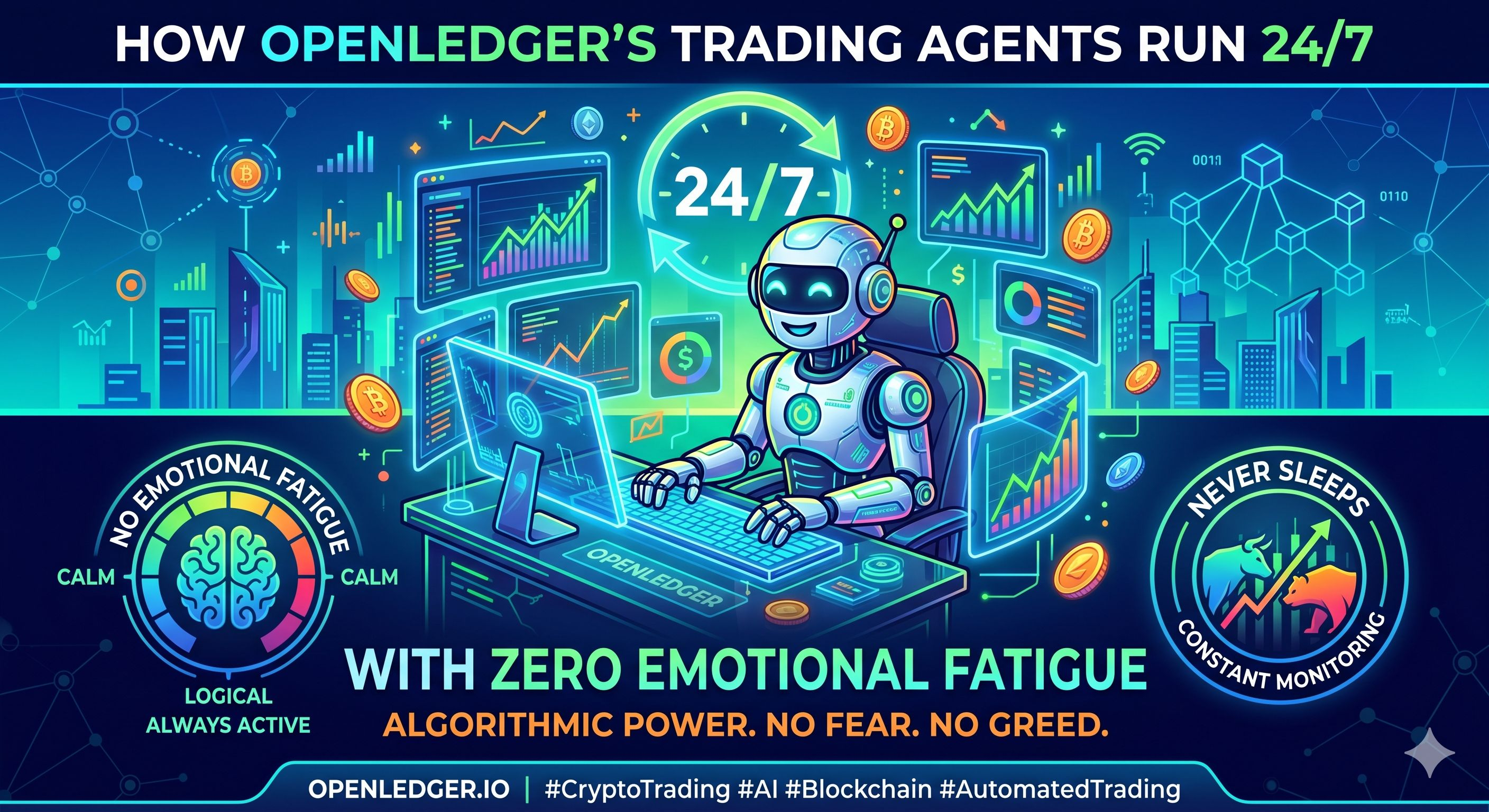
The largest source of loss in Web3 trading is rarely a lack of information.
It is human behavior.
A trader watches a portfolio bleed during a liquidation cascade and panic-sells at the bottom. Another stays awake chasing narratives across time zones, only to miss the real move because fatigue slows decision-making. Someone else abandons risk management after a winning streak and increases leverage at exactly the wrong moment.
The market does not care whether the mistake came from fear, greed, exhaustion, or overconfidence.
It only records the result.
This problem becomes exponentially larger in Web3 because the market never closes. Narratives rotate while people sleep. Liquidity shifts across chains in minutes. Sentiment changes faster than human reaction cycles. In a 24/7 environment, emotional endurance becomes a bottleneck.
That is why the next evolution of trading is not simply better prediction models.
It is the elimination of emotional bias from execution itself.
This is where autonomous trading agents enter the picture, and where OpenLedger introduces an important architectural direction.
The common misunderstanding around AI trading agents is that they are merely automated bots searching for alpha. That view is incomplete.
The real innovation is creating agents that can execute continuously while remaining verifiable, constrained, and trustless.
An agent running on OpenLedger’s framework can theoretically consume multiple live intelligence streams simultaneously: market structure data, sentiment signals, on-chain state changes, governance activity, liquidity movement, and smart contract events. Unlike human operators, these systems do not experience fatigue after sixteen hours of monitoring. They do not panic during volatility spikes. They do not FOMO into late entries.
They execute according to rules.
But this creates a more difficult question:
How do we trust autonomous execution?
A powerful AI agent without verification simply replaces emotional risk with black-box risk.
OpenLedger’s broader ecosystem becomes relevant here because the future of AI trading is not only about agents; it is about trusted data infrastructure.
Trading intelligence is only as reliable as the data feeding it.
If sentiment inputs are manipulated, if on-chain signals lack provenance, or if datasets cannot be verified, then autonomous systems merely automate flawed decisions faster.
This is why OpenLedger’s approach around data attribution and structured intelligence layers matters. Verifiable data pipelines create the foundation for verifiable agents.
The architecture starts to become clear.
The data layer provides trusted inputs.
The agent layer processes real-time intelligence.
The execution layer operates on-chain.
The security layer enforces immutable constraints.
These constraints are critical. Position limits, wallet permissions, stop-loss parameters, treasury exposure, leverage ceilings, and execution rights should not remain hidden assumptions. They should exist as transparent guardrails enforced through smart contracts.
In that model, autonomy does not mean unlimited freedom.
It means bounded intelligence.
Agents adapt within predefined limits while remaining accountable to verifiable rules.
This changes the role of humans entirely.
Humans stop micromanaging trades.
They define objectives, risk frameworks, and security boundaries.
Agents handle execution.
The future high-performance trader may not be the person staring at charts for twenty hours a day.
It may be a network of autonomous agents operating continuously, powered by trusted data, executing without emotional fatigue, and constrained by transparent on-chain guardrails.
In markets where milliseconds matter and narratives move overnight, removing emotion is not enough.
The real advantage comes from replacing emotional execution with verifiable intelligence.
That is the direction Web3 trading is moving toward.
And OpenLedger is building directly into that future.