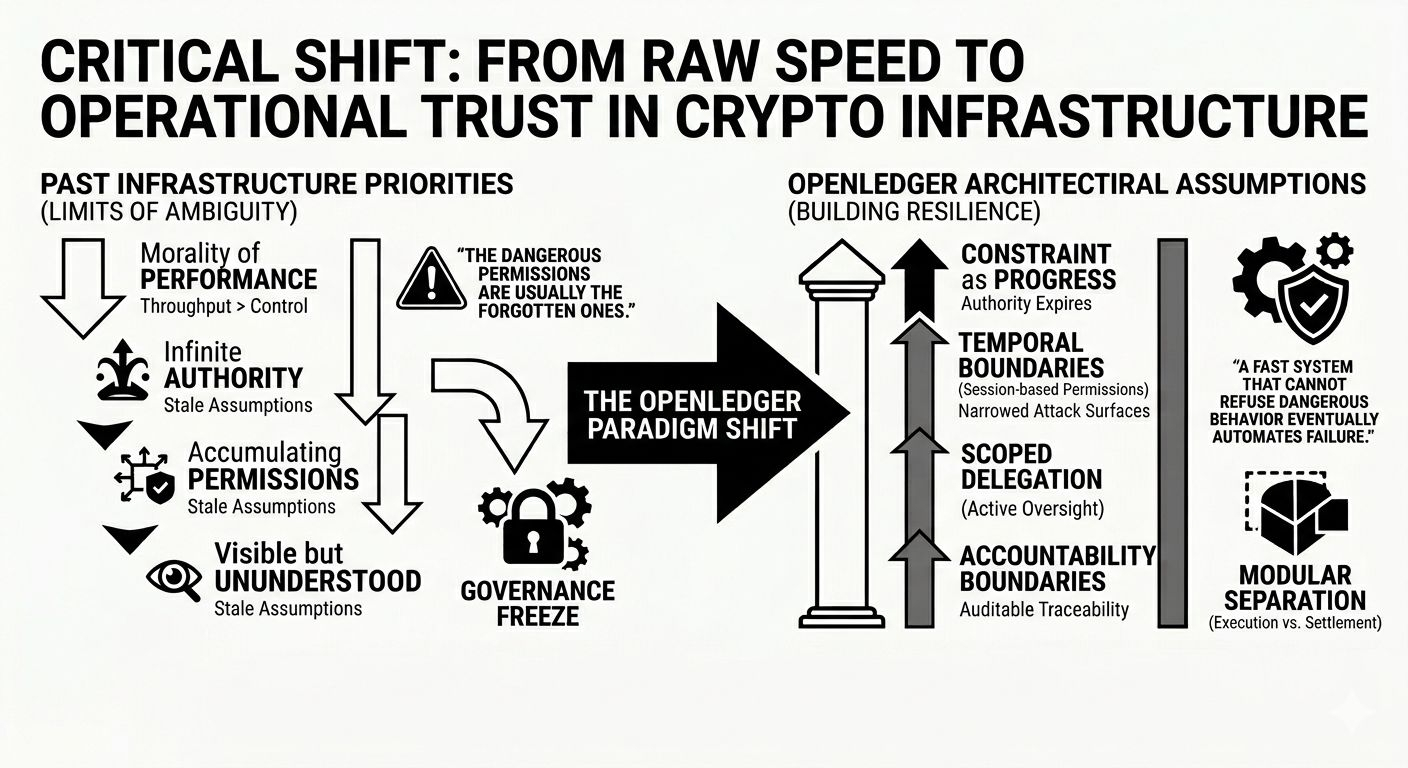
I still remember a governance freeze that unfolded sometime after midnight, when technical certainty disappeared faster than anyone expected. A treasury movement had triggered alarms, not because funds had definitively been stolen, but because nobody could cleanly explain the execution path that remained open. One signer believed their authority had expired weeks earlier. Another assumed delegation had been scoped to a specific operational event. Internal documentation suggested restraint; actual permissions suggested persistence. The engineering question became secondary to a more uncomfortable institutional one: who, exactly, still possessed the right to act?
That kind of ambiguity is not an anomaly in crypto infrastructure. It is one of its defining conditions.
For years, the industry treated performance as a moral good. More throughput meant progress. Lower latency meant sophistication. Smoother UX meant maturity. Entire architectural debates became centered around execution speed and settlement efficiency, while authority management remained strangely underdeveloped. Wallet permissions accumulated through convenience. Governance frameworks expanded faster than accountability clarity. Bridges promised interoperability while importing fragile trust assumptions across domains. Monitoring dashboards multiplied, but visibility is not the same as understanding. Infrastructure fatigue emerged not from computational weakness, but from institutional uncertainty.
“Trust rarely disappears gradually.”
That is partly why OpenLedger deserves attention—not as a speculative asset narrative, but as a set of architectural assumptions about operational trust.
The more compelling idea is not speed. It is constraint.
Session-based permissions suggest a recognition that authority should have temporal boundaries. Scoped delegation reflects a harder truth: permanent signer authority almost always outlives active oversight. Reducing signatures can create efficiency, but efficiency becomes meaningless if execution authority remains effectively indefinite. Most institutional failures are not born from malicious design. They emerge from operational ambiguity, stale assumptions, inherited permissions, and systems nobody fully revisits until pressure arrives.
“The dangerous permissions are usually the forgotten ones.”
OpenLedger’s SVM-based execution and high-throughput architecture are technically familiar. More interesting is the modular separation between execution and settlement. That separation creates clearer accountability boundaries, not merely cleaner engineering abstractions. EVM compatibility appears less ideological than practical, acknowledging that institutions rarely operate in isolated environments. But interoperability remains dangerous. Bridge fragility does not disappear because architecture becomes modular. State verification across environments creates monitoring blind spots. Composability increases attack surfaces faster than governance discipline usually evolves.
“A fast system that cannot refuse dangerous behavior eventually automates failure.”
Institutional psychology remains remarkably consistent. Auditors care about traceability. Treasury teams care about authority expiration. Operators care about narrowing attack surfaces. Validators inherit responsibility, not simply yield.
Infrastructure is not ultimately judged by how efficiently it accelerates execution.
It is judged by how well it contains human error before trust becomes unrecoverable.