
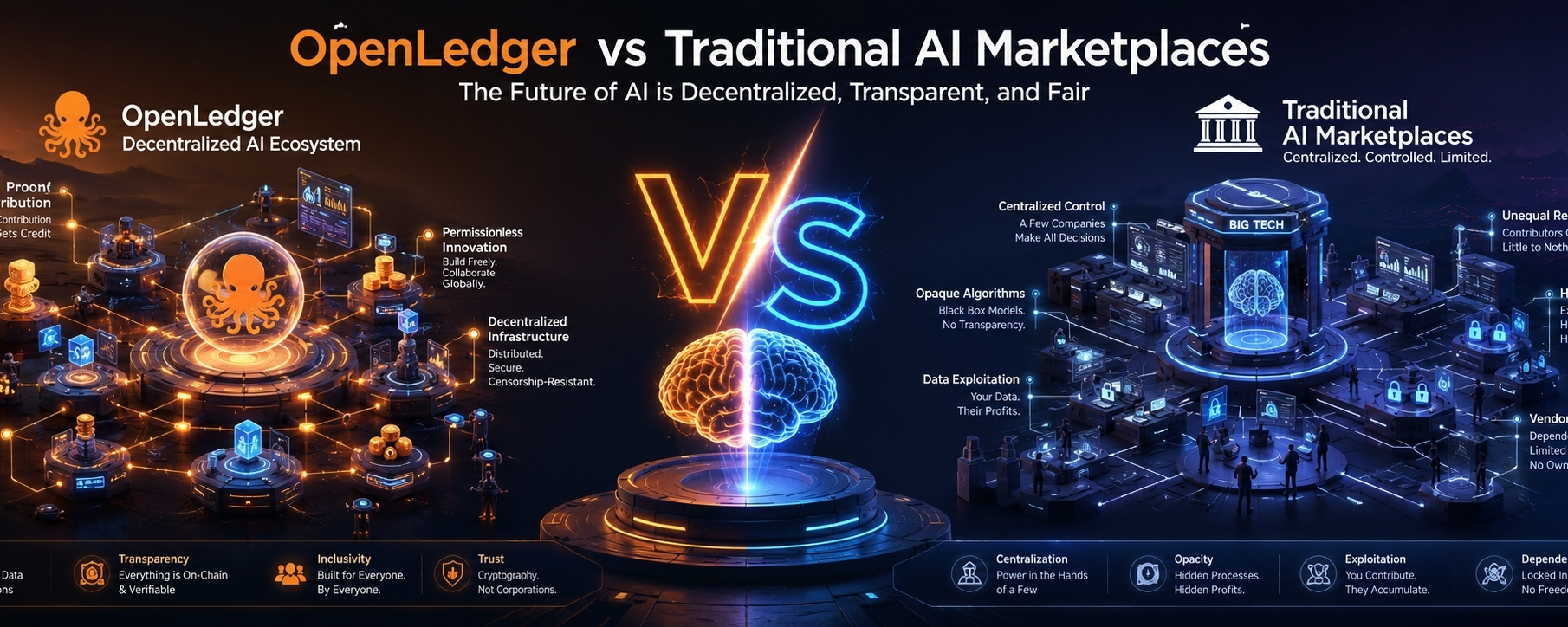
Artificial Intelligence is no longer just a futuristic concept discussed in research labs or tech conferences. Today, it is shaping healthcare, education, finance, e-commerce, media, and almost every digital industry. As AI continues to evolve, I believe one question is becoming more important than ever: who actually owns the intelligence, the data, and the profits generated by AI systems? This is where the debate between OpenLedger and traditional AI marketplaces becomes highly relevant.
For years, traditional AI marketplaces have dominated the industry. Large tech companies built centralized systems where developers could access APIs, cloud computing, machine learning models, and datasets from one controlled platform. These marketplaces made AI easier to use, and honestly, they accelerated innovation at a massive scale. However, I also think they created a system where a few companies gained enormous control over data, infrastructure, and revenue.
OpenLedger represents a completely different direction. Instead of allowing one company to own the ecosystem, it introduces a decentralized AI infrastructure powered by blockchain technology. In simple words, OpenLedger tries to create an AI economy where contributors, developers, and users are rewarded more fairly for the value they bring. From my observation, this is not just a technical upgrade; it is a philosophical shift in how AI systems may operate in the future.
Traditional AI marketplaces usually work through centralized ownership. A company controls the servers, algorithms, storage systems, pricing models, and governance. Users upload data, developers train models, and businesses consume AI services through the platform. While this structure is efficient, I think it also creates dependency. If the platform changes its policies, increases pricing, or limits access, users have very little control.
This is one of the biggest reasons decentralized AI projects are gaining attention. OpenLedger focuses heavily on transparency and contributor ownership. Instead of hiding operations behind closed systems, it records contributions on-chain so participants can actually see how value is created and distributed. Personally, I think this level of transparency is something the AI industry has needed for a long time.
One issue I often notice in traditional AI ecosystems is that contributors rarely receive proportional rewards. Millions of people generate data every day through content creation, research, coding, writing, and online activity. AI companies use enormous datasets to train models, but the individuals contributing indirectly to these systems usually receive nothing in return. OpenLedger tries to change that through its “Proof of Attribution” mechanism, which tracks contributions and rewards participants accordingly.
From my perspective, this idea could become extremely important in the future. As generative AI tools continue growing, debates about copyright, ownership, and creator rights are increasing worldwide. Writers, artists, designers, and developers are becoming more concerned about how their work is being used to train AI models. I think systems like OpenLedger are responding directly to these concerns by introducing accountability and traceability into AI development.
Another major difference between OpenLedger and traditional AI marketplaces is governance. In centralized systems, decision-making power stays with company executives and shareholders. Users may depend on the platform, but they usually have no influence over policies or future development. OpenLedger introduces community governance where token holders can participate in ecosystem decisions. I believe this creates a stronger sense of ownership among participants because they are not just customers anymore; they become stakeholders in the ecosystem itself.
Cost is another area where I see decentralized AI creating long-term opportunities. Building AI systems today is incredibly expensive. Traditional AI marketplaces rely on massive cloud infrastructure and GPU resources controlled by major corporations. Smaller startups and independent developers often struggle to compete because the costs are simply too high. OpenLedger’s decentralized infrastructure attempts to distribute computing resources more efficiently. If this model matures successfully, I think it could lower the barrier to entry for thousands of smaller innovators around the world.
At the same time, I do not think traditional AI marketplaces are disappearing anytime soon. They still offer huge advantages such as reliability, scalability, enterprise support, and faster deployment. Large corporations trust these systems because they are stable and well-established. OpenLedger and other decentralized AI projects are still in their early growth phase, and they must prove they can handle real-world demand at scale.
One thing I personally appreciate about OpenLedger is its focus on building an ecosystem rather than just a platform. Many traditional AI companies operate within closed environments where users stay dependent on one provider. OpenLedger seems to encourage collaboration between decentralized data providers, compute networks, and AI developers. This creates a more open structure where innovation can come from multiple directions instead of one centralized authority.
However, I also think decentralized AI faces serious challenges. Regulation is one of the biggest. Governments worldwide are introducing AI laws related to privacy, copyright, ethics, and accountability. Managing compliance in decentralized systems could become complicated because operations are distributed globally rather than controlled by one organization. Questions about legal responsibility and governance still need clearer answers.
Another challenge is adoption. Most businesses prefer systems that are easy, fast, and reliable. Traditional AI marketplaces already have established infrastructure and strong reputations. OpenLedger must convince companies that decentralization can offer not only fairness but also performance and scalability. In my opinion, this will determine whether decentralized AI becomes mainstream or remains a niche sector.
Still, I think the momentum behind decentralized AI is real. The technology industry is gradually shifting toward models that prioritize user ownership, transparency, and community participation. We already saw this transition happen in finance through decentralized finance platforms. Now, similar ideas are entering the AI industry. OpenLedger appears to be positioning itself at the center of this movement.
Looking ahead, I believe the future benefits of decentralized AI could be significant. First, contributors may finally receive measurable rewards for the data and resources they provide. Second, businesses could gain access to more transparent AI systems where decision-making processes are easier to verify. Third, developers may no longer depend entirely on expensive centralized providers to build and scale AI products.
I also think decentralized AI can democratize innovation. Right now, only a handful of companies have enough resources to dominate advanced AI development. If decentralized infrastructure lowers operational costs and increases accessibility, smaller startups, researchers, and independent developers could compete more effectively. That would create a healthier and more competitive AI ecosystem overall.
In many ways, OpenLedger represents more than just another blockchain project. From my observation, it reflects a growing demand for fairness in the digital economy. People no longer want to contribute value without recognition or compensation. They want ownership, participation, and transparency. OpenLedger’s model attempts to align AI development with those expectations.
In conclusion, the comparison between OpenLedger and traditional AI marketplaces highlights two very different visions for the future of artificial intelligence. Traditional marketplaces offer stability, convenience, and powerful infrastructure, but they also centralize control and profits within a few corporations. OpenLedger introduces a decentralized alternative that focuses on transparency, contributor rewards, and community governance.
I do not think one system will completely replace the other overnight. Instead, I believe both models may coexist for years while the industry decides which approach creates more long-term value. However, one thing is clear to me: the rise of decentralized AI is not just a temporary trend. It is part of a much larger transformation in how technology, ownership, and digital economies are evolving. OpenLedger may still be developing, but its ideas are already influencing how people think about the future of AI.