
Last Tuesday, I checked out an AI agent running on OpenLedger. It doesn't just trade; it also reallocates capital through various states within the same strategy.
What made me go 'WOW' wasn't the final result, but how the system 'remembers' the entire capital flow process at each step in the execution flow. It's not like your usual trade log anymore; it's like watching a financial heartbeat recorded through each state transition.
I used to think of it simply like this. Memory in AI or agents is just conversational memory, like how ChatGPT retains chat segments to respond in context. The market isn’t much different; just add context and it’s enough. I once believed that with enough chat data, enough transaction logs, the agent would ‘understand’ capital behavior on its own.
But when I looked more closely at the experimental AI trading systems on OpenLedger, I began to see that assumption was a bit off. There are situations where the bot makes reasonable decisions at the current moment, but contradicts its own past capital behavior. Not because the model is bad, but because it lacks a proper memory layer of how the financial states have transitioned step-by-step. There's a case I see quite clearly: the bot hedges in the right direction during a funding arbitrage, but a few blocks later adds an opposite exposure, and when audited, it’s not that the logic is wrong, but that it ‘doesn't know what it has become’ at the previous step. AI doesn’t forget orders. It forgets the state that those orders created.
For me personally, the interesting point about OpenLedger lies in the fact that they no longer consider memory as text. The financial memory here isn’t about 'what was said before,' but rather 'what states the capital has gone through.' It logs state transitions, so every time capital changes position, risk, or exposure, the system records it as a structured state transition chain.
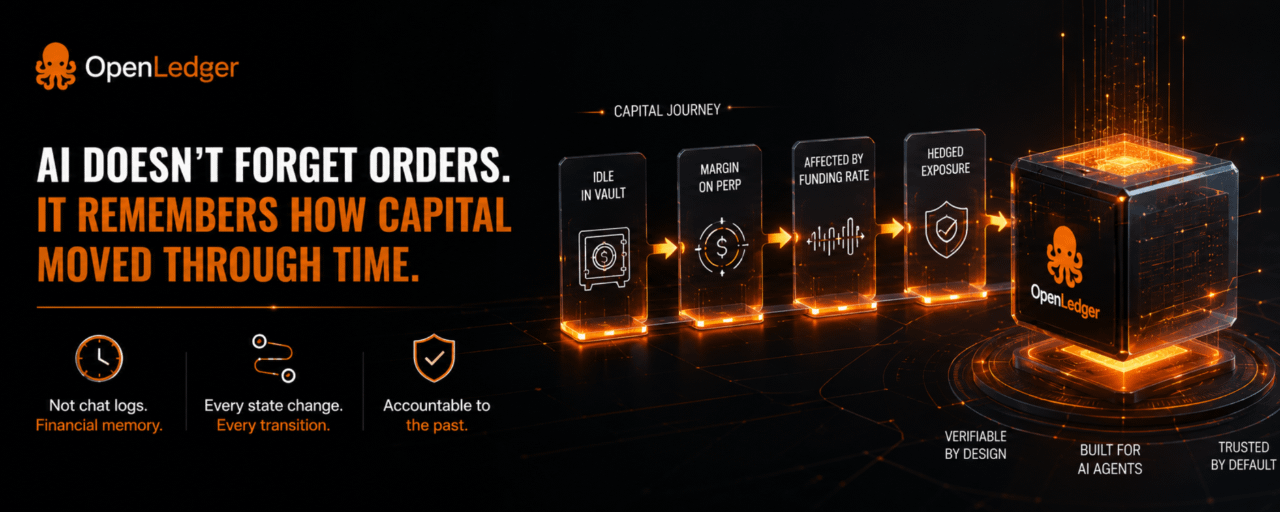
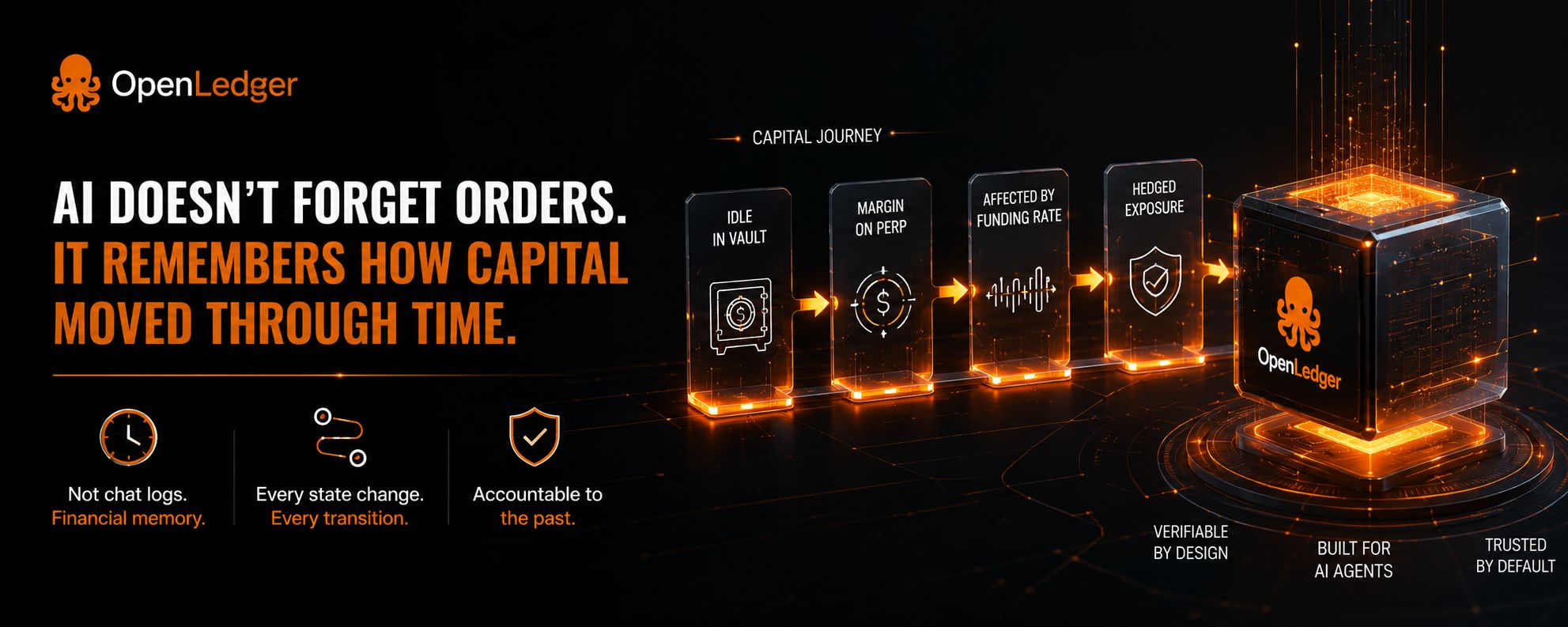
I saw a small example: an AI agent executing an arbitrage funding strategy between two venues. Instead of just logging buy and sell orders, OpenLedger records the entire lineage of capital, from when it was idle in the vault, to margin on perp, influenced by funding rates, and then back to a hedge state. Looking back, it resembles a movement map of capital rather than a transaction history, and more importantly, each step can be traced back to understand 'why the current state makes sense within the internal logic of the system.'
This design approach makes me think of something simpler. It’s like the difference between a chat and an accounting ledger. Chat just tells you 'what was said,' while accounting tells you 'where the money went and how it changed states.' The financial memory of OpenLedger is closer to an accounting ledger, but for AI agents instead of humans.
What’s a bit unintuitive is that when you start fully logging state transitions like this, you not only help the AI ‘remember,’ but also force it to take responsibility for its own past. A new decision is no longer independent, but rather a continuation of a capital chain that has already been shaped. It’s like the system no longer allows the agent to ‘reinterpret the past’ in the most convenient way for current decisions.
But of course, no design is perfect. I think the biggest issue is the complexity of accurately reconstructing the lineage. Just one wrong link in the bridge data, latency, or skewed oracle, and the entire financial memory can become distorted. And at that point, AI isn't wrong because of logic, but because the input reality layer was already off. It can be even more dangerous if it remains 'confidently correct' because the upper memory still appears consistent internally.
At this point, I feel this direction is more important than just increasing model size or adding tools for the agent. Because when AI starts managing real capital, what matters isn’t how well it ‘understands conversations,’ but whether it accurately retains the history of capital movements.
And if we return to OpenLedger, perhaps the most crucial point isn't that AI trades better, but that it is no longer allowed to forget how it has previously moved capital through the system. Once financial memory becomes a mandatory layer, OpenLedger is not just a place where execution happens anymore, but a place where the history of capital is fixed into something that all future decisions must navigate through.
