
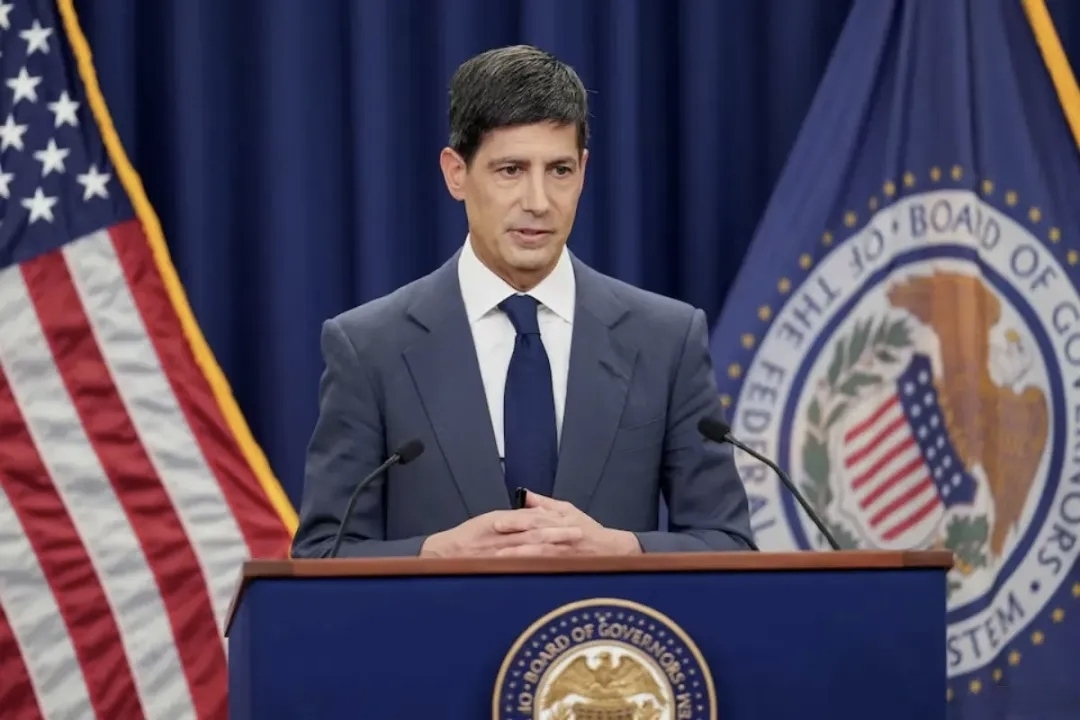
In the early hours of June 18th, Beijing time, the new Fed chair Kevin Wash made his debut.
The rate itself was a no-brainer—holding steady at 3.50%-3.75%, keeping it on hold for the fourth time in a row, with a unanimous vote for the first time in nine months. But what really sent the market into a frenzy were the three things Wash put out: a significantly trimmed-down statement, an unexpectedly hawkish dot plot, and a complete cancellation of forward guidance.
What's Wash up to?
First, let's look at the statement. The FOMC statement from April had 341 words, and this time it’s down to just 130, cutting almost two-thirds. They removed all hints of 'further rate adjustments' and scrapped the forward guidance.
Wash's explanation is: the current environment's forward guidance is no longer applicable.
In layman's terms — I don't even know how things will play out, so don't hold me to my previous statements.
This sounds tough, but Wall Street traders are losing their minds. For the past decade, their job was to 'interpret Fed guidance'; now that guidance is gone, and with 19 regional Fed presidents each voicing their opinions, market expectations will become extremely chaotic.
Now let's look at the dot plot. Wash himself did not submit a forecast, becoming the first Fed chair in 14 years to skip submitting a dot plot. However, among the other 18 officials, 9 believe there should be at least one rate hike this year, with 6 believing there should be at least two, and 1 believing there should be three. Only 1 insists that rates should be cut.
Back in March, multiple officials were predicting rate cuts, but now it's all flipped.
In terms of inflation forecasts, the overall PCE for 2026 was significantly raised from 2.7% to 3.6%, with core PCE going from 2.7% to 3.3%, and GDP growth rate adjusted down from 2.4% to 2.2%.
This is a signal of being all in on hawkishness.
Market Reaction: Double whammy for stocks and bonds, gold took a nosedive.
As soon as the data came out, the market just collapsed.
Bond Market: The 2-year US Treasury yield jumped about 13 to 16 basis points in a single day to around 4.21%, marking the highest since February 2025. The 10-year yield rose to about 4.48%.
Dollar: The dollar index surged 0.85%, reporting 100.4, regaining the crucial 100 level. This 100.4 level needs close monitoring; if it breaks decisively, the dollar could enter a sustained rally mode.
Gold: Spot gold plummeted immediately after the announcement, hitting a low of $4218.99/oz, ultimately closing down 1.7% at $4257.78. It fell nearly 2% in a single day. Gold has now breached the 200-day moving average; the technical picture was already weak, and now with the hawkish shift, short-term downside risks are significant.
US Stocks: All three major indices closed down, with the S&P 500 down about 1.2%, the Nasdaq down 1.34%, and the Dow down about 1%. The Nasdaq led the decline, which is a signal — indicating that the market is pricing in the fading expectation of Fed rate cuts.
Interestingly, SpaceX saw its first drop after going public, closing down nearly 5%. Meta fell over 5%, while Amazon and Microsoft dropped over 3%. Conversely, the Philadelphia Semiconductor Index rose 1.38% against the trend — the belief in AI hardware is still strong.
Interest Rate Futures Market: Traders are casting their votes with real cash. Before the meeting, the probability of a rate hike in September was 33.2%, and in December, it was 41.3%. After the meeting, the September probability shot up to over 80%. On Polymarket, the probability of 'no rate cuts in 2026' also skyrocketed to 82.9%.

Wash's Dilemma
Wash's current situation is honestly quite challenging.
His father-in-law is the owner of Estée Lauder, a long-time backer and close friend of Trump. Trump's core demand has always been for rate cuts — something he's been chasing Powell about for years.
But would Wash come in and cut rates? That would make him a puppet, undermining the Fed's independence. So, Wash must first establish an 'independent persona' — I'm not taking orders from Trump, I'm only looking at the data.
How to proceed? Keep inflation below 2% before even talking about rate cuts.
But here's the catch: inflation is at 4.2%, a new high since May 2023. The May CPI rose 0.5% month-on-month, with energy prices surging 23.5% year-on-year. Bringing it down to 2% is no easy task.
Moreover, Wash's policy options are contradictory: raising rates to combat inflation → stock market crash; cutting rates to please the White House → credibility collapse; reducing the balance sheet → long-term rates soar, contradicting White House demands.
He can only hope that several ideal scenarios happen simultaneously: the US-Iran deal genuinely lowers oil prices, AI productivity stories materialize, and inflation naturally retreats.
The variable in the US-Iran agreement.
Speaking of the US-Iran deal, both sides electronically signed a memorandum of understanding on June 15, and it will be formally signed in Switzerland on June 19. The Strait of Hormuz is expected to reopen.
This timing is quite interesting — the FOMC just wrapped up, Wash just went hawkish, and Trump immediately went to sign a ceasefire agreement. If oil prices drop and inflation pressures ease, Wash will have 'data-driven' reasons to consider rate cuts.
Trump and Wash, one is a bit wild, the other is well-dressed, but don't forget they are in this together.
What's the next move?
In the short term, the market won't just crash all at once, but volatility will be greater.
What the Fed is doing right now is essentially a stress test — seeing if the market can digest the rate hike expectations. If it can't hold up, the Fed will also be tested on whether it has the policy space to step in.
The biggest macro risk is no longer just about one or two rate hikes, but how long the AI narrative can hold up. July is the tech earnings season for US stocks; if giants like Nvidia, Microsoft, and Google report disappointments, combined with rate hike expectations, volatility in the third quarter could be extremely severe.
On gold, don't expect it to spike to 7,000 or 10,000 in the short term — that's a speculative mindset. The tug of war between gold and the dollar will continue for several years; that's the nature of a gold bull market. If the dollar index breaks decisively above 100.4, gold will feel immediate pressure.
One last thing: In times of prosperity, watch for bubbles; in times of excitement, think of crises. When everyone is panicking, that's the opportunity for those who are prepared. The prerequisite is — you need to be ready in advance, including your positions and mindset.
(End of the article)