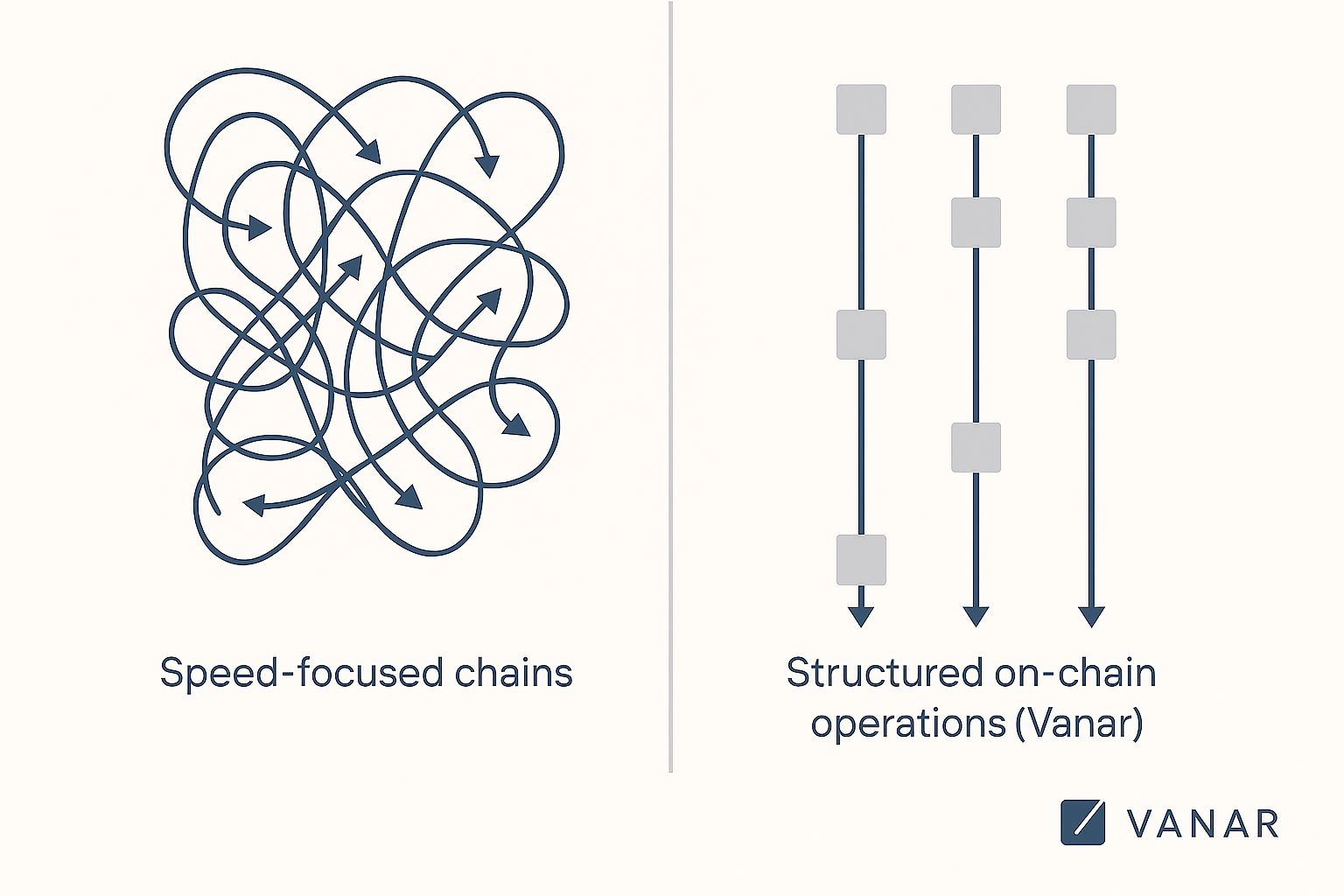
Most blockchains try to impress users with numbers such as transactions per second, block time, or theoretical throughput. But these metrics only describe how fast a system can move, not how clearly it behaves. Vanar @Vanarchain approaches the problem from a different angle by focusing on how on-chain operations are structured and exposed to users and developers.
At the protocol level, Vanar separates different categories of actions instead of treating all transactions as identical. Simple transfers, contract interactions, and more complex processes do not compete blindly in the same way. This separation allows resource usage to be more visible and predictable, which reduces uncertainty when the network is under real usage pressure.
This design matters because blockchain usage is rarely uniform. Traffic comes in bursts. Some actions are cheap and frequent, while others are heavy and occasional. When a network does not distinguish between these patterns, congestion becomes difficult to manage. Vanar's structure allows different workloads to coexist without collapsing into a single bottleneck.
From a developer perspective, this creates clearer constraints. When operations are well defined, applications can be designed around them rather than guessing how the network will behave. Developers know which actions are lightweight and which ones require more planning. This reduces trial-and-error development and makes performance more consistent across different use cases.
Another important effect is on user behavior. When actions have clear definitions and costs, users interact with the network more intentionally. Instead of spamming interactions or treating the chain as an experiment, users begin to understand which actions are worth repeating. Over time, this shifts usage from curiosity-driven activity to habit-driven activity.
In my view, this is where Vanar quietly differentiates itself. It does not try to hide complexity entirely, but it also does not overwhelm users with technical detail. The structure exists in the background, guiding behavior without forcing people to read documentation to understand why something works or fails.
This approach also improves long-term reliability. When resource usage is predictable, infrastructure can be optimized for real demand instead of theoretical peaks. Nodes are less likely to experience sudden stress from unexpected workloads, and applications become more stable as usage grows.
Rather than chasing attention with extreme performance claims, Vanar seems to focus on making normal usage feel stable and understandable. This may not create instant hype, but it builds confidence for developers and users who care about consistency more than spectacle.
As blockchain adoption moves beyond testing and into everyday use, clarity may become more valuable than speed alone. Will users continue to favor networks that look fast on paper, or will they choose systems like Vanar where $VANRY supports structured, predictable on-chain activity they can understand and rely on over time ?