

Today’s world is changing very rapidly. Technology is no longer just helping us, but is also gradually becoming a part of decision-making. At the center of this change are two powerful things—Artificial Intelligence and Blockchain. Until now, we have seen them as separate entities. But the change that is happening now is something different. Together, these two technologies are creating something that will redefine the future economy, finance, and digital trust structures. This is where Vanar Chain comes into its own.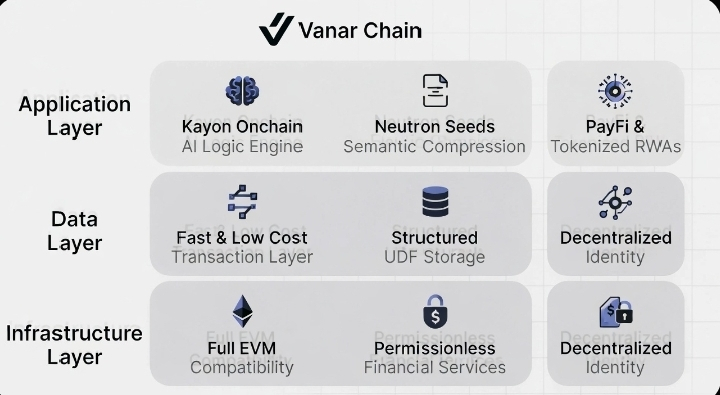
Vanar Chain cannot be called just another Layer-1 blockchain. Because it has come out of the old mindset, where the work of blockchain was just to record transactions. Vanar was created from the beginning with a completely different vision. It is a chain that does not just store data, but tries to understand the meaning of that data. Here, blockchain is no longer a silent ledger; rather, it is gradually becoming an “intelligent system”.
Today, we see that most blockchains are adding AI from the outside. That is, first a chain is built, and then some AI features are installed on it. But Vanar has taken the opposite path here. Vanar is AI-native from the beginning. That means AI is not an add-on, not a plug-in. AI is the internal language of this chain, the internal logic, part of the internal thinking. This is why many see Vanar as a solid foundation for the financial infrastructure of the future.
The most unique and revolutionary aspect of Vanar is Kayon. Simply put, Kayon is a decentralized AI brain inside the chain. The smart contracts we have seen so far basically work according to very specific rules. If this condition is met, then this will work—this kind of straightforward logic. But real-life finance, legal documents, or compliance are never that straightforward. There is context, interpretation, layers of conditions, and dependence on real situations.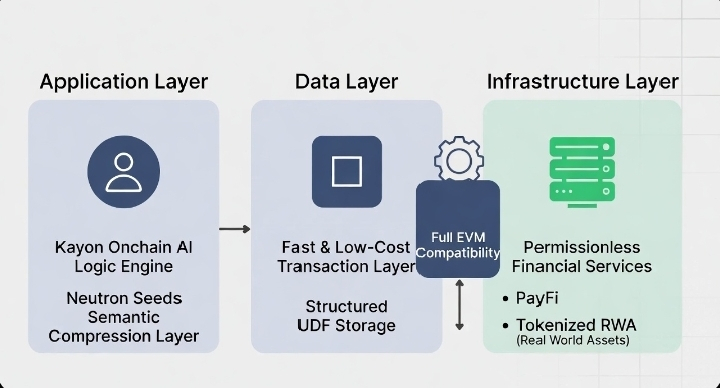
This is exactly where Kayon makes a difference. It empowers smart contracts, AI agents, and dApps to query, analyze, and make decisions on live, compressed, and verifiable data. Imagine automatically extracting the necessary logic from a legal document or receipt. If the conditions are right, the payment is released, and if there is a compliance issue, it is blocked. Everything happens on-chain, without relying on any oracles, without the hassle of off-chain computation. This is not just a marketing buzzword; it is real, structured, AI-native logic. Another big strength of Vanar is its full-stack design. Here, all layers are deeply connected to each other. The core Vanar Chain layer is very fast, low-cost, and EVM-compatible. This means that developers can work easily here, and users get fast transactions and low fees. This is very important for PayFi or everyday payments. At the same time, it creates a solid foundation for tokenized real-world assets, such as invoices, bonds, or real estate in the future.
Then comes Neutron Seeds. It would be wrong to call it just a compression tool. Neutron Seeds basically does semantic compression. Large files, such as videos, legal documents, or financial records, can be converted into small “Seeds” and stored on-chain. Here, not only are the files getting smaller; the meaning of the data is also being retained. As a result, that data is easier for AI to read and understand. As a result, the problem of data fragmentation that has been in blockchain so far is largely eliminated.
Standing on top of all this, Kayon analyzes that data again, understands the context, and helps take action. The Vanar Stack that these three layers have created together can actually be called a complete on-chain intelligent financial infrastructure. Axon and Flows are coming up, which will take automation and industry-specific applications a step further.
PayFi and Real-World Asset Tokenization—these two sectors are now widely understood to be huge in the future. But these sectors don’t just need fast blockchains. They also need compliance, automation, and intelligent decision-making. This is where Vanar fits in perfectly. Here payments are not just fast, they’re smart. Here assets are not just tokenized, they’re truly liquid and intelligent.
At the heart of this entire ecosystem is the $VANRY token. It’s not some empty speculative coin. It’s directly tied to gas fees, staking, governance, and network security. The more AI workloads, the more on-chain reasoning, and the more real-world usage, the more natural demand for VANRY will be. This demand is not artificial; it comes from real utility.
Another big plus point of Vanar is its accessibility. Being EVM-compatible makes it very easy for developers to come here. Also, using tools like myNeutron, ordinary users can also upload files, create semantic memories. This means that even though it has enterprise-grade capabilities, it is not limited to large companies.
In conclusion, it can be said that
It brings the idea of a blockchain that not only stores data, but also understands that data and acts on it when needed. Compliance, auditability, transparency—everything is possible on-chain. There is no blind reliance on oracles, there are fewer trust gaps.
Those who can look a little further into the future understand—AI agents will be the backbone of the economy of the future, PayFi will expand rapidly, and the RWA market will take on a huge size. Vanar stands right at the intersection of these three trends. So in the eyes of many, it is not just another project, but the beginning of a new horizon. Vanar Chain is becoming a symbol of innovation, intelligence, and financial freedom. It is not just a chain, it is an idea—where blockchain learns to think, money flows intelligently, and future possibilities slowly begin to take shape.