
Vanar Chain is easiest to understand when you stop looking for spectacle. It does not behave like a project trying to dominate conversation or rush into every emerging narrative. Instead, it behaves like infrastructure that expects to be judged over time, through use rather than attention. That choice shapes almost everything about VANAR Chain, from its technical priorities to how it positions itself around creators, developers, and end users.
Infrastructure rarely gets credit when it works. Roads, payment rails, and operating systems fade into the background once they are reliable enough. Blockchain, by contrast, still tends to announce itself loudly. Wallet pop-ups, confirmation delays, and unfamiliar language remind users constantly that they are interacting with something complex. Vanar’s core idea seems to be that this visibility is not a feature. It is friction.
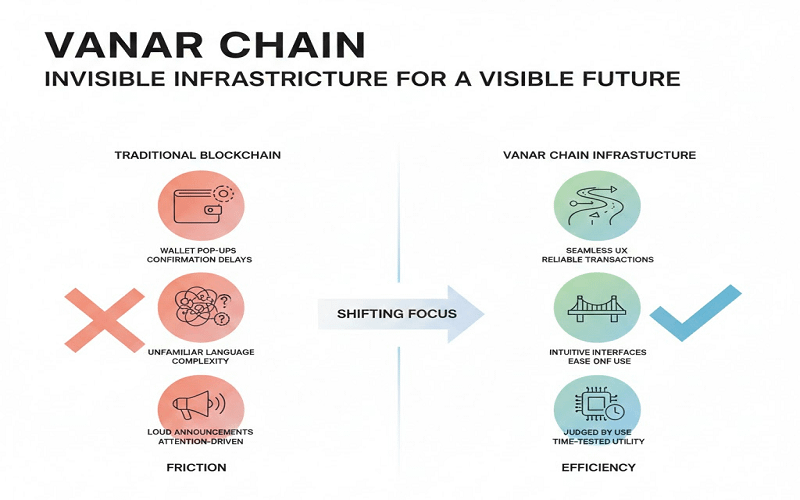
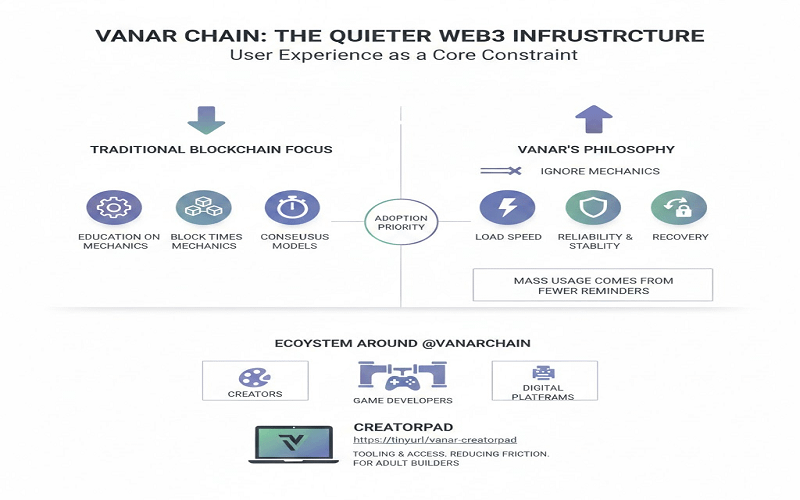
When you observe Vanar Chain from that angle, the emphasis on user experience starts to feel less like a marketing phrase and more like a constraint. The goal is not to educate every user about blockchain mechanics. The goal is to let them ignore those mechanics entirely. If someone is creating content, launching a digital asset, or interacting inside a game, the chain should not demand attention. It should behave more like a background process than a destination. This philosophy matters most when adoption is the priority. Real users do not measure block times or care which consensus model is running underneath. They care about whether something loads quickly, whether it breaks, and whether they can recover when it does. Vanar’s approach suggests an understanding that mass usage will not come from better explanations of blockchain, but from fewer reminders that blockchain is involved at all.
The ecosystem around @Vanarchain reflects this quieter mindset. Instead of positioning itself as a single flagship application, Vanar supports multiple use cases that depend on stability rather than novelty. Creators, game developers, and digital platforms all benefit from infrastructure that does not force them to redesign user flows around technical limitations. In that sense, Vanar behaves less like a product and more like shared plumbing. The CreatorPad, available at https://tinyurl.com/vanar-creatorpad, is a good example of this tone. It does not promise shortcuts or instant visibility. It focuses on tooling and access, assuming that teams already know what they want to build. That assumption is subtle but important. It treats builders as adults, not as participants in a campaign. The platform exists to reduce friction, not to manufacture excitement.
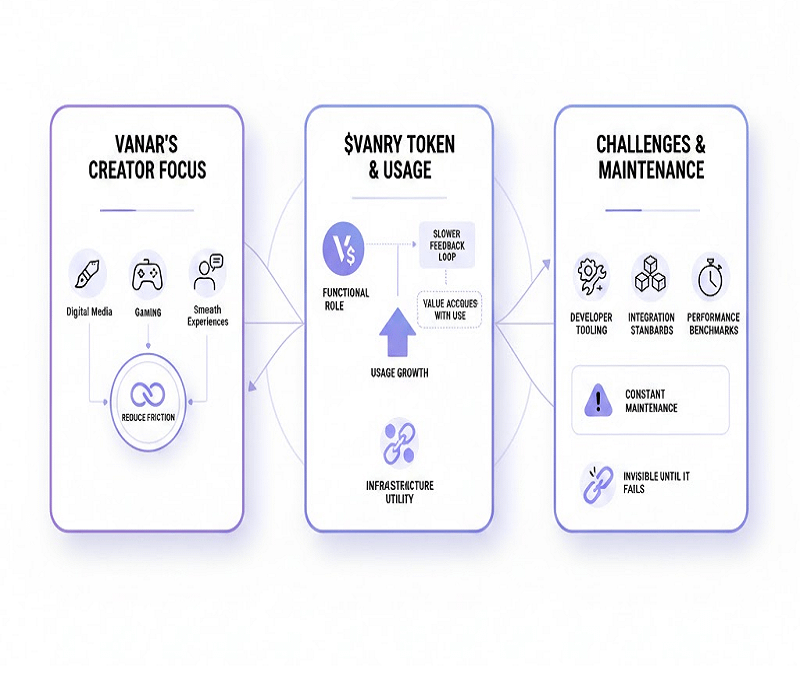
This restraint also shapes how the $VANRY token fits into the system. VANRY is not framed as the centerpiece of attention. Its role is functional. Its relevance grows with usage, not with narrative cycles. That creates a slower feedback loop than many market participants prefer. There are no guarantees of rapid discovery or sudden demand. Value accrues only if the underlying infrastructure becomes useful enough to justify it. That tradeoff is risky, but it is also honest. Infrastructure tokens tied to real usage often struggle during periods when attention drives markets. They do not benefit from constant reinvention of purpose. Instead, they are exposed to a simpler question: are people actually using this chain for something that matters to them?
Vanar’s focus on creators highlights this tension clearly. Creative work, especially in digital media and gaming, depends on smooth experiences. Audiences leave quickly when friction appears. A wallet prompt at the wrong moment or a failed transaction can break immersion entirely. Vanar’s effort to reduce these interruptions aligns with how creators already think about their audiences. The technology should support the experience, not interrupt it. Still, this approach comes with real limitations. Competing infrastructure chains are not standing still. Developer tooling, integration standards, and performance benchmarks evolve quickly. A chain that prioritizes invisibility must also prioritize constant maintenance. Falling slightly behind can undo the benefit of being unobtrusive. Users will not forgive infrastructure that disappears only when it fails.
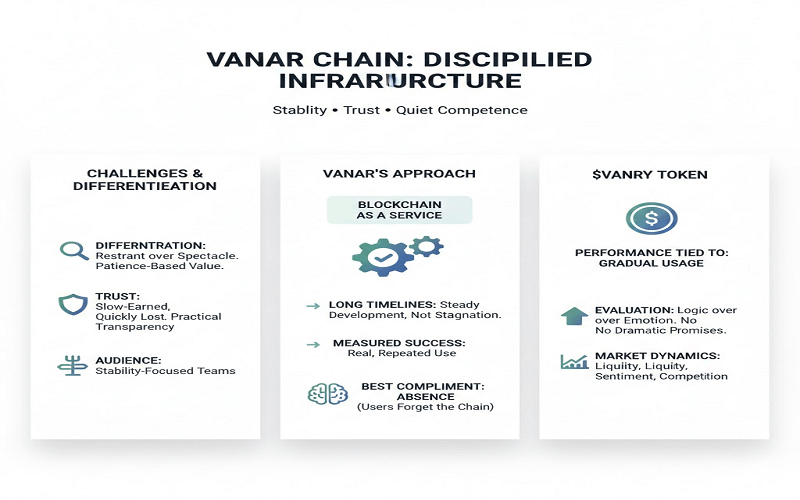
Another challenge is differentiation. When you deliberately avoid spectacle, it becomes harder to explain why your system matters. Many chains compete on similar promises of speed, scalability, and cost efficiency. Vanar’s distinguishing feature is restraint, but restraint does not translate easily into headlines. It requires patience from both builders and observers. There is also the question of trust. Infrastructure earns trust slowly and loses it quickly. Security incidents, downtime, or unclear governance can damage credibility in ways that marketing cannot repair. Vanar’s quiet posture means there is little room to distract from mistakes. If something goes wrong, the response has to be practical and transparent, not performative.
From an adoption perspective, this can be both a weakness and a strength. Teams that value stability over attention may find Vanar appealing precisely because it avoids hype. Others may prefer ecosystems with larger visibility and faster feedback. Vanar does not try to be everything to everyone, and that choice narrows its audience by design. The broader narrative around VANAR Chain today reflects this middle ground. It is present, active, and steadily developing, but rarely dominant in conversation. That can be misread as stagnation, when it may simply be the result of choosing long timelines. Infrastructure projects often look quiet until they suddenly become indispensable.
The $VANRY token inherits this ambiguity. Its performance is tied less to announcements and more to gradual usage. For some, that makes it uninteresting. For others, it makes it easier to evaluate without emotional noise. There are no dramatic promises to weigh against reality. Only steady progress or lack thereof. This does not mean Vanar is immune to broader market dynamics. Liquidity, sentiment, and external competition all matter. A functional system can still struggle if it fails to attract enough developers or users. Quiet competence is not enough on its own. It has to translate into real, repeated use. What makes Vanar worth watching is not any single feature, but the discipline of its approach. It treats blockchain less as a stage and more as a service. It assumes that the best compliment is not attention, but absence. If users forget they are using a chain at all, the system has done its job.
That mindset is rare in a space that often rewards constant reinvention. It also requires confidence. Building infrastructure for everyday use means accepting long periods without validation. It means trusting that usefulness will eventually matter more than visibility. Whether Vanar Chain succeeds on those terms remains an open question. The risks are clear, and the competition is real. But the philosophy behind it is coherent. It aims to be something people rely on without thinking about it.

Some technologies are designed to impress. Others are designed to endure. #Vanar #vanar