(Featuring: Vanar Chain & OpenClaw)
There are many agent frameworks evolving across Web3, but very few ecosystems are building the deeper intelligence layers these agents will depend on for years. That is exactly where Vanar Chain shifts the entire landscape. Vanar is not just improving execution, speed, or infrastructure. It is shaping the memory architecture that will define the next generation of autonomous digital workers. And Neutron, the memory API built inside the Vanar ecosystem, is the clearest example of that long-term vision.
Today, everyone sees how powerful OpenClaw agents have become. They run workflows, automate tasks, track objectives, and behave more like digital co-workers than simple scripts. But even the smartest OpenClaw agent hits the same wall: it forgets. It learns inside temporary files like MEMORY.md, USER.md, and SOUL.md. This works in the early stages, but the moment the agent restarts, shifts machines, or runs long enough for its context to get noisy, the entire memory becomes technical debt. The agent slows down, loses context, forgets tasks, and becomes unpredictable.
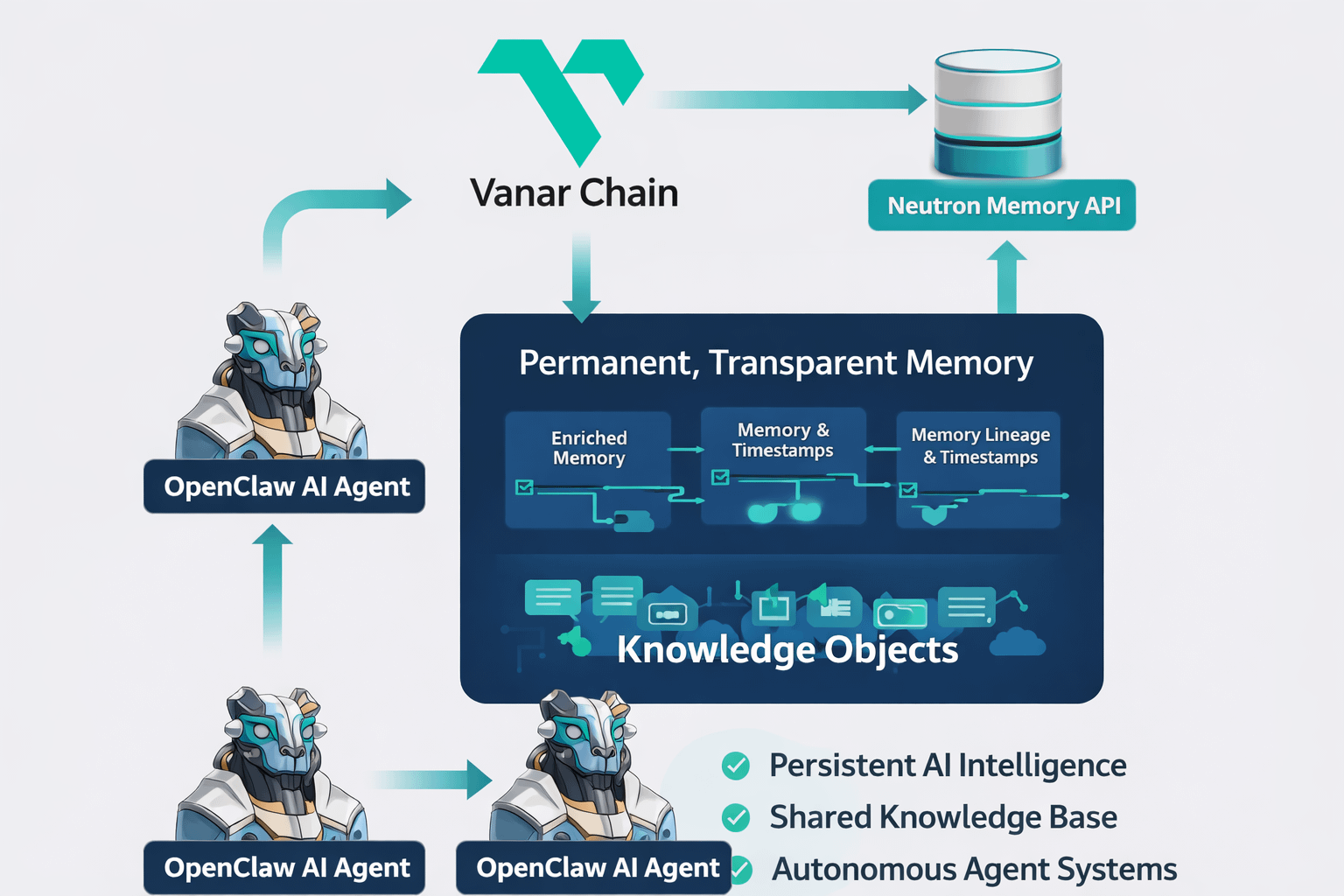
Vanar saw this problem early and built Neutron, a memory layer that changes how agents store, keep, and grow their intelligence. The moment OpenClaw plugs into Neutron, the behavior of the agent transforms fundamentally. Instead of memory living inside fragile, local files, it becomes something permanent and device-agnostic. The agent can shut down, restart, migrate to another machine, or be replaced entirely, and it still picks up exactly where it left off. What the agent learns no longer dies with the instance.
With Neutron, the agent becomes disposable.
The knowledge becomes permanent.
This is a major shift in agent design. Instead of dragging full histories into every prompt, Neutron compresses what matters into clean, structured knowledge objects. The agent queries memory the same way it queries tools. This keeps context windows small, reduces token costs, and makes long-running backgrounds agents finally practical. Multi-agent systems also benefit, because memory becomes infrastructure that multiple agents can rely on, instead of temporary scratchpads.
There’s another problem Neutron fixes that most people never think about.
Local memory is dangerously easy to corrupt. A plugin, a bad prompt, or even a misaligned workflow can overwrite the agent’s understanding without any transparency. You never know what the agent learned, when it learned it, or why its behavior changed after a long session.
Neutron solves this with something most agent frameworks do not even attempt — memory lineage. Every piece of knowledge has an origin, a timestamp, and a clear source. You can review the entire history of what the agent learned and decide exactly what is allowed to modify its memory. As agents gain more autonomy and more access to real systems, this becomes essential. Neutron gives developers control, visibility, and trust in a way local files never can.
Neutron is often compared to Supermemory, but that comparison misses the point. Supermemory is recall. Neutron is architecture. Supermemory injects snippets into context. Neutron builds permanent, portable, infrastructure-level knowledge that outlives any single agent, tool, or vendor. With Neutron, the memory doesn’t belong to a service provider — it belongs to the ecosystem and to the developer. What OpenClaw learns today can be reused by the next agent tomorrow and by an entirely different system next year. That is the kind of foundation you want if you expect AI agents to become long-term digital infrastructure.
This is why Vanar’s Neutron becomes the upgrade that changes everything for OpenClaw.
OpenClaw proved that agents can act.
Neutron ensures that what they learn survives.
When you combine both, you get agents that grow, compound, and evolve the longer they operate. They stop functioning like temporary tools and start behaving like persistent digital intelligence. The kind that can scale, learn continuously, and handle real workloads without losing themselves every time they reset.
An agent that forgets is temporary.
An agent that remembers is infrastructure.
Vanar’s Neutron is the upgrade that gives OpenClaw a future.