

I noticed Plasma approaches user alignment differently from most Layer 1 networks, not by segmenting features or messaging, but by enforcing consistent behavior across very different types of settlement activity. Plasma is positioned as a Layer 1 blockchain tailored for stablecoin settlement, and that focus creates a common operational baseline for both retail users in high-adoption markets and institutions operating in payments and finance.
Plasma's execution environment is fully EVM compatible through Reth, allowing existing stablecoin contracts and tooling to function without modification. This compatibility matters because it removes the need for parallel environments or specialized contract versions for different user classes. Retail transfers and institutional payment flows execute under the same virtual machine rules, ensuring uniform behavior regardless of transaction origin or size.
Finality on Plasma is delivered through PlasmaBFT, providing sub-second confirmation. This characteristic is particularly relevant for payment-oriented usage, where settlement latency directly affects operational certainty. Retail users benefit from fast confirmation for everyday transfers, while institutions rely on deterministic finality to support reconciliation, treasury movement, and payment processing workflows. Plasma does not vary confirmation behavior based on user type, maintaining a shared settlement experience across participants.
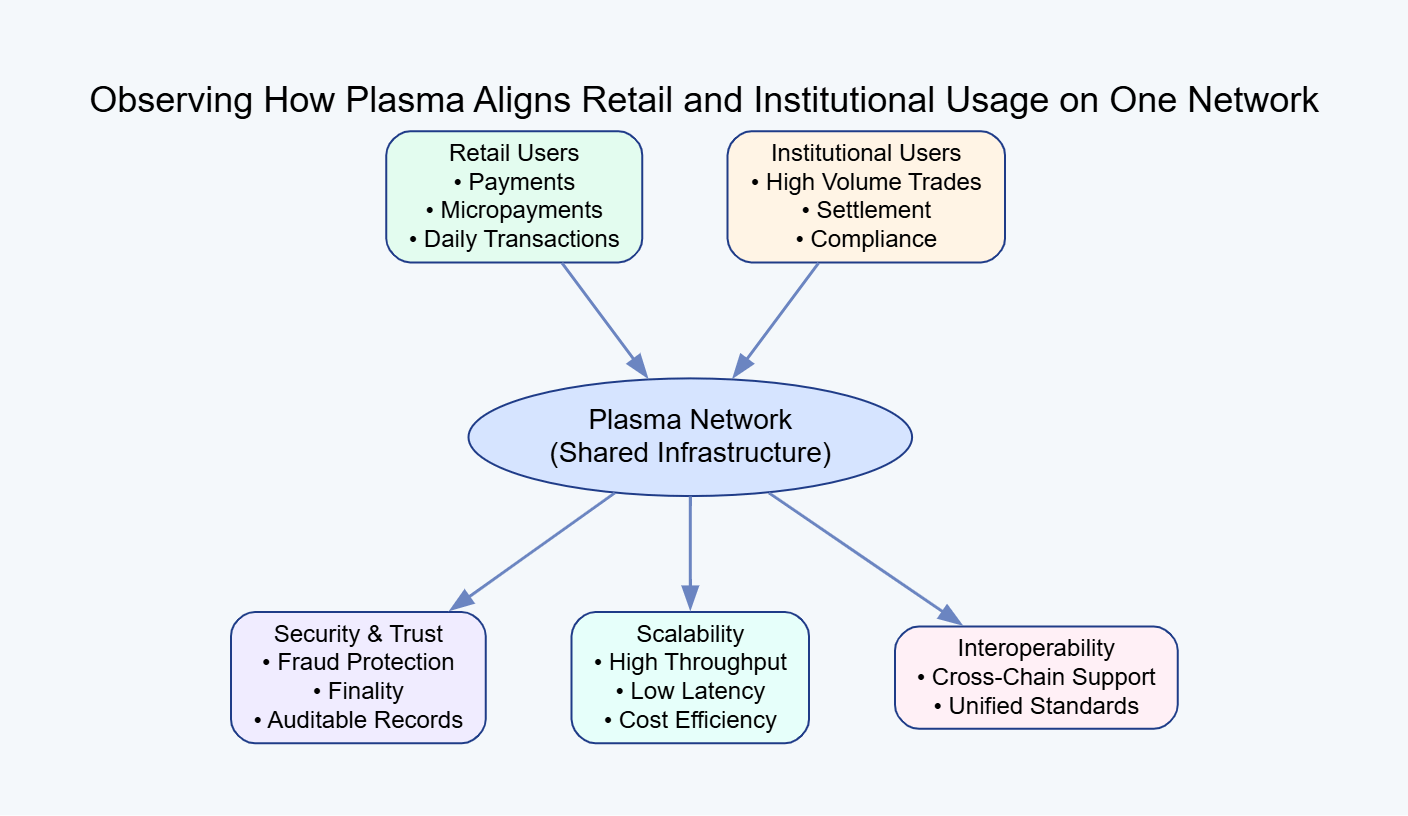
One of the clearest indicators of alignment is Plasma's approach to transaction fees. Stablecoin-first gas allows fees to be paid directly in stable assets, and gasless USDT transfers further reduce friction for users whose primary interaction is stable value movement. These features are not positioned as convenience layers for a specific audience. Instead, they operate at the protocol level, enabling both retail and institutional actors to interact with the network without managing auxiliary assets solely for execution costs.
Security considerations also reflect this shared design approach. Plasma incorporates Bitcoin-anchored security to strengthen neutrality and censorship resistance. This anchoring is relevant for institutions that require strong assurances around transaction inclusion and settlement integrity, while also benefiting retail users in regions where network neutrality is a practical concern. The security model does not distinguish between participant categories; all transactions inherit the same guarantees once processed.
What becomes apparent is that Plasma does not attempt to optimize separately for consumer-scale and enterprise-scale behavior. There are no visible priority classes or differentiated execution paths. Instead, the network applies the same rules uniformly, allowing different usage patterns to coexist without introducing hierarchy or special handling. Retail activity in high-adoption markets and institutional payment flows share the same execution surface.
This alignment reduces fragmentation. Institutions do not operate on a privileged settlement layer, and retail users are not confined to a simplified subset of functionality. Both interact with the same system, using stablecoins as the primary settlement asset, within the same execution and finality framework. This consistency simplifies integration for payment providers while preserving accessibility for individual users.
Plasma's design choices suggest a preference for operational clarity over feature segmentation. By centering the network around stablecoin settlement and applying uniform execution behavior, Plasma avoids the complexity that often arises when networks attempt to tailor infrastructure separately for different audiences. Instead, it provides a single settlement environment capable of supporting diverse transaction profiles.
As usage grows across regions and institutions, this shared foundation becomes increasingly relevant. Retail adoption does not introduce behavioral changes that affect institutional settlement, and institutional usage does not impose separate rules on retail participants. Plasma’s alignment strategy is embedded in how the network operates, not how it markets itself.
Conclusion
Plasma aligns retail and institutional usage by enforcing a common settlement framework built around stablecoins. Through EVM compatibility via Reth, sub-second finality with PlasmaBFT, stablecoin-first gas mechanics, and Bitcoin-anchored security, the network maintains consistent behavior across diverse users. Rather than segmenting infrastructure, Plasma applies uniform execution rules, allowing retail adoption and institutional payment activity to coexist on the same Layer 1 without distortion.