There’s something almost unfashionable about Vanar.
Not outdated. Not behind. Just uninterested in being impressive in the way this industry defines the word. No dramatic reinventions every quarter. No desperate alignment with the loudest trend. No sprawling declarations about becoming the backbone of everything digital. In a space that rewards spectacle, that restraint feels intentional almost stubborn.
The first time I paid serious attention to Vanar, I kept waiting for the twist. The moment where it would reveal the breakthrough angle that justified the attention. But the longer I looked, the more I realized that the absence of a twist was the point. Vanar isn’t trying to surprise you. It’s trying to remain steady.
That distinction feels small until you’ve seen what instability looks like up close.
Gaming platforms that stutter when traffic spikes. Digital worlds that feel alive at launch and hollow six months later. Brand integrations that quietly disappear after the campaign ends because the infrastructure underneath couldn’t keep up. Web3 has no shortage of ambition. It has a shortage of endurance.
Vanar seems to have internalized that.
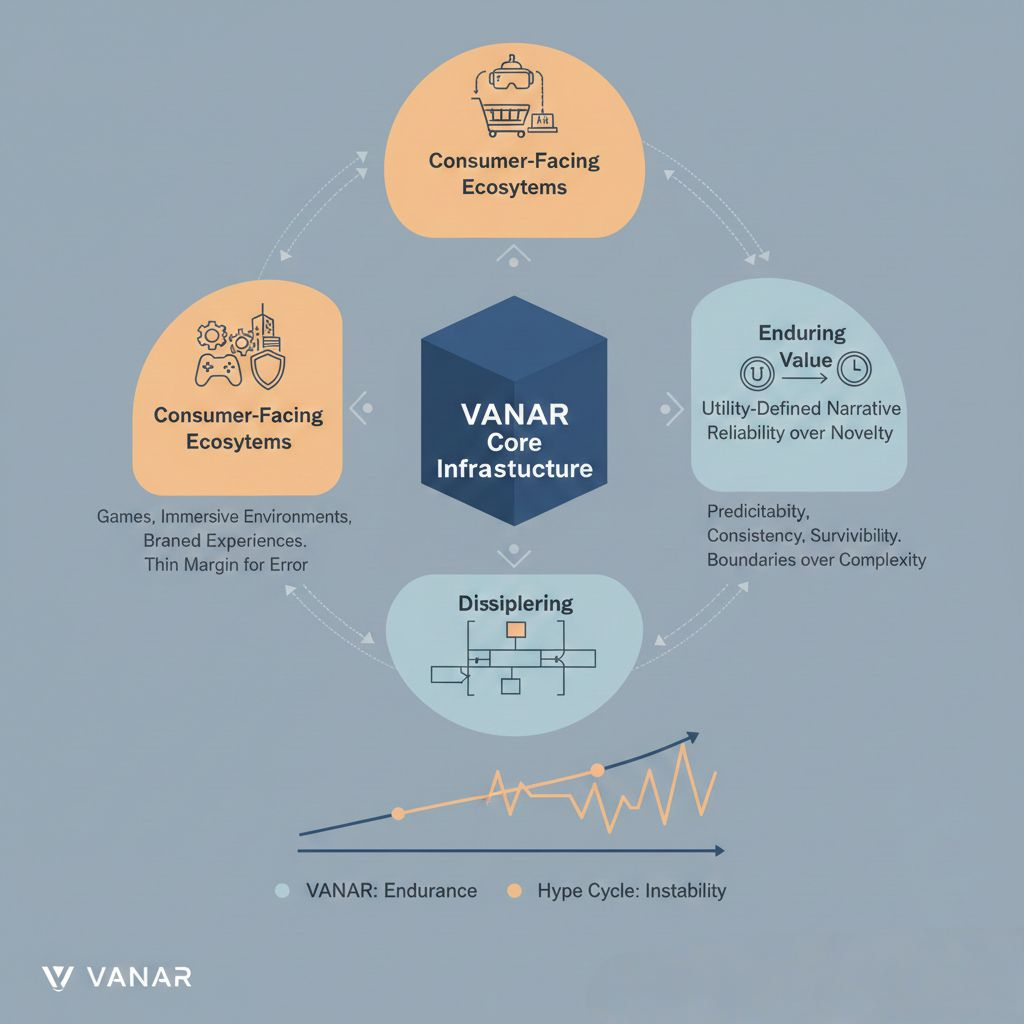
Its orientation toward consumer-facing ecosystems games, immersive digital environments, branded experiences is not an attempt to be trendy. It’s a commitment to operate where the margin for error is thin. These environments don’t forgive friction. They don’t grant users patience because something is decentralized. They don’t reward innovation if it compromises flow. Infrastructure here either behaves or it gets replaced.
And that pressure produces a very different kind of system.
Instead of chasing theoretical ceilings, Vanar appears to prioritize predictability. Instead of maximizing flexibility, it narrows its focus to what can be delivered consistently. That might limit certain forms of experimentation, but it dramatically increases survivability. In consumer contexts, survivability is more valuable than novelty.
I’ve watched many projects confuse optionality with strength. More composability. More modularity. More layers. Eventually, the system becomes capable of everything in theory and fragile in practice. Vanar doesn’t feel eager to accumulate complexity for its own sake. It feels like it’s drawing boundaries early deciding what it will support well rather than what it could support eventually.
That’s not flashy engineering. It’s disciplined engineering.
Even the way the ecosystem treats its economic layer reflects this moderation. The token exists as infrastructure, not identity. That’s a meaningful choice. When price becomes the headline, priorities warp. Short-term attention starts dictating long-term architecture. Vanar appears comfortable allowing its utility to define its narrative rather than the other way around.
What stands out most, though, is psychological. Vanar doesn’t act like it expects applause. It acts like it expects indifference and builds accordingly. It assumes users will not read documentation. It assumes developers want fewer surprises, not more features. It assumes brand partners care about reliability, not ideology.
That assumption changes design decisions in ways that are hard to see at first glance but impossible to ignore over time.
Of course, restraint carries its own risk. In a market that rewards velocity, moving deliberately can look like stagnation. Narrow focus can be mistaken for limited ambition. And consumer-facing infrastructure will always face shifting expectations, regulatory uncertainty, and competitive pressure from centralized systems that already operate at scale.
The real question isn’t whether Vanar can avoid those pressures. It’s whether it can maintain its discipline when confronted with them.
Right now, it feels like it can.
Because the most unusual thing about Vanar isn’t its technology. It’s its temperament. Calm. Selective. Grounded. Almost indifferent to hype cycles. In an ecosystem where urgency is often confused with progress, that temperament feels rare.
If Web3 is ever going to mature beyond its own echo chamber, it won’t be because one chain dazzled the world. It will be because some chains quietly refused to dazzle and instead focused on not failing when nobody was looking.
Vanar feels like one of those chains.
Not impressive in the loud sense.
Impressive in the enduring one.