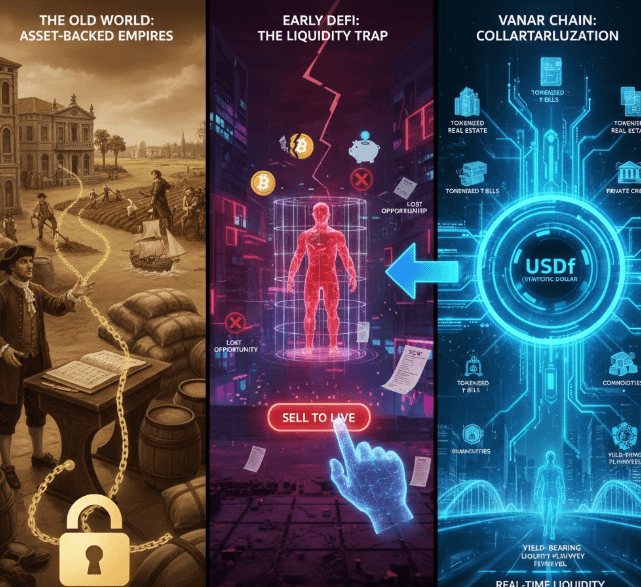
Long before the internet, before central banks, before paper money, before anyone had ever heard the words "decentralized finance," humanity stumbled onto the most powerful wealth-creation mechanism ever conceived. Not trade. Not taxation. Not even interest-bearing debt. Collateral. The simple, extraordinary idea that you could unlock the economic energy buried inside something you owned without surrendering it. That insight built empires, funded the Renaissance, powered the Industrial Revolution, and underwrote almost every meaningful leap in human economic progress. And for centuries, access to it has been one of the most reliable predictors of who accumulates wealth and who doesn't.
The merchants of 14th-century Venice used their warehoused goods as collateral to fund trade expeditions across the known world. The landed aristocracy of 18th-century England borrowed against their estates to finance ambitious agricultural improvements that redefined productivity. The American middle class of the 20th century built generational wealth by borrowing against rising home values to fund education, businesses, and investments in other appreciating assets. In each case, the pattern was identical: someone transformed a static asset into dynamic capital without relinquishing the asset itself, and that multiplication of economic utility changed their financial trajectory in ways that mere saving or selling never could.
The blockchain era, for all its revolutionary ambition, managed to largely miss this lesson. For over a decade, the crypto ecosystem treated assets as things to be traded, speculated upon, staked, or eventually sold, but rarely as collateral in the deep, productive sense that had driven wealth creation for centuries. That gap is what Vanar Chain is now positioned to close, and understanding why it matters requires looking honestly at how we got here.
The Long Road to Getting Collateral Right On-Chain
Early DeFi protocols understood intellectually that collateralized lending was important. MakerDAO launched in 2017 with exactly this vision: lock up Ethereum, mint a stable token, use it without selling your position. The concept was sound. The execution revealed the limitations of first-generation thinking. Collateral options were narrow, liquidation mechanisms were brutal, and the system's stability depended on a community of sophisticated actors managing parameters that most users couldn't begin to understand.
What followed was a decade of experimentation that ranged from genuinely innovative to catastrophically misguided. Overcollateralized protocols became increasingly complex in search of capital efficiency. Algorithmic stablecoins abandoned overcollateralization entirely in pursuit of elegance, and the market paid the price in ways that are still being calculated. Yield aggregators promised to optimize collateral returns but layered smart contract risks upon smart contract risks until even their creators couldn't fully audit the exposure.
Through all of it, the fundamental problem remained unsolved for most users: you couldn't simply bring your assets, whatever they happened to be, digital tokens or tokenized stakes in real-world assets or anything in between, and receive reliable, stable liquidity against them without navigating a maze of technical complexity, narrow collateral windows, and liquidation risk that often felt more predatory than protective.
The lesson that took a decade to learn is that getting collateralization right on-chain isn't a product challenge, it's an infrastructure challenge. And infrastructure requires a different kind of thinking entirely.
What Infrastructure Actually Means
There's a reason we don't usually talk about roads as a product. Roads are infrastructure. They don't compete with the businesses that operate on them; they enable those businesses. They don't optimize for a single use case; they serve every vehicle that travels them. They're built to last, built to scale, and built with the understanding that their value compounds as more people use them.
Vanar Chain's decision to describe their collateralization system as infrastructure rather than protocol or product is one of the most revealing choices they've made, and it shapes everything else about how they've built. Infrastructure thinking means accepting diverse collateral from day one, because you don't know in advance which assets your users will bring, only that they'll bring the assets they have. It means designing for stability over yield optimization, because infrastructure that fails in adverse conditions isn't infrastructure at all. It means building for composability, because other protocols and applications will want to build on top of this foundation, and that's exactly what you want them to do.
USDf, the overcollateralized synthetic dollar that emerges from depositing assets into the protocol, isn't trying to be the most capital-efficient stablecoin or the one with the most exotic yield mechanisms. It's trying to be the most reliable one, the one that works predictably across market conditions, that maintains its peg through transparency and overcollateralization rather than algorithmic faith, and that can be trusted as a building block by the applications layered on top of it.
The acceptance of tokenized real-world assets alongside digital tokens is perhaps the clearest expression of this infrastructure mindset. We are living through the early stages of a tokenization wave that will bring trillions of dollars of traditional assets on-chain over the coming decade. Real estate, private credit, treasury securities, commodities, infrastructure projects, intellectual property, and dozens of other asset classes are already beginning their migration to blockchain rails. A collateralization protocol that can only work with crypto-native assets will be irrelevant to this transformation. Vanar Chain is building the on-ramp that lets all of it participate.
The Quiet Revolution in How We Think About Holding
There's a behavioral economics phenomenon that researchers call the endowment effect: people assign significantly higher value to things they already own than to equivalent things they don't. An investor who acquired Bitcoin at fifteen thousand dollars doesn't just rationally prefer to hold it. They feel it, viscerally, as an extension of themselves and their judgment. Selling isn't just a financial transaction; it's a kind of admission, a severing of relationship with a conviction they've staked real money and real identity on.
This creates a profound tension in the lives of crypto holders that purely financial analysis tends to underestimate. The rational case for selling an appreciated asset to fund a genuine need can be compelling on paper and still feel completely wrong in practice. People will take on expensive short-term debt, defer important expenditures, or make genuine sacrifices in quality of life before they'll sell a position they believe deeply in. This isn't irrational; it's human.
What Vanar Chain's infrastructure offers these people isn't just a better interest rate or a more efficient liquidation mechanism. It's something much more psychologically significant: permission to be human about their assets while still functioning effectively in an economy that runs on liquidity. You don't have to choose between your conviction and your needs. You don't have to time the market or make irreversible decisions under pressure. You can hold your position, maintain your exposure to the future you believe in, and still access stable dollars for whatever the present requires.
This reframing, from collateral as a financial instrument to collateral as a form of permission, has implications that extend far beyond individual users. Institutional holders who can pledge assets as collateral for operational liquidity don't need to maintain large idle cash reserves. DAOs with productive treasuries can access working capital without disrupting their strategic asset allocations. Protocols that hold governance tokens or productive on-chain assets can collateralize them rather than selling into markets when they need operational funds. Every one of these use cases becomes cleaner, more efficient, and more stable when reliable collateralization infrastructure exists.
Stability as a Feature, Not a Compromise
One of the persistent tensions in DeFi has been between stability and yield. The implicit argument from capital-efficient stablecoin designs has always been that overcollateralization is wasteful: all that extra collateral sitting there, doing nothing, when it could be deployed productively. It's a reasonable-sounding argument that has repeatedly turned catastrophic in practice.
The reason overcollateralization isn't wasteful is precisely the same reason bridge engineering standards require structures to hold several times their expected maximum load. The extra capacity isn't idle, it's what converts a failure into a near-miss. The collateral buffer in USDf isn't capital sitting around doing nothing, it's the margin of safety that allows the protocol to absorb market volatility without triggering cascading liquidations, the shock absorber that keeps the system functioning when asset prices behave the way asset prices sometimes do.
In a market that watched billions evaporate when algorithmic elegance met real-world stress testing, stability isn't a compromise position. It's the product. The user who deposits assets into Vanar Chain's infrastructure isn't settling for less capital efficiency in exchange for safety. They're getting something the market has consistently undervalued until it's too late: the confidence to use their position as a productive financial tool without constant anxiety about systemic fragility.
The Long Game
History has a way of vindicating patient builders who work on foundational problems while everyone else chases the next speculative wave. The internet's most valuable companies weren't the ones that raced to capitalize on the first boom; they were the ones that built infrastructure capable of serving whatever came next. Database companies, cloud providers, payment processors: unglamorous, essential, extraordinarily durable.
Vanar Chain is making a similar bet, that the foundational problem of on-chain collateralization, bringing together diverse assets, issuing stable synthetic liquidity against them, and maintaining system integrity through transparent overcollateralization, is worth solving completely and correctly rather than quickly and cleverly. That the infrastructure capable of handling digital tokens and tokenized real-world assets today will be ready to handle whatever new categories of on-chain value emerge in the years ahead
The oldest money trick in the world is simply this: don't sell what will make you wealthy tomorrow to fund what you need today. Find a way to use what you have without giving it up. Vanar Chain has built the mechanism that makes this possible for the on-chain economy, a universal collateralization infrastructure worthy of the civilization scale opportunity in front of it.