

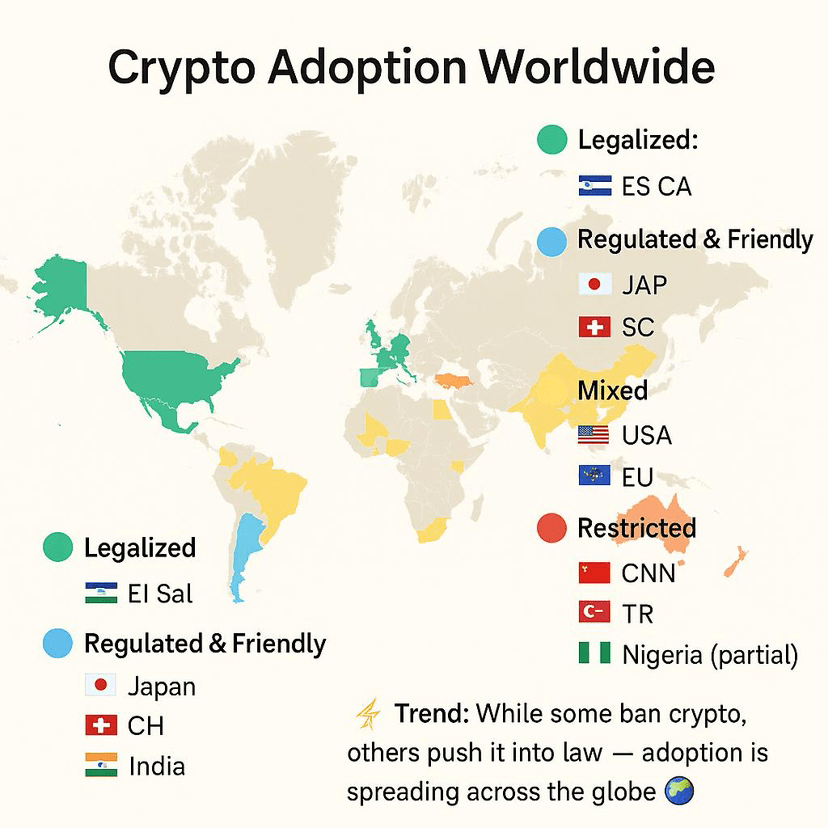
Im Laufe des letzten Jahrzehnts haben sich Kryptowährungen von einem „Geek-Experiment“ zu einem globalen Finanzinstrument entwickelt. Heute können Sie in Tokio mit Bitcoin Kaffee kaufen, Steuern in der Schweiz bezahlen oder Gehälter in Nigeria überweisen. Aber Regierungen gehen sehr unterschiedlich mit Krypto um – von vollständiger Legalisierung bis hin zu völligen Verboten.
🟢 Pioniere (Vollständige Legalisierung)
🇸🇻 El Salvador
* Im Jahr 2021 wurde Bitcoin als gesetzliches Zahlungsmittel anerkannt.
* Bürger erhielten die Chivo-Wallet und Zugang zu Bitcoin-Geldautomaten.
* Ziel: Verbesserung der finanziellen Inklusion (70 % der Bevölkerung ist unbanked).
🇨🇫 Zentralafrikanische Republik
* Im Jahr 2022 wurde BTC neben dem CFA-Franc zur offiziellen Währung.
* Herausforderung: schwache Infrastruktur und niedrige digitale Kompetenz.
⚖️ Regulierungsbehörden (Klare Rahmenbedingungen)
🇯🇵 Japan
* BTC wird als Zahlungsmittel anerkannt.
* Börsen müssen lizenziert sein und Rücklagen halten.
* Einer der transparentesten Märkte für Krypto-Unternehmen.
🇨🇭 Schweiz
* Zug ist bekannt als „Crypto Valley.“
* Steuern können in BTC/ETH bezahlt werden.
* Ein krypto-freundlicher Dreh- und Angelpunkt für Startups und ICOs.
🇦🇪 VAE
* Dubai hat die Virtual Assets Regulatory Authority (VARA) gegründet.
* Hunderte von lizenzierten Börsen und Blockchain-Unternehmen sind aktiv.
* Ziel: VAE als globalen Web3-Dreh- und Angelpunkt positionieren.
🟡 Vorsichtige Akteure
🇺🇸 USA
* Kein einheitliches Gesetz; Regulierung variiert je nach Bundesland.
* New York: BitLicense; Miami & Texas übernehmen aktiv Krypto.
* ⚖️ Laufende Debatte zwischen SEC und CFTC darüber, ob Krypto ein Wertpapier oder eine Ware ist.
🇪🇺 Europäische Union
* Im Jahr 2023 wurde der MiCA-Rahmen (Markets in Crypto Assets) verabschiedet.
* Klare Regeln für Stablecoins, Börsen und Verwahrer.
* Ziel ist ein harmonisierter EU-weit Ansatz.
🇮🇳 Indien
* Lange Zeit in einer Grauzone operiert.
* 30 % Steuer auf Krypto-Gewinne.
* Börsen arbeiten unter starkem regulatorischen Druck.
🔴 Restriktive Länder
🇨🇳 China
* Mining und Krypto-Transaktionen wurden 2021 verboten.
* Fördert seine eigene CBDC — digitalen Yuan (e-CNY).
🇹🇷 Türkei
* Krypto-Zahlungen verboten, aber Handel und Halten bleiben legal.
* Bürger nutzen aktiv Krypto als Absicherung gegen Inflation.
🌍 Afrika & Lateinamerika
🇳🇬 Nigeria
* Im Jahr 2021 verbot die Zentralbank Banken, Krypto-Nutzer zu bedienen.
* Trotz Einschränkungen gehört Nigeria zu den führenden Ländern im P2P BTC-Handel.
* Eine nationale digitale Währung eingeführt: eNaira.
🇧🇷 Brasilien
* Im Jahr 2022 wurden Krypto-Zahlungen legalisiert.
* BTC ist kein offizielles Zahlungsmittel, wird aber als gültiges Tauschmittel anerkannt.
* Börsen müssen sich registrieren und die AML-Anforderungen erfüllen.
📊 Schlüsseltrends
1. Vielfältige Ansätze — von der vollständigen Legalisierung in El Salvador bis zum strengen Verbot in China.
2. Verschärfung der Regulierung — die USA, die EU und Indien streben ein Gleichgewicht zwischen Innovation und Kontrolle an.
3. CBDCs im Aufwind — weitere Länder testen digitale Zentralbankwährungen (China, Nigeria, EU).
4. Akzeptanz in Entwicklungsländern — Inflation und schwaches Bankwesen treiben die Krypto-Nutzung (Türkei, Argentinien, Nigeria).
⚡️ Fazit: Krypto wird global, aber seine Zukunft hängt davon ab, wie die Welt Innovation mit staatlicher Kontrolle in Einklang bringt.
#globaladoption #crypto #world #Adoption


