#MarketRebound #TrendingTopic #Binance #AIBinance 
Shattered Solidarity: How Iran’s 'Regional Accountability' Doctrine Redrew the Middle East Map in 2026
Early March, 2026
TEHRAN — The landscape of the Middle East was seismically altered not only by the February 28 strikes on Tehran, but by the devastating Iranian response against its neighbors in the days that followed. The doctrine of strategic patience, long a hallmark of Iranian foreign policy, has been replaced. We are now witnessing the brutal implementation of what Iranian officials are calling the doctrine of "Regional Accountability."
This strategy represents a total abandonment of Tehran’s decades-long attempt to court "Pan-Islamic Unity." In 2026, solidarity is dead, replaced by a ruthless demand for absolute loyalty—or severe consequences.
The Fracture in the Gulf: Mapping the Breakdown
For observers trying to understand the speed and intensity of this shift, the conceptual map is no longer abstract; it is written in real-time military movements and infrastructure damage.
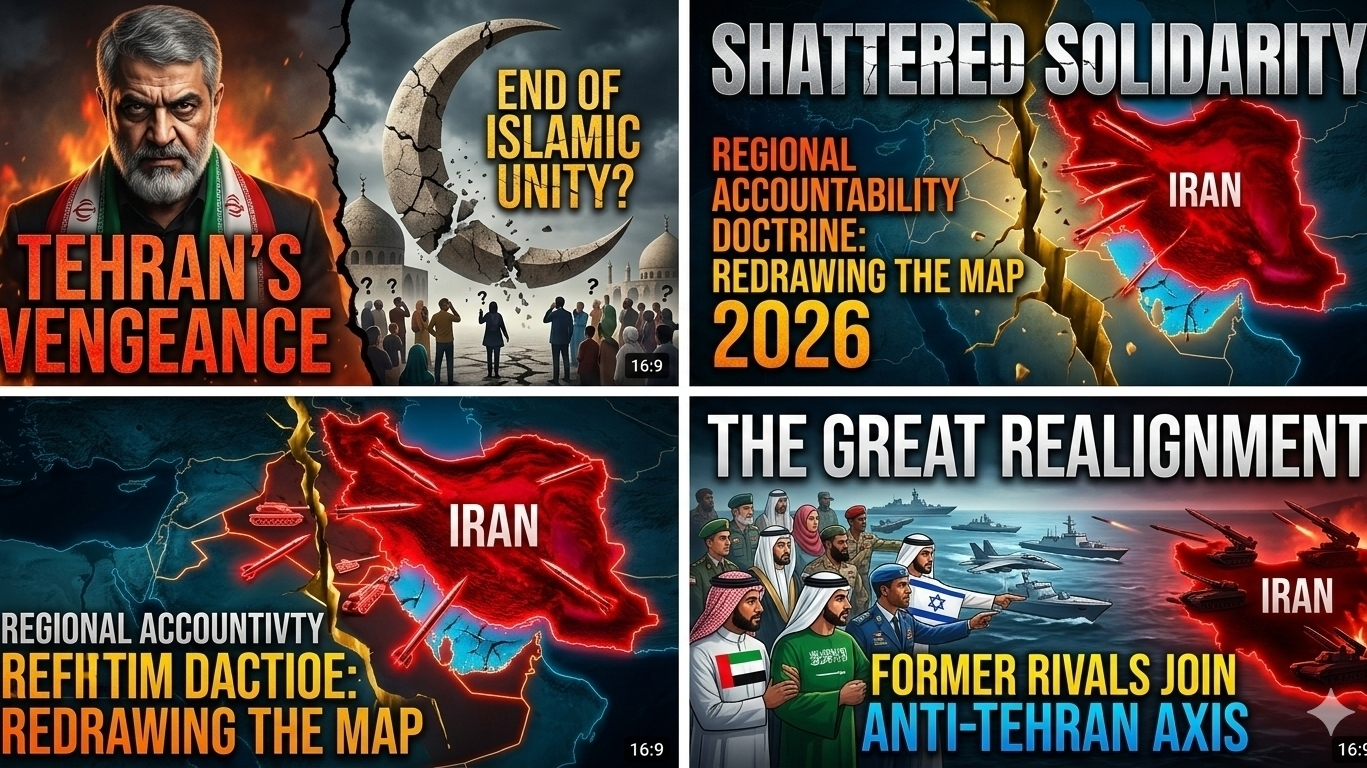
The visualize above captures the essence of this new reality. As illustrated, the traditional political alliances have fractured. The traditional concept of a united "Muslim world" or even a coherent "Gulf coalition" has collapsed. The map visually represents this breakdown with a deep, pulsating fracture line cutting directly across the region, splitting formerly stable cooperative areas.
The Iranian landmass itself, shown in a deep, fiery red, symbolizes a nation that feels it has been cornered and betrayed by its neighbors. Tehran’s narrative is that GCC states, by hosting Western military assets or adhering to international sanctions, were complicit in the attacks against Iran.
Vengeance on Infrastructure: Strikes on "Silent" Neighbors
The immediate execution of the "Regional Accountability" doctrine has been swift and focused. Over the past week, we have seen unprecedented, direct missile and drone strikes targeting critical economic infrastructure in countries that Iran accused of "betrayal of the Ummah" for failing to offer military support or condemn the strikes on Tehran.
UAE & Qatar: Strikes targeted desalination plants and specialized energy export terminals. Iran claims these actions are "proportional consequences" for the UAE and Qatar's "silent complicity" in the Western-led isolation of Tehran.
Bahrain & Kuwait: Cyber-attacks paralyzed logistical hubs, accompanied by menacing rhetoric from Tehran about the presence of US Navy assets in these territories.
The message from Tehran is unmistakable: Neutrality is no longer viewed as a passive stance, but as active betrayal. By making its neighbors pay the price for regional instability, Iran hopes to force a renegotiation of security arrangements, demanding that its neighbors choose between loyalty to Islamic solidarity (as defined by Tehran) or the "false security" of Western security umbrellas.
The Unintended Consequence: A New Anti-Tehran Axis
However, early analysis suggests Iran’s gambit may have backfired strategically. The sheer brutality of the retaliatory strikes has accelerated a regional realignment that, until recently, would have been unthinkable.
Rather than intimidating its neighbors into submission, the strikes are driving them into an active, synchronized defensive front. We are witnessing the rapid emergence of a powerful "Anti-Tehran Axis," pushing former rivals like Israel and several Sunni-majority GCC states into historic levels of security cooperation.
Joint air defense exercises are now occurring publicly, intelligence sharing has become seamless, and there are active discussions about a regional security pact explicitly designed to contain Iranian aggression. The fracture on the map hasn't just isolated Iran; it has forced the creation of a powerful counter-alliance on the opposite side of the crack.
Conclusion: Redrawing the Future
As we move deeper into March 2026, the old geopolitical maps are obsolete. Iran’s attempt to impose "regional accountability" through vengeance has shattered solidarity and redrawn the Middle East into two heavily armed, deeply mistrustful camps. The primary question now is not if the conflict escalates, but whether the new Anti-Tehran Axis can deter further aggression before the fract$BTC ure line deepens into an abyss.$XRP