
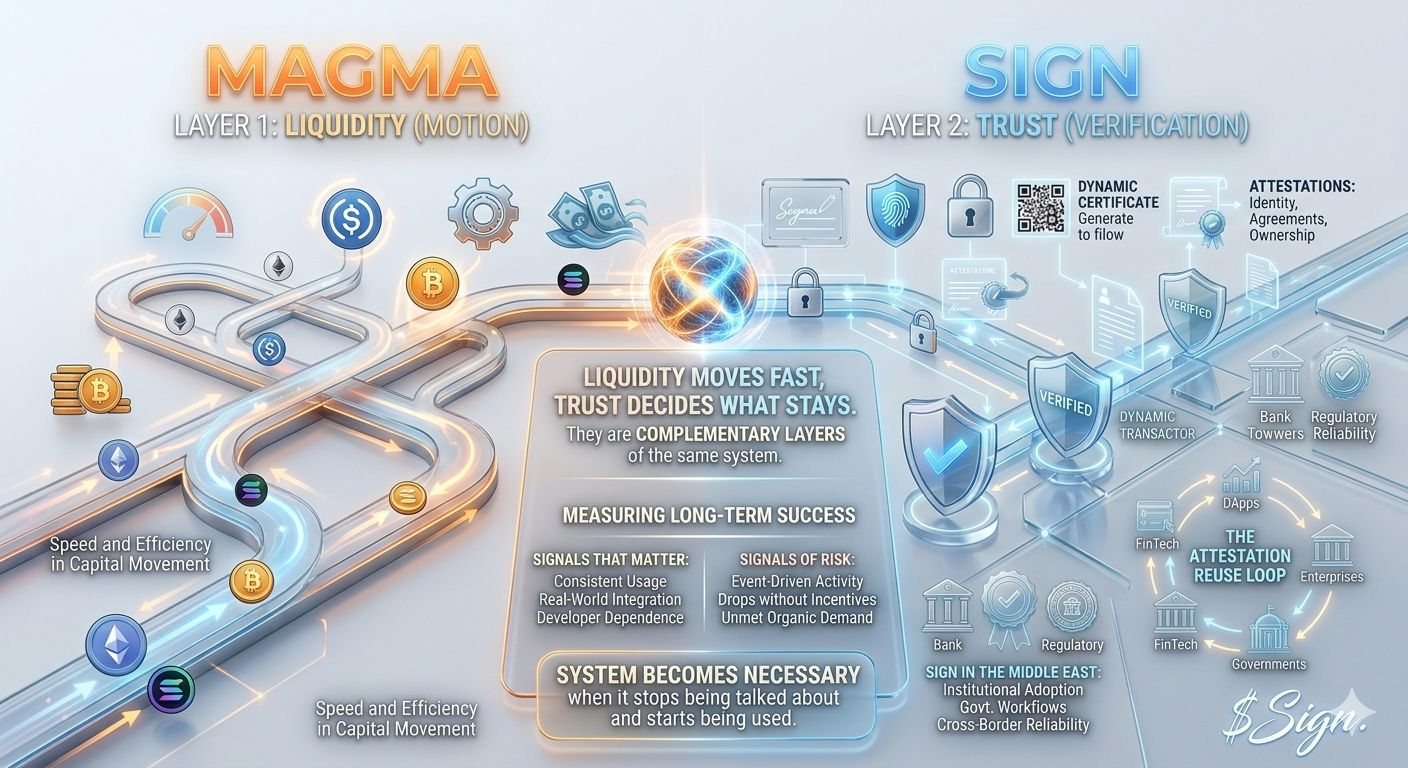
There was a time when I thought liquidity was the ultimate signal. Wherever capital moved fast, I assumed value would follow. Systems that could attract, rotate, and deploy liquidity efficiently felt like the backbone of the next financial cycle, and honestly, projects like MAGMA reinforced that belief because they showed how quickly markets could organize themselves when capital had the right pathways. But over time, something started to feel incomplete, and it wasn’t obvious at first, because movement alone doesn’t create stability.
You can have millions flowing through a system, capital rotating at high speed, opportunities appearing and disappearing within hours, but one question always remains quietly in the background: what actually holds all of this together? That question is where my perspective started to shift, because I realized that liquidity creates motion, but it doesn’t create trust, and without trust, even the most active systems struggle to sustain themselves over time.
That’s where SIGN enters the conversation, not as a replacement for liquidity, but as the missing layer that gives it meaning. While MAGMA focuses on coordinating capital efficiently, SIGN focuses on verifying the identity and agreements behind that capital, turning interactions into something reliable. Instead of relying on assumptions, it introduces attestations—verifiable proofs that can represent ownership, credibility, or commitments between participants, and these are not just static records, but dynamic elements that applications can read, use, and build upon.
And that changes the structure of the entire system, because now it’s not just about how fast money moves, it’s about whether that movement can be trusted repeatedly. A system where identity and agreements are verifiable doesn’t just move capital, it builds confidence, and confidence is what keeps participants engaged even when the market slows down.
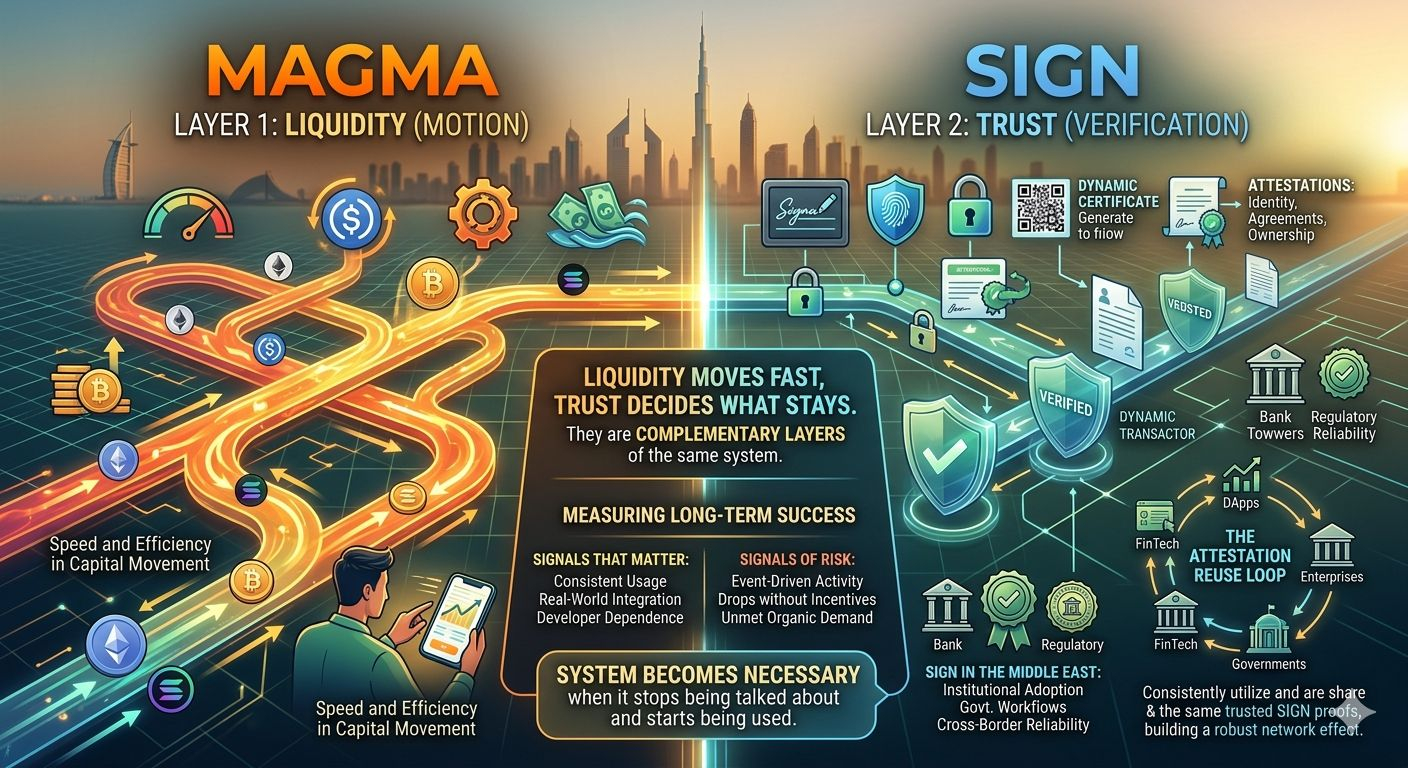
But here’s the part most people overlook: creating attestations is easy sustaining their usage is not. The real strength of a system like SIGN doesn’t come from how many identities are created or how many verifications happen initially it comes from how often those attestations are reused across different applications. If developers start depending on them if businesses begin integrating them into workflows, if institutions recognize their value then the system evolves into infrastructure. If not it risks becoming just another layer that exists but isn’t essential.
the market feels like it’s still in the early stage of figuring this out. There is attention there are discussions and there are moments of activity, but consistency is still forming, and that usually means one thing: people are positioning for potential not reacting to proven adoption. In markets like this, that difference defines everything, because real infrastructure doesn’t depend on hype, it depends on repetition.
For regions like the Middle East this becomes even more important. There is strong potential for digital expansion increasing institutional involvement and growing cross-border activity but none of that translates into real impact unless systems like SIGN integrate directly into these structures. Governments financial systems and enterprises don’t adopt concepts they adopt solutions that reduce friction and increase reliability in their daily operations.
So the real question is not whether SIGN works the real question is whether it becomes necessary. Because when a system becomes necessary it stops being talked about and starts being used and that is the moment where speculation fades and real value begins to form.
If I had to measure confidence here I wouldn’t look at price or short-term spikes, I would watch usage patterns. Are attestations being used consistently across different platforms? Are developers building applications that depend on them? Are real-world entities starting to integrate them into their operations? These are the signals that matter.
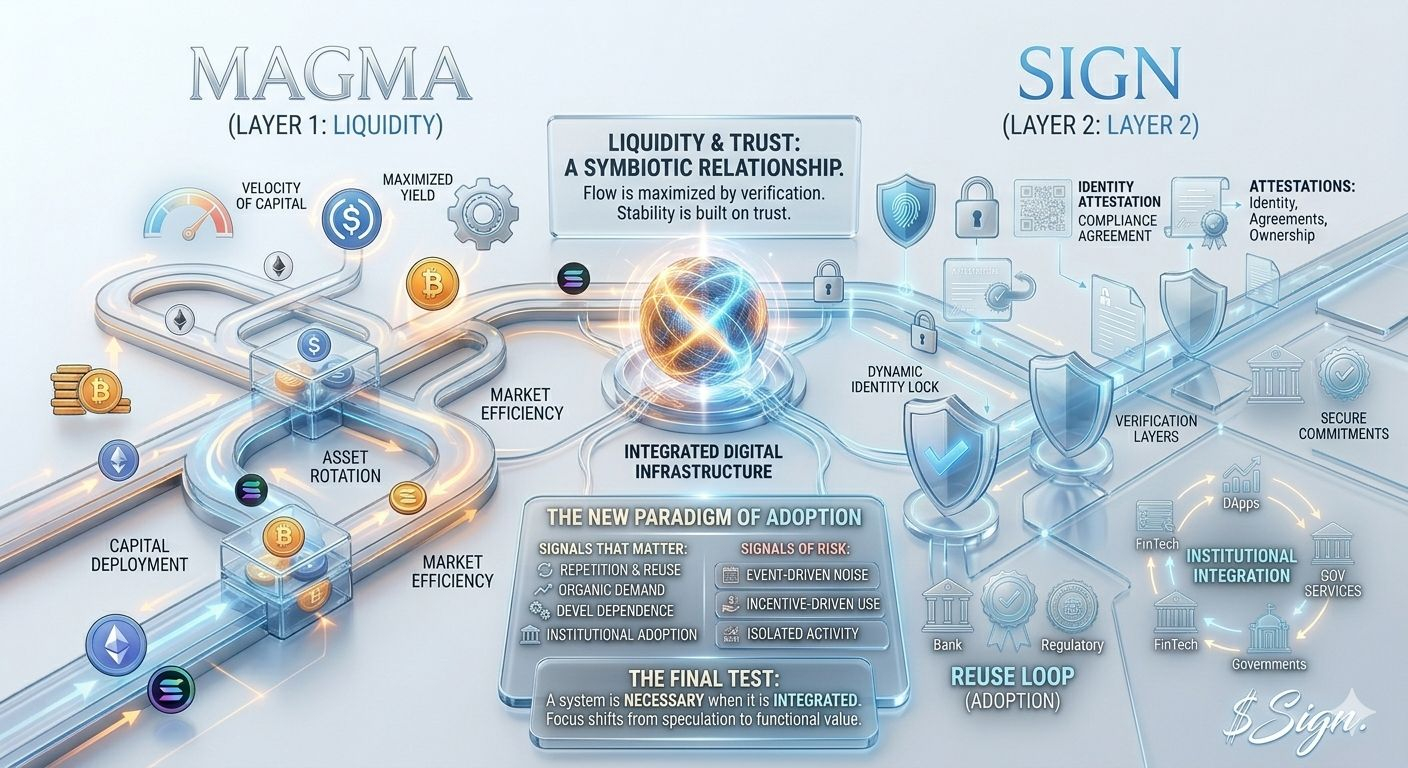
On the other hand, if activity remains event-driven if participation drops when incentives slow down then it tells a different story. It suggests that the system hasn’t yet reached organic demand and without that sustainability becomes uncertain.
At the end of the day liquidity and trust are not competing forces they are complementary layers of the same system. MAGMA shows how capital can move SIGN shows how that movement can be trusted and in the long run markets don’t just reward speed they reward systems where everything keeps working even when the excitement disappears.
@SignOfficial
#SignDigitalSovereignInfra
$SIGN

$JTO $HUMA
#Megadrop #MegadropLista #MarketRebound #MarchFedMeeting